
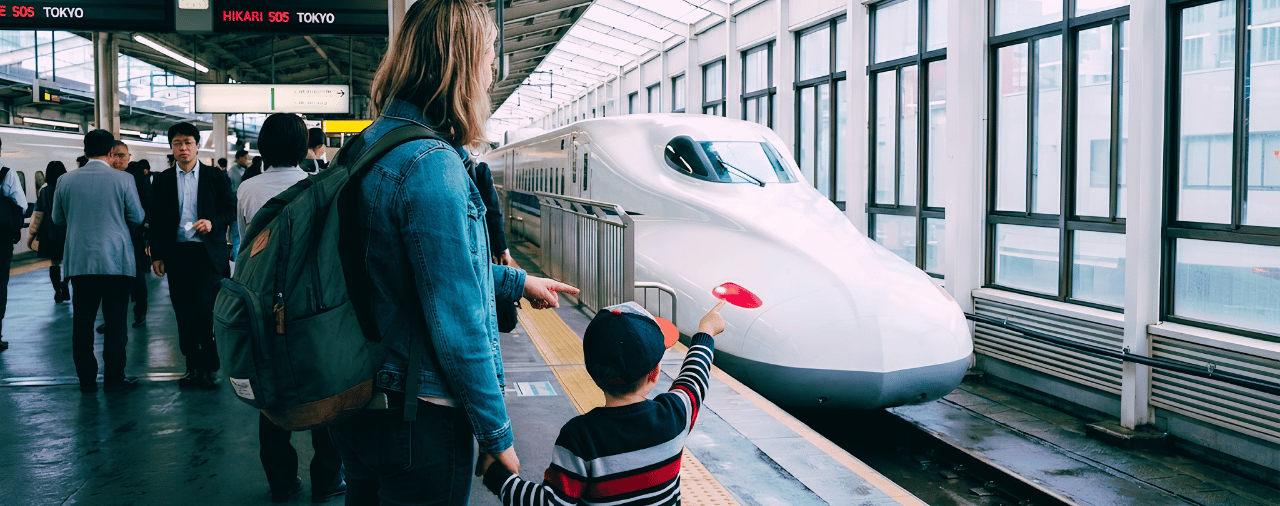
Two weeks in Japan with kids is enough time to enjoy Tokyo, Kyoto and Osaka without packing up every morning. The key is to choose a few useful bases, give the Shinkansen its own travel day, and leave space for the ordinary parts of a family trip: breakfast, playgrounds, laundry and an early night.
This Japan itinerary with kids uses three hotel bases and only two hotel changes. Spend six nights in Tokyo, four in Kyoto and three in Osaka, with an optional Nara day trip. Fly into Tokyo and out of Kansai International Airport if the flight options work for your family.
The route is designed for a first family trip to Japan, especially with primary-school-age children. Toddlers can follow a shortened version of each day; older children can use the optional activities. You do not need to fit every suggestion into the trip.
The family route at a glance
- Days 1–6: Tokyo — arrival, neighbourhood sightseeing, one optional theme-park day and recovery time.
- Days 7–10: Kyoto — Shinkansen arrival, railway museum, Arashiyama and a short shrine visit.
- Days 11–13: Osaka — settle in, optional Nara day trip and a flexible final day.
- Day 14: Depart from Kansai Airport.
Total: 14 days and 13 nights. The two-week count includes arrival and departure, rather than assuming 14 full sightseeing days.
Why this itinerary uses three bases
Every hotel move brings more than a train journey. You need to pack, check out, find lifts, manage bags, wait for check-in and locate the next meal. Staying several nights in each place gives children a familiar room and parents fewer logistics to solve.
Tokyo provides the longest settling-in period. Kyoto adds a different setting without a string of overnight stops. Osaka gives you a convenient final base for food, shopping and a possible Nara excursion before flying home.
Kyoto and Osaka are close enough that you could also use one Kansai base. Families who strongly prefer fewer moves can keep all seven Kansai nights in Kyoto or Osaka and visit the other city by train. The three-base version below avoids repeated commuting on sightseeing days, while keeping the move between them short.
Day-by-day family itinerary
The table gives each day one main focus. Local rail journeys depend on your hotel; avoid crossing the city repeatedly to chase a long attraction list. Where a time range appears, it is a station-to-station planning estimate. Add walking, waiting, lifts and meal stops.
| Day | Overnight base | Train or station plan | Main activity | Rest or easy swap |
|---|---|---|---|---|
| 1 | Tokyo | Airport transfer chosen for your hotel | Check in, find food and explore the immediate area | No timed sightseeing booking |
| 2 | Tokyo | Asakusa; optional Oshiage connection | Senso-ji and a short neighbourhood walk | Hotel break; skip the second area |
| 3 | Tokyo | Ueno | Ueno Park and one museum or zoo visit | Park-only outing and laundry |
| 4 | Tokyo | Harajuku; optional Shibuya | Meiji Shrine area and one child-chosen stop | Return after lunch |
| 5 | Tokyo | Optional JR Keiyo/Musashino Line to Maihama | One Tokyo Disney park, or a shorter local activity | Choose a half-day outing if theme parks are not a priority |
| 6 | Tokyo | Stay near your hotel, or one easy direct journey | Flexible recovery day, packing and laundry | Keep most of the day unbooked |
| 7 | Kyoto | Tokyo or Shinagawa → Kyoto by Shinkansen; allow roughly 2¼–3 hours depending on service | Train ride, bag drop and settling in | No major attraction after arrival |
| 8 | Kyoto | JR Sagano Line to Umekoji-Kyotonishi | Kyoto Railway Museum and a park break | Swap days if the museum is closed |
| 9 | Kyoto | JR Sagano Line to Saga-Arashiyama, or rail route matching your hotel | Arashiyama: one short walk and lunch | Return before afternoon fatigue |
| 10 | Kyoto | JR Nara Line to Inari | Short Fushimi Inari visit and an easy afternoon | Skip the mountain climb; do laundry |
| 11 | Osaka | Kyoto → Osaka by JR Special Rapid, about 30 minutes, then hotel connection | Move hotels; brief evening food walk if everyone has energy | Leave the afternoon open |
| 12 | Osaka | Optional Osaka-Namba → Kintetsu-Nara; check the day’s express service | Nara Park area, or stay in Osaka | Turn back after lunch; day trip is optional |
| 13 | Osaka | One local outing near a useful station | Child-chosen activity, shopping and packing | Protect an early evening before departure |
| 14 | — | Airport rail route from your actual hotel area | Depart Kansai Airport | No sightseeing before an early flight |
For train times, use JR Central’s current Shinkansen timetable and JR West’s route finder and station maps. Kyoto–Osaka takes about 30 minutes on the JR route, but that does not include travel to a Namba hotel. Osaka’s official tourism site also gives the approximate rail connection between the two cities.
Days 1–6: Tokyo with kids, without crossing the city all day
Day 1: Arrive and make tomorrow easier
Choose the airport transfer after choosing the hotel. A direct service to a useful station can be more comfortable than a cheaper route with several changes. If you arrive before check-in, ask whether the hotel can hold your bags.
Find a nearby breakfast option, pick up snacks and confirm the station entrance you will use the next morning. A short walk is enough for arrival day. If you land at Narita, compare the choices in our Narita airport transfer guide only after checking that the destination station suits your accommodation.
Days 2–4: One neighbourhood cluster at a time
Start with Asakusa on Day 2. Enjoy the temple approach and nearby streets, then stop for lunch. Add the Oshiage area only if the family still has energy; there is no need to turn the day into an Asakusa, Skytree, Ueno and Akihabara marathon.
Use Day 3 for Ueno Park and one main attraction. A museum or zoo can take most of the available energy, so leave the remainder of the day flexible. Make this the first laundry opportunity rather than waiting until clothes run out.
On Day 4, combine a short walk around the Meiji Shrine area with one child-chosen stop in Harajuku or Shibuya. These are choices, not a checklist. See our Tokyo with kids guide for alternatives by interest and station.
Day 5: Choose one special outing
If Disney is a priority, choose one park and give it the whole day. JR Maihama is the resort’s rail gateway; the official park guide gives about 15 minutes from Tokyo Station by train. Allow additional time for the Keiyo Line platform walk at Tokyo Station, queues, the walk from Maihama and any resort transport. Buy the dated park ticket before visiting; the official Tokyo Disney Resort guide says park ticket booths do not sell admission tickets.
If your family prefers something smaller, choose an aquarium, science activity or character-shopping stop from the Tokyo guide. Keep the remainder of that day easy. You do not need a theme park to make a Japan family vacation memorable.
Day 6: Leave room for recovery
A recovery day is particularly useful after a theme park. Sleep later, revisit something nearby, wash clothes and prepare the train-day bag. Avoid booking a distant day trip that makes it difficult to return early. This spare day also absorbs rain or a disrupted plan earlier in the week.
Day 7: Tokyo to Kyoto by Shinkansen
Take a direct Tokaido Shinkansen from Tokyo or Shinagawa to Kyoto. Choose the boarding station that makes your hotel departure simplest. For planning, allow roughly 2¼–3 hours on the train depending on the service; use the exact train’s timetable when booking. Kyoto’s official arrival guide provides approximate Nozomi and Hikari journey times. The train ride is only part of the move: set aside around half a day for packing, reaching the station, lunch, travel and hotel arrival.
Reserve seats together and check your bags’ dimensions before choosing the seats. Buy lunch and drinks before boarding and keep a small bag of essentials at your feet. Do not book an attraction immediately after the expected arrival time.
If you use the nationwide JR Pass, ordinary eligible Hikari services are covered; Nozomi requires an additional pass-holder ticket. Families buying individual tickets can simply compare the available Nozomi and Hikari departures. Our JR Pass reservation guide explains the pass-specific process; individual-ticket travellers can check SmartEX.
Days 8–10: Kyoto with a mix of trains, scenery and short visits
Day 8: Kyoto Railway Museum
The museum gives rail-interested children a main activity without needing several city crossings. It is about a two-minute walk from Umekoji-Kyotonishi Station on the JR Sagano Line, according to the museum’s access page. Walking all the way from Kyoto Station is listed at about 20 minutes; the short rail hop may suit tired legs better.
Checked October 12, 2026, admission is ¥1,500 for adults aged 18+, ¥500 for elementary/junior-high students and ¥200 for children aged 3+ below school age. University/high-school admission is ¥1,300. The museum normally closes Wednesdays, with exceptions shown on its calendar. Simulator use requires an advance ticket. Check the official calendar and tickets, and swap this day with another Kyoto day when needed.
Day 9: A short Arashiyama outing
From Kyoto Station, use the JR Sagano Line to Saga-Arashiyama, then walk toward the sightseeing area. Kyoto’s official access guide notes that the Sagano platforms are farther away than other platforms and that services can be crowded. Choose the rail route that suits your hotel rather than automatically returning to Kyoto Station.
Keep the outing to a bamboo-grove or riverside walk, lunch and an optional extra stop. There is no need to combine the area with a monkey-park climb, sightseeing train, boat trip and several temples. The ordinary JR Sagano Line used to reach the area is different from the separately ticketed Sagano sightseeing train.
Day 10: Fushimi Inari at your family’s pace
Use JR Inari Station for a short visit to the shrine’s lower area. Decide how far to walk once you see the children’s energy and the crowding. Turning back without completing the mountain route is a sensible family choice. Steps make the longer route less convenient with a stroller.
Keep the afternoon for a meal, a small local outing or hotel time. Wash clothes before the move to Osaka so you can pack fewer items and avoid arriving with a suitcase of damp laundry.
Days 11–14: Osaka, an optional Nara day and departure
Day 11: A short train journey still needs a gentle day
For a conventional JR move, take a Special Rapid service from Kyoto to Osaka Station and make the hotel connection from there. Osaka Station, Shin-Osaka and Namba are different places. The Shinkansen stops at Shin-Osaka; a hotel described as “near Osaka” may be somewhere else entirely.
Allow around two to three hours for the complete move, including check-out, station access and bag drop. That is a family planning allowance, not the train’s running time. Once settled, make dinner the outing. A short Dotonbori visit may work for older children, but younger children do not need a crowded late evening.
Day 12: Nara, if everyone wants a day trip
From the Namba area, compare Kintetsu services between Osaka-Namba and Kintetsu-Nara. Use the official Kintetsu site for your travel date, timetable and ticket choice. Limited Express services need an additional Limited Express ticket; they should not be confused with ordinary express trains. Kintetsu is a private railway, so do not count this journey as nationwide JR Pass travel.
Choose a modest walk around the Nara Park area and one main sight, then stop for lunch. Keep food away from deer unless you are deliberately using the designated deer crackers, and closely supervise children around the animals. Skip the day trip if another train journey feels tiring; a quiet Osaka day serves the itinerary just as well.
Day 13: Keep the last day flexible
Let each child choose one final activity or shopping stop. Avoid loading this day with several prebooked commitments: it is your buffer for weather, unfinished plans and packing. Families who place Universal Studios Japan above Nara can replace the Nara day with a full park day, then protect this recovery day. Check current admission, area-entry and ride requirements directly before booking.
Day 14: Kansai Airport
Choose the airport train from your actual hotel area. From Nankai Namba, Nankai’s Rapi:t offers reserved seating and takes as little as 34 minutes to Kansai Airport, with journey time depending on the service. It requires a Limited Express ticket in addition to the basic fare. It is not a JR train.
That fastest time does not include the walk to the station, ticket handling, terminal access or the airline’s check-in allowance. For an early flight, check the first available service and consider a final-night airport hotel if the connection is uncomfortable. From other Osaka neighbourhoods, compare JR airport services rather than making an unnecessary trip across town to Namba.
Where to stay: station access, beds and laundry
Choose accommodation using the exact room and exact station exit. A property name mentioning a major station does not guarantee a short walk to the platforms. For a family, a room with enough beds, a useful breakfast setup and laundry can be more valuable than a famous neighbourhood.
- Tokyo: Tokyo/Shinagawa access helps with the Kyoto departure; Ueno or Asakusa may suit your sightseeing and airport route. Read our Tokyo Station-area hotels with kitchens and Tokyo hotels with in-room laundry. Check the actual walking route and room facilities.
- Kyoto: Kyoto Station is a practical starting point for the museum, JR Arashiyama access, Inari and the onward move. A central sightseeing location can also work; compare the additional transfers before booking.
- Osaka: Namba suits evening meals, Kintetsu access for Nara and Nankai airport trains. The Osaka/Umeda area suits the Kyoto connection. Shin-Osaka prioritizes Shinkansen access. Compare Osaka hotels with kitchens, then check your room’s occupancy and laundry arrangements.
Check bed sharing, children’s ages, maximum occupancy and whether “laundry” means an in-room machine or a shared coin laundry. A washer-dryer combination can take time to finish a load; schedule laundry early enough for clothes to dry before departure.
Luggage and strollers: solve the train-day details before leaving home
Use laundry to reduce the number of clothes you carry. Keep one overnight change, medicines, chargers and children’s essentials in an accessible bag. If you forward suitcases between hotels, confirm acceptance, delivery timing, fees and the receiving reservation name with both hotels and the carrier. Do not assume a Tokyo-to-Kyoto delivery will arrive the same day.
For the Tokaido Shinkansen, an ordinary suitcase measuring more than 160 cm and up to 250 cm in combined length, width and height needs a seat reservation with the designated oversized-baggage space. There is no additional charge for that space when booked correctly; luggage exceeding 250 cm cannot be brought aboard under the ordinary carry-on rule. Smaller bags still need to fit safely in the permitted storage areas. Strollers have an exception to the size-triggered reservation rule, but you need the appropriate reservation to use the designated oversized-baggage area. See JR Central’s current luggage rules.
Use the TTJ luggage guide for planning and the family train guide for seating and stroller advice. Leave time to find lifts; the nearest exit on a map is not always the easiest exit with a stroller.
Do you need a JR Pass for this two-week itinerary?
Start by pricing individual tickets. The core route includes one long Shinkansen journey, a short Kyoto–Osaka journey and local sightseeing. Several useful journeys are on subways or private railways. Staying in Japan for two weeks does not mean a 14-day nationwide pass is the right purchase.
As a concrete comparison, the SmartEX reserved-seat table currently linked by the operator lists Tokyo–Kyoto at ¥13,970 per adult for a regular-season Nozomi, or ¥13,650 for Hikari/Kodama. These are examples from its April 1, 2025 price table, checked October 12, 2026. Your travel date, season and product can change the amount; local journeys before and after the Shinkansen are separate with SmartEX. Official fare table · SmartEX conditions.
The official nationwide Ordinary JR Pass price page, checked October 12, 2026, lists adult prices of ¥50,000 for seven days and ¥80,000 for 14 days when purchased online through the official service. Overseas designated-agency prices are ¥53,000 and ¥84,000 respectively. Compare the current official pass prices rather than assuming every seller has the same price.
For this route, those pass prices are far above the one-way Tokyo–Kyoto example. Add your actual local and airport tickets before making a final decision, and count only journeys the pass covers. If you change the route to include several expensive long-distance trips, recalculate for the eligible journeys inside the pass’s consecutive validity period.
Nozomi is not included with the nationwide pass alone. A pass holder must buy the special Nozomi/Mizuho ticket before boarding; the listed Tokyo–Kyoto adult additional price is ¥4,960. Include it in any pass comparison if you plan to use Nozomi.
Budget for each child’s actual seat needs
Under JR Central’s standard rules, ages 6–11 generally pay half the adult basic fare and ordinary Limited Express/reserved-seat charges, subject to rounding; age 12+ generally pays adult fares. Japanese elementary-school-status exceptions apply at the age boundaries. Up to two children aged 1–5 can normally travel free with one fare-paying adult or child, but an infant or baby using their own reserved seat needs the appropriate child ticket. Green Car charges follow different rules. Check JR Central’s official child-fare rules for your situation.
A separate reserved seat can be a worthwhile comfort choice for a younger child on the long Tokyo–Kyoto journey. Include that choice when comparing the whole family’s tickets with passes.
How to adapt the route
If you fly home from Tokyo
Keep Tokyo nights 1–6 and Kyoto nights 7–10. Stay in Osaka on nights 11–12, return to Tokyo on Day 13 and stay there that night before flying on Day 14. This adds a hotel move and a second long train journey, so compare it with the cost and convenience of departing Kansai. Shorten the Osaka activities and do not plan a rushed Osaka-to-Tokyo rail connection immediately before an international flight.
With toddlers
Keep the same bases but shorten outings, protect naps and remove the Nara trip if needed. Prefer one activity followed by lunch and hotel time. A familiar nearby park can be more useful than another distant attraction.
With older children and teenagers
Let them choose between museums, character shops, shopping districts and a theme park. Keep the travel and recovery days even when they can handle more sightseeing. Do not add distant overnight stops just to fill the schedule.
If you want Hakone or a hot-spring stay
Replace part of the Tokyo stay or another base rather than adding a fourth destination on top of everything here. Hakone is a worthwhile separate planning decision because it introduces more transfers and weather-dependent sightseeing. Our Hakone hotels with private open-air baths guide can help you compare the accommodation side of that alternative.
Before you book
- Compare arriving Tokyo/departing Kansai flights with a Tokyo return, including the extra rail day and hotel.
- Book rooms with confirmed beds, occupancy, laundry and a manageable station walk.
- Reserve the main Shinkansen journey together, including baggage space where required.
- Check museum opening dates and buy any dated attraction tickets through the official service.
- Keep at least one flexible day and avoid a major outing on a hotel-change day.
- Recheck rail service information close to travel; a general timetable is not a guarantee against disruption.
A relaxed family trip to Japan needs enough structure to make travel days straightforward and enough freedom to stop when everyone has had a good day. Tokyo, Kyoto and Osaka provide plenty for two weeks. Fewer hotel changes, one main outing each day and practical laundry breaks help make the route manageable.
Rail rules, example prices and museum information checked October 12, 2026. Confirm date-specific fares, schedules, opening calendars and booking conditions before purchasing.