
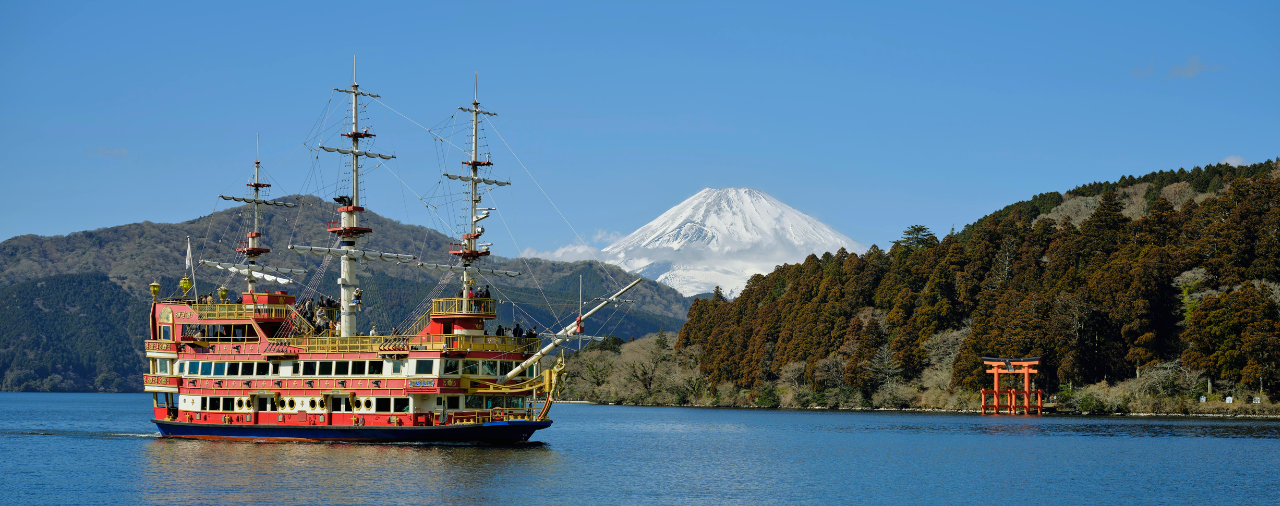
Hakone and Lake Ashi make one of the best escapes from Tokyo for mountains, hot springs, scenic train rides and views of Mount Fuji. Located in Fuji-Hakone-Izu National Park, the area combines Lake Ashi, volcanic landscapes, traditional onsen, museums and some of Japan’s most enjoyable mountain transportation.
One of the best things about visiting Hakone is that the transportation is part of the experience. Instead of simply taking a train to one attraction and returning the same way, you can travel around Hakone using the mountain railway, cable car, ropeway, sightseeing cruise and buses to create a scenic loop through the region.
Hakone can be visited as a day trip from Tokyo, but staying overnight gives you much more time to enjoy the area — especially if you want to experience a traditional ryokan and onsen without rushing back to the city.
Hakone at a Glance
| Best for | Hot springs, Mount Fuji views, scenic transportation, nature, museums and traditional ryokan stays |
|---|---|
| Recommended time | 1 full day for the highlights, or 1–2 nights for a more relaxed visit |
| Main gateway | Hakone-Yumoto Station |
| From Shinjuku | Odakyu Limited Express Romancecar directly to Hakone-Yumoto in as little as about 75 minutes |
| From Tokyo Station | JR or Tokaido Shinkansen to Odawara, then continue into Hakone |
| Best local transport pass | Hakone Freepass for travelers using several parts of the Hakone sightseeing network |
| JR Pass coverage | Useful for eligible JR travel to Odawara, but most transportation inside Hakone is not covered |
How to Get to Hakone from Tokyo
There are two main ways to reach Hakone from central Tokyo: take the Odakyu Romancecar directly from Shinjuku to Hakone-Yumoto, or travel by JR to Odawara and continue into Hakone from there.
The best option depends mainly on where you are staying in Tokyo and whether you are using a Japan Rail Pass or another JR pass.
Option 1: Odakyu Romancecar from Shinjuku
The Odakyu Limited Express Romancecar is one of the easiest and most enjoyable ways to travel from Tokyo to Hakone.
Direct trains run from Shinjuku Station to Hakone-Yumoto Station, with the fastest services taking about 75 minutes. All Romancecar seats are reserved, so you can enjoy the journey without changing trains.
This is usually the most convenient choice if you are staying around Shinjuku, Shibuya or the western side of central Tokyo.
Good to know: The Romancecar requires a limited express ticket in addition to the regular fare or Hakone Freepass. Seat reservations are recommended for weekends, public holidays and other busy travel periods.
Option 2: JR to Odawara
If you are staying near Tokyo Station, Shinagawa or another convenient JR station, traveling first to Odawara Station can be the better option.
Odawara is the main JR gateway to Hakone. From there, transfer to the Hakone Tozan Line for Hakone-Yumoto and continue into the sightseeing area.
The Tokaido Shinkansen is the fastest JR option from Tokyo or Shinagawa. However, only some Shinkansen services stop at Odawara, so check the stopping pattern before boarding.
Conventional JR trains are slower but can also be a practical option if you are not in a hurry.
Romancecar vs JR: Which Route Is Better?
| Option | Best For | Main Advantage |
|---|---|---|
| Romancecar from Shinjuku | Travelers staying around Shinjuku, Shibuya or western Tokyo | Direct reserved-seat journey to Hakone-Yumoto with no transfer |
| JR via Odawara | Travelers staying near Tokyo Station or Shinagawa, and JR Pass users | Fast access to Odawara and potential use of existing JR coverage |
Quick recommendation: If you are staying near Shinjuku and want the simplest journey, take the Romancecar. If you are staying near Tokyo Station or Shinagawa — or already have a JR pass covering the trip to Odawara — the JR route usually makes more sense.
Using a Japan Rail Pass
A nationwide Japan Rail Pass can cover eligible JR trains between Tokyo and Odawara, but it does not cover most transportation within Hakone.
After arriving at Odawara, you will normally need to pay separately for the Hakone Tozan Train, buses, cable car, ropeway and Lake Ashi sightseeing cruise — or use a Hakone Freepass.
JR Pass tip: If your JR pass already covers the journey to Odawara, you generally do not need the Shinjuku version of the Hakone Freepass. Travel to Odawara using JR and consider buying the Hakone Freepass from Odawara instead.
The Hakone Sightseeing Loop
One of the best ways to explore Hakone is to follow the classic sightseeing loop, combining several different types of transportation through the mountains and around Lake Ashi.
The journey itself is part of the attraction. You can ride a mountain railway, cable car and ropeway, stop at the volcanic valley of Owakudani, cruise across Lake Ashi and then return by bus toward Hakone-Yumoto.
Typical Hakone Loop Route
| Stage | Route | Transport | What to Expect |
|---|---|---|---|
| 1 | Hakone-Yumoto → Gora | Hakone Tozan Train | Scenic mountain railway with steep gradients and switchbacks |
| 2 | Gora → Sounzan | Hakone Tozan Cable Car | Short uphill ride connecting Gora with the ropeway |
| 3 | Sounzan → Owakudani | Hakone Ropeway | Volcanic scenery and views across the mountains |
| 4 | Owakudani → Togendai | Hakone Ropeway | Possible views of Mount Fuji and Lake Ashi on clear days |
| 5 | Togendai → Hakone-machi / Moto-Hakone | Hakone Sightseeing Cruise | Scenic cruise across Lake Ashi |
| 6 | Moto-Hakone / Hakone-machi → Hakone-Yumoto | Hakone Tozan Bus | Return toward Hakone-Yumoto or continue sightseeing around the lake |
Tip: You do not have to complete the entire loop. If you have only one day in Hakone, choose the attractions that interest you most and leave enough time to enjoy the journey between them.
Hakone Tozan Train
The Hakone Tozan Train between Hakone-Yumoto and Gora is one of Japan’s classic mountain railways. The approximately 8.9-kilometre journey takes around 40 minutes and climbs steeply through the mountains using switchbacks.
The ride is particularly scenic during the hydrangea season in early summer and when autumn colors appear in the mountains.
Hakone Ropeway & Owakudani
From Sounzan, the Hakone Ropeway travels across the volcanic landscape toward Owakudani and Lake Ashi.
Owakudani is one of Hakone’s most distinctive sights, with steaming volcanic vents, sulfurous terrain and dramatic mountain scenery.
On a clear day, the ropeway between Owakudani and Togendai can provide some of the best Mount Fuji views in Hakone.
Check before you travel: Ropeway service can occasionally be suspended because of strong winds, volcanic conditions, inspections or other operational issues. Check the latest service information before setting out.
Lake Ashi Sightseeing Cruise
At Togendai, the ropeway connects with the Hakone Sightseeing Cruise across Lake Ashi.
The distinctive sightseeing ships travel between Togendai, Hakone-machi and Moto-Hakone. Depending on the section of the route, the cruise takes roughly 25 to 40 minutes.
On clear days, Lake Ashi is one of the best places in Hakone to see Mount Fuji. The area around Moto-Hakone is also convenient for visiting Hakone Shrine and its famous lakeside torii gate.
Which Direction Should You Travel?
You can travel around the Hakone sightseeing loop in either direction.
For first-time visitors arriving at Hakone-Yumoto in the morning, the route through Gora → Sounzan → Owakudani → Togendai → Lake Ashi is simple to follow and works well for a full-day visit.
Our recommendation: Start with the Hakone Tozan Train and travel clockwise toward Owakudani and Lake Ashi. During especially busy periods, however, traveling in reverse can sometimes help you avoid the heaviest crowds.
Hakone Freepass: Is It Worth It?
If you plan to follow the classic Hakone sightseeing loop, the Hakone Freepass is usually the easiest and most convenient way to get around.
Instead of buying separate tickets for each train, cable car, ropeway, bus and sightseeing cruise, the pass gives you unlimited travel on designated transportation in the Hakone area for either two or three consecutive days.
What Does the Hakone Freepass Cover?
The Hakone Freepass covers eight types of designated transportation in and around Hakone, including:
✓ Hakone Tozan Train
✓ Hakone Tozan Cable Car
✓ Hakone Tozan Bus on designated routes
✓ Hakone Ropeway
✓ Hakone Sightseeing Cruise on Lake Ashi
✓ Selected sightseeing and local bus services
The pass also includes discounts or special benefits at many participating museums, hot springs, attractions and other facilities around Hakone.
Hakone Freepass Prices
There are two versions that are particularly useful for travelers coming from Tokyo: one starting from Shinjuku and another starting from Odawara.
| Starting Point | 2-Day Adult | 2-Day Child | 3-Day Adult | 3-Day Child |
|---|---|---|---|---|
| Shinjuku | ¥7,100 | ¥1,600 | ¥7,500 | ¥1,850 |
| Odawara | ¥6,000 | ¥1,500 | ¥6,400 | ¥1,750 |
Which version should you buy? Choose the Shinjuku version if you are traveling from Tokyo on the Odakyu Line. If you are reaching Odawara using JR — particularly with a Japan Rail Pass or another JR ticket — the Odawara version usually makes more sense.
What Is Included from Shinjuku?
The Shinjuku version includes one round trip on the Odakyu Line between your departure station and Odawara, together with unlimited travel on the designated Hakone transportation network during the validity period.
This is generally the simplest option if you are staying around Shinjuku and plan to travel to and from Hakone using Odakyu.
Romancecar note: The Hakone Freepass does not include the Limited Express Romancecar surcharge. If you want to use the Romancecar, you must purchase a separate limited express ticket in addition to the pass.
Is the Hakone Freepass Worth It for a Day Trip?
Although the shortest Hakone Freepass is valid for two days, it can still be worthwhile for a one-day visit if you plan to complete much of the classic sightseeing loop.
Individual fares for the Hakone Tozan Train, cable car, ropeway, Lake Ashi cruise and buses can add up quickly. The pass also saves time because you do not need to purchase a separate ticket every time you change transportation.
When the Hakone Freepass Makes Sense
Good value if:
You plan to use several forms of Hakone transportation and visit multiple areas during the same trip.
Especially convenient if:
You plan to follow the main sightseeing loop through Gora, Owakudani, Togendai and Lake Ashi.
Individual tickets may be better if:
You are visiting only one or two places and will use very little local transportation.
Hakone Freepass and the Japan Rail Pass
The Hakone Freepass and Japan Rail Pass serve different purposes and can work well together.
A nationwide Japan Rail Pass can cover eligible JR travel from Tokyo to Odawara, but it does not cover most transportation within Hakone.
JR Pass tip: If your JR pass already covers the journey to Odawara, travel there using JR and buy the Hakone Freepass from Odawara. This avoids paying for the Shinjuku–Odawara portion twice.
This combination gives you JR coverage for the Tokyo–Odawara journey and convenient unlimited transportation for sightseeing within Hakone.
What to See in Hakone
Hakone has much more to offer than scenic transportation. The area combines lakes, volcanic landscapes, historic shrines, museums, hot springs and excellent views of Mount Fuji.
If you have only one day, focus on the main sightseeing loop and choose a few highlights rather than trying to visit everything.
Lake Ashi
Lake Ashi, or Ashinoko, is one of Hakone’s most famous sights. The lake sits inside the Hakone caldera and is surrounded by forested mountains.
On clear days, you may be able to see Mount Fuji rising beyond the lake, especially from the northern and eastern shores.
The Hakone Sightseeing Cruise connects Togendai, Hakone-machi and Moto-Hakone, making the lake easy to include as part of the classic Hakone loop.
Best Places Around Lake Ashi
Moto-Hakone:
One of the best bases for exploring the eastern shore of Lake Ashi. Hakone Shrine, the lakeside torii gate and several viewpoints are nearby.
Hakone-machi:
Convenient for the sightseeing cruise and the historic Hakone Checkpoint area.
Togendai:
Located at the northern end of the lake and directly connected to the Hakone Ropeway.
Hakone Shrine
Hidden among tall cedar trees near the shore of Lake Ashi, Hakone Shrine is one of the area’s most atmospheric cultural sights.
The shrine dates back to 757 and has long been associated with travelers, warriors and prayers for safe journeys. Today, visitors climb the stone steps through the forest to reach the main shrine buildings.
The shrine itself is free to enter and can easily be combined with a visit to Moto-Hakone and Lake Ashi.
The Famous Lakeside Torii Gate
The bright red Heiwa no Torii — often called the Hakone Shrine floating torii gate — stands directly in the waters of Lake Ashi.
It has become one of Hakone’s most photographed locations, particularly when Mount Fuji is visible across the lake.
Tip: The torii gate can attract long lines for photos, especially in the middle of the day. Visiting earlier in the morning or later in the afternoon can make the experience much more pleasant.
How to Get to Hakone Shrine
From Moto-Hakone, Hakone Shrine is within walking distance along the lakeshore.
From Hakone-Yumoto, buses travel toward Moto-Hakone and the Lake Ashi area. If you are following the Hakone sightseeing loop, it is easy to visit the shrine after arriving by sightseeing cruise.
How Much Time Should You Allow?
Allow around 45–60 minutes for Hakone Shrine itself, and longer if you want to wait for a photo at the lakeside torii gate.
If you also want to walk around Moto-Hakone, enjoy the lake views or visit nearby attractions, plan for around 1.5–2 hours.
Owakudani, the Open-Air Museum & Gora
Owakudani Volcanic Valley
Owakudani is one of Hakone’s most dramatic landscapes. The volcanic valley is filled with steaming vents, sulfurous terrain and views across the surrounding mountains.
It is also one of the most convenient stops on the Hakone sightseeing loop because the Hakone Ropeway stops directly at Owakudani Station.
What to Do at Owakudani
See the volcanic landscape:
Walk around the observation areas near the ropeway station and enjoy views of the steaming valley below.
Look for Mount Fuji:
On clear days, Owakudani can offer excellent views of Mount Fuji. Morning generally gives you a better chance of clear visibility.
Try a black egg:
Owakudani is famous for kurotamago — eggs cooked using the area’s geothermal heat, which turns their shells black.
Local tradition says eating one black egg may add seven years to your life. We cannot promise that part, but they are certainly one of Hakone’s most famous snacks.
How Much Time Should You Allow at Owakudani?
Around 45–60 minutes is usually enough for the main viewpoints, shops and a black egg stop.
Allow longer if you want to visit the Hakone GeoMuseum, eat lunch or spend more time enjoying the views.
Tip: Weather conditions can change quickly at this elevation, and ropeway operations can occasionally be affected by strong winds or maintenance. Check the latest transport information on the day of your visit.
Hakone Open-Air Museum
The Hakone Open-Air Museum is one of Japan’s most enjoyable art museums and an excellent stop if you want to combine Hakone’s natural scenery with modern art.
Spread across approximately 70,000 square metres, the museum displays around 120 works by major modern and contemporary sculptors in landscaped outdoor spaces surrounded by the Hakone mountains.
There are also indoor galleries, including a Picasso collection, as well as family-friendly installations and a natural hot-spring footbath.
Hakone Open-Air Museum at a Glance
Nearest station: Chokoku-no-Mori Station
Opening hours: 9:00 AM–5:00 PM
Last admission: 4:30 PM
Adult admission: ¥2,000 at the ticket counter
Recommended time: Around 1.5–2.5 hours
If you are traveling between Hakone-Yumoto and Gora, the museum is easy to include because Chokoku-no-Mori Station is just one stop before Gora on the Hakone Tozan Train.
Gora
Gora is an important transportation hub in central Hakone and a useful place to stop for lunch, cafés, museums or an overnight stay.
This is where the Hakone Tozan Train from Hakone-Yumoto connects with the Hakone Tozan Cable Car toward Sounzan and the ropeway.
Why Stop in Gora?
Gora works especially well if you want to slow down your itinerary rather than rushing through the entire sightseeing loop.
You can visit the nearby Open-Air Museum, explore the Gora area, have lunch or stay overnight at one of the many ryokan and hotels in the surrounding hills.
It is also a convenient point to break the journey if you are traveling with children or luggage.
Suggested Hakone Itineraries
Hakone can be visited as a day trip from Tokyo, but the experience is much more relaxed if you stay overnight.
For a one-day visit, focus on the classic sightseeing loop and choose only a few major stops. If you have two days, you can enjoy the same highlights at a slower pace and add an onsen, museum or ryokan stay.
1-Day Hakone Itinerary from Tokyo
A one-day trip works best if you leave Tokyo early and keep the itinerary relatively simple.
| Approx. Time | Plan | What to Do |
|---|---|---|
| 7:00–8:00 AM | Leave Tokyo | Take the Romancecar from Shinjuku, or travel by JR to Odawara and continue to Hakone-Yumoto. |
| 9:00–10:00 AM | Hakone-Yumoto → Gora | Ride the Hakone Tozan Train through the mountains. If the Open-Air Museum is a priority, get off one stop before Gora at Chokoku-no-Mori. |
| 10:00–11:30 AM | Gora → Owakudani | Take the cable car to Sounzan and transfer to the Hakone Ropeway. Stop at Owakudani for the volcanic landscape, possible Mount Fuji views and a famous black egg. |
| 11:30 AM–1:00 PM | Owakudani → Lake Ashi | Continue by ropeway to Togendai and board the Hakone Sightseeing Cruise across Lake Ashi. |
| 1:00–3:00 PM | Moto-Hakone & Hakone Shrine | Explore the lakeshore, visit Hakone Shrine and the Heiwa no Torii gate, and stop for lunch. |
| 3:00–4:30 PM | Return toward Hakone-Yumoto | Take a bus from the Lake Ashi area toward Hakone-Yumoto. |
| Late Afternoon / Evening | Return to Tokyo | Travel back by Romancecar or return via Odawara and JR. |
Don’t try to see everything in one day: For a comfortable day trip, choose around three or four main experiences. Adding the Open-Air Museum, a long lunch, an onsen and every stop on the sightseeing loop can make the day feel rushed.
Should You Add the Hakone Open-Air Museum?
The Hakone Open-Air Museum is one of the area’s best attractions, but it requires around 1.5–2.5 hours if you want to enjoy it properly.
If the museum is a priority, consider shortening another part of the sightseeing loop rather than trying to squeeze everything into the same day.
Good one-day combinations: Choose either Open-Air Museum + Owakudani + Lake Ashi, or Owakudani + Lake Ashi + Hakone Shrine. Both are more realistic than trying to visit every major attraction.
2-Day Hakone Itinerary
Spending one night in Hakone gives you much more flexibility and allows you to experience one of the area’s biggest attractions: staying at a traditional ryokan or hotel with an onsen.
Day 1: Gora, Owakudani & Onsen
Morning:
Leave Tokyo and travel to Hakone-Yumoto.
Ride the Hakone Tozan Train toward Gora and visit the Hakone Open-Air Museum.
Afternoon:
Continue through Gora and Sounzan to Owakudani by cable car and ropeway.
Take your time exploring the volcanic scenery before continuing toward your accommodation.
Evening:
Check into your ryokan or hotel, enjoy an onsen and have a relaxed dinner instead of rushing back to Tokyo.
Day 2: Lake Ashi & Hakone Shrine
Morning:
Head toward Lake Ashi while the weather is often at its clearest.
Take the Hakone Sightseeing Cruise and enjoy the possibility of Mount Fuji views across the lake.
Late Morning:
Visit Moto-Hakone, Hakone Shrine and the lakeside Heiwa no Torii gate.
Afternoon:
Have lunch around Lake Ashi or Hakone-Yumoto, browse local shops or enjoy another short onsen visit.
Return to Tokyo in the late afternoon or evening.
Day Trip or Overnight Stay?
| Option | Best For | Main Advantage |
|---|---|---|
| 1-Day Trip | Travelers with limited time in Japan | See the main sightseeing loop and return to Tokyo the same day |
| 1 Night / 2 Days | Most first-time visitors | More relaxed sightseeing plus time for a ryokan or onsen stay |
| 2 Nights | Travelers who enjoy museums, onsen and slower travel | More time for quieter areas such as Sengokuhara and additional attractions |
Our recommendation: If your Japan itinerary allows it, spend one night in Hakone. Two days gives you enough time to enjoy the sightseeing loop, Lake Ashi, Owakudani and an onsen without constantly watching the clock.
Where to Stay in Hakone
Hakone is spread across a large mountainous area rather than centered around a single town, so choosing the right place to stay can make a noticeable difference to your trip.
For most first-time visitors, Hakone-Yumoto, Gora and the Lake Ashi area are the easiest places to consider. Each offers a different balance of transportation convenience, sightseeing and onsen atmosphere.
Hakone-Yumoto: Best for Convenience
Hakone-Yumoto is the main gateway to Hakone and one of the easiest places to stay if you are arriving from Tokyo.
The station is served by trains from Odawara and direct Romancecar services from Shinjuku, and buses and the Hakone Tozan Train connect Hakone-Yumoto with the rest of the sightseeing area.
The town also has restaurants, souvenir shops and many traditional ryokan and hotels with onsen.
Best for: First-time visitors, short stays, easy transport and travelers with luggage.
Gora: Best for the Classic Hakone Loop
Gora is an excellent base if sightseeing is your main priority.
It sits near the middle of the classic Hakone route, with the Hakone Tozan Train connecting toward Hakone-Yumoto and the cable car continuing toward Sounzan, Owakudani and Lake Ashi.
Gora also has a wide selection of ryokan, hotels and upscale onsen properties.
Best for: Sightseeing, museums, onsen stays and travelers spending two days in Hakone.
Lake Ashi: Best for Scenery & Mount Fuji Views
Staying near Lake Ashi gives you a quieter, more scenic Hakone experience.
Areas around Moto-Hakone, Hakone-machi and Togendai provide convenient access to the lake, sightseeing cruise and nearby attractions.
On clear mornings, some lakeside hotels and ryokan can offer memorable views toward Mount Fuji.
Best for: Scenery, couples, relaxed stays and travelers who want to spend more time around Lake Ashi.
Sengokuhara: Best for a Quiet Onsen Stay
Sengokuhara is located in northern Hakone and has a quieter, more spacious atmosphere than Hakone-Yumoto or Gora.
The area is known for nature, museums and numerous ryokan and resort-style hotels.
Public transportation is available, but Sengokuhara is less convenient if your main goal is to complete the sightseeing loop as quickly as possible.
Best for: Relaxation, longer stays, nature and travelers prioritizing their accommodation experience.
Why Stay Overnight in Hakone?
Hakone is certainly possible as a day trip from Tokyo, but staying overnight changes the pace of the visit completely.
Instead of spending much of the afternoon thinking about your return train, you can check into a ryokan, enjoy an onsen, have dinner and continue sightseeing the following morning.
Private Onsen & Open-Air Baths
For many travelers, an overnight stay is also the best opportunity to experience one of Hakone’s most famous attractions: an onsen with a private open-air bath.
Some ryokan and hotels offer guest rooms with their own rotenburo, allowing you to enjoy the hot spring privately without using a communal bath.
This can be especially appealing for couples, families, first-time onsen visitors or anyone who simply prefers more privacy.
When Is the Best Time to Visit Hakone?
Hakone is a year-round destination, but the experience changes noticeably with the seasons.
Spring brings cherry blossoms and fresh greenery, early summer is famous for hydrangeas, autumn offers some of the most beautiful mountain scenery, and winter often provides the clearest views of Mount Fuji.
Spring: March to May
Spring is one of the most attractive times to visit Hakone, with cherry blossoms appearing at different times depending on elevation.
In lower areas such as Hakone-Yumoto, blossoms often appear from late March into early April, while higher areas around Lake Ashi can bloom later.
April and May also bring fresh green scenery and generally comfortable temperatures for sightseeing.
Temperatures can still be cool in the morning and at higher elevations, so carrying an extra layer is a good idea.
Best for: Cherry blossoms, mild weather and fresh spring scenery.
Early Summer: June & Hydrangea Season
June is particularly famous for Hakone’s hydrangeas.
The flowers bloom along the Hakone Tozan Train line from around mid-June. Because the railway climbs steadily into the mountains, the blooming period gradually moves upward with the elevation.
During this season, the Hakone Tozan Train is often nicknamed the “Hydrangea Train”, with colorful flowers visible beside sections of the railway.
June also overlaps with Japan’s rainy season, so expect a greater chance of cloudy or wet weather.
Best for: Hydrangeas, lush green scenery and atmospheric mountain views.
Summer: July to August
Hakone is generally cooler than central Tokyo because of its higher elevation, making it a popular summer escape from the city.
July and August are good months for green mountain scenery, Lake Ashi cruises and summer activities, although humidity can still be high.
Mount Fuji can be harder to see during summer because clouds often build around the mountain as the day becomes warmer.
If seeing Mount Fuji is a priority, try to reach viewpoints such as Lake Ashi or Owakudani earlier in the morning.
Best for: Cooler mountain air, green scenery and summer sightseeing.
Autumn: October to November
Autumn is one of the most beautiful times to visit Hakone.
Fall colors generally begin in the higher areas around Owakudani in late October and gradually move toward lower elevations during November.
The Hakone Ropeway, Lake Ashi and Hakone Tozan Train can all provide excellent views of the changing leaves.
Sengokuhara is also famous for its fields of golden susuki, or Japanese pampas grass, which are particularly attractive during autumn.
Autumn weekends can be very busy, so weekday visits are preferable when possible.
Best for: Autumn foliage, photography and scenic train travel.
Winter: December to February
Winter can be an excellent time to visit Hakone, especially if seeing Mount Fuji is high on your list.
The colder, drier air often provides clearer visibility than during warmer months, and Mount Fuji may remain visible for longer periods on clear days.
Winter is also an ideal season for enjoying an onsen, particularly if you are staying overnight at a ryokan or hotel with an open-air bath.
However, Hakone can be considerably colder than Tokyo, especially around Owakudani, Sounzan and Lake Ashi.
Snow and icy conditions are possible, so dress warmly and check transportation conditions if bad weather is forecast.
Best for: Mount Fuji views, onsen stays and quieter sightseeing.
Best Time to See Mount Fuji from Hakone
Mount Fuji can be visible from Hakone at any time of year, but there is never a guarantee.
In general, winter offers the most reliable visibility because the air tends to be colder, drier and clearer.
During spring and summer, your chances are often better earlier in the morning before clouds develop around the mountain.
Mount Fuji tip: Do not plan your entire Hakone visit around seeing Mount Fuji. Even on otherwise beautiful days, the mountain can be completely hidden by clouds. Lake Ashi, Owakudani, the sightseeing loop, museums and onsen still make Hakone well worth visiting.
Hakone Seasons at a Glance
| Travel Priority | Best Time | What to Expect |
|---|---|---|
| Best overall weather | April–May and October–November | Mild temperatures and comfortable sightseeing conditions |
| Cherry blossoms | Late March through April | Blooming times vary depending on elevation |
| Hydrangeas | Mid-June through July | Flowers along the Hakone Tozan Train route |
| Summer scenery | July–August | Lush greenery and cooler temperatures than central Tokyo |
| Autumn colors | Late October through November | Foliage moves gradually from higher to lower elevations |
| Best chance of Mount Fuji views | December–February | Colder, drier air generally provides clearer visibility |
| Best for onsen | Autumn through winter | Cooler weather makes hot-spring stays especially enjoyable |
Our pick: For a first Hakone trip, April–May or October–November offers the best balance of comfortable weather and beautiful scenery. If seeing Mount Fuji is your top priority, winter is usually the better choice.
Practical Tips for Visiting Hakone
Hakone is easy to explore without a car, but traveling around the area is different from sightseeing in a large city. The mountains, multiple transfers and changing weather mean a little preparation can make your visit much smoother.
Travel Light If Possible
The classic Hakone loop involves several transfers between trains, cable cars, ropeways, boats and buses. Carrying a large suitcase through the entire route can quickly become inconvenient.
What to Do with Your Luggage
If you are staying overnight, consider leaving your luggage at your accommodation, using a coin locker or taking advantage of Hakone’s luggage delivery services.
A luggage transport service operates from Hakone-Yumoto Station to participating hotels and ryokan, allowing you to send your bags ahead and spend the day sightseeing without them.
A return service from participating accommodations to Hakone-Yumoto Station is also available.
Tip: Same-day luggage services have morning or midday acceptance deadlines, so check the latest operating hours and participating accommodations before relying on the service.
Check Transport Conditions Before You Start
Hakone’s transportation system is generally reliable, but mountain weather can occasionally affect services.
The Hakone Ropeway and Lake Ashi sightseeing cruise can be suspended because of strong winds, fog, inspections or other operating conditions.
Buses can also be delayed by road congestion, particularly on weekends, holidays and during popular seasonal periods.
Have a Backup Plan
Before leaving your hotel, check the current operation status of the Hakone Tozan Train, Cable Car, Ropeway, sightseeing cruise and buses.
If part of the sightseeing loop is suspended, do not assume your entire Hakone day is ruined. In many cases, buses can be used to reach Lake Ashi, Gora, Sengokuhara and other major sightseeing areas.
Keep your itinerary flexible rather than planning every transfer down to the minute.
Expect Crowds at Popular Times
Hakone can become very busy on weekends, Japanese public holidays, during autumn foliage season and around other major travel periods.
Popular bottlenecks can include buses from Hakone-Yumoto, the ropeway around Owakudani, sightseeing cruises and the photo line at Hakone Shrine’s lakeside torii gate.
Ways to Avoid the Worst Crowds
✓ Leave Tokyo early in the morning
✓ Stay overnight and begin sightseeing before day-trippers arrive
✓ Avoid weekends and public holidays when your itinerary allows
✓ Consider traveling around the sightseeing loop in the opposite direction if one route appears especially crowded
✓ Allow extra time for buses rather than scheduling a tight return connection
Prepare for Changing Weather
Conditions can be noticeably different between Hakone-Yumoto, Gora, Owakudani and Lake Ashi because of the changes in elevation.
Even if Tokyo is warm and sunny, higher parts of Hakone can be cooler, windier or covered in cloud.
Bring an extra layer outside summer, comfortable walking shoes and rain protection if the forecast is uncertain.
Don’t Plan Your Entire Trip Around Seeing Mount Fuji
Views of Mount Fuji from Hakone can be spectacular, but the mountain is frequently hidden by clouds.
Treat a clear Fuji view as a bonus rather than the only reason for visiting. Lake Ashi, Owakudani, the mountain railway, onsen and museums still make Hakone worthwhile even when Fuji is completely hidden.
Visiting Hakone with Children
Hakone can be a particularly fun destination for families because children get to experience several different forms of transportation in a single day.
The mountain train, cable car, ropeway and sightseeing cruise can turn getting from place to place into part of the adventure.
Family Travel Tips
Keep the itinerary simple:
With younger children, choose a few major attractions instead of attempting every stop on the sightseeing loop.
Use a compact stroller:
Hakone includes slopes, stairs, transfers and crowded transportation, so a lightweight stroller is generally easier to manage than a large one.
Allow extra transfer time:
Avoid planning tight connections when traveling with children, especially when buses are involved.
Carry snacks and drinks:
Restaurants and shops are available at the major sightseeing areas, but options can be limited between stops.
Consider staying overnight:
Dividing the sightseeing loop over two days makes Hakone considerably easier with young children.
Don’t Leave Your Return Too Late
If you are visiting Hakone as a day trip, keep an eye on your return transportation rather than waiting until the final possible train or bus.
Mountain transportation generally finishes earlier than urban rail services in Tokyo, and delays or congestion can make the return journey take longer than expected.
Our Advice for a Stress-Free Hakone Trip
Start early, travel light and keep your itinerary flexible.
Hakone is at its best when you enjoy the journey rather than treating every train, ropeway and bus as something you need to rush through.
Hakone FAQ
Is Hakone worth visiting?
Yes. Hakone is one of the best side trips from Tokyo if you want to combine mountain scenery, onsen, Lake Ashi, volcanic landscapes and unusual forms of transportation such as the Hakone Tozan Train, cable car and ropeway.
It is especially worthwhile for travelers who want a break from Japan’s large cities without traveling too far from Tokyo.
Can you visit Hakone in one day from Tokyo?
Yes. Hakone is a popular day trip from Tokyo, and you can experience many of the main highlights in one full day if you leave early.
A typical day trip can include the Hakone Tozan Train, Owakudani, the ropeway, Lake Ashi and Hakone Shrine.
However, trying to add too many museums, long meals and onsen stops can make the day feel rushed.
Is Hakone covered by the Japan Rail Pass?
Only partly.
A valid Japan Rail Pass can be used on eligible JR services as far as Odawara, but most transportation within Hakone is operated by non-JR companies.
The Hakone Tozan Train, cable car, ropeway, sightseeing cruise and most local buses are not covered by the nationwide JR Pass.
Do I need a Hakone Freepass?
You do not have to buy one, but it is usually very convenient if you plan to travel around several parts of Hakone.
The pass covers designated local trains, cable cars, ropeway services, buses and the Lake Ashi sightseeing cruise, so you do not need to purchase individual tickets throughout the day.
If you are visiting only one or two places, individual fares may be sufficient.
Should I buy the Hakone Freepass from Shinjuku or Odawara?
If you are traveling from Shinjuku on the Odakyu Line, the Shinjuku version is usually the most convenient.
If you are reaching Odawara using JR — particularly with a Japan Rail Pass or another JR ticket — the Odawara version normally makes more sense.
Can you see Mount Fuji from Hakone?
Yes, but visibility depends heavily on the weather.
Popular places for Mount Fuji views include Lake Ashi, Owakudani and sections of the Hakone Ropeway.
Clear winter days generally offer the best visibility, while during warmer months your chances are often better earlier in the morning.
Is it better to stay overnight in Hakone?
If your itinerary allows it, we recommend staying at least one night.
An overnight stay gives you more time for sightseeing and allows you to experience one of Hakone’s main attractions — relaxing in an onsen or staying at a traditional ryokan.
It also gives you another morning for Mount Fuji views if the weather is poor on your first day.
How many days do you need in Hakone?
One full day is enough for the main sightseeing loop, while two days and one night is ideal for most first-time visitors who want a more relaxed experience.
Two nights can work well if you want to spend more time at museums, onsen or quieter areas such as Sengokuhara.
Can I visit Hakone with luggage?
Yes, but large luggage can be inconvenient because sightseeing often involves several transfers.
If possible, leave large bags at your accommodation, use station lockers or take advantage of Hakone’s luggage delivery services rather than carrying suitcases around the full sightseeing loop.
Is Hakone good for families with children?
Yes. Hakone can be particularly enjoyable for children because the journey includes trains, cable cars, ropeways, buses and sightseeing ships.
Families with younger children should keep the itinerary simple, allow extra transfer time and consider staying overnight rather than completing the entire sightseeing loop in a single day.
What happens if the Hakone Ropeway is closed?
Ropeway services can occasionally be suspended because of strong winds, weather, inspections or other operating conditions.
If this happens, buses can often be used to reach major sightseeing areas such as Lake Ashi, Gora and Sengokuhara.
Check the latest Hakone transportation status before starting your sightseeing day and keep your route flexible.
Final Thoughts: Is Hakone Worth Visiting?
Hakone is one of the easiest places to add mountains, hot springs and scenic transportation to a Tokyo itinerary without traveling far from the city.
A day trip is enough to experience highlights such as the Hakone Tozan Train, Owakudani, the ropeway, Lake Ashi and Hakone Shrine. However, if your schedule allows it, staying overnight gives you more time to enjoy the area and experience a traditional ryokan or onsen without rushing.
Our Recommendation
For a first visit, allow one full day at minimum and start early from Tokyo.
If you can spare the time, stay one night in Hakone, complete the sightseeing loop at a relaxed pace and enjoy an onsen in the evening.
Travelers using JR can travel as far as Odawara on eligible JR services, while the Hakone Freepass is particularly useful for the local trains, buses, cable car, ropeway and Lake Ashi sightseeing cruise.
Related Guides
Best Hakone Hotels with Private Onsen
Planning to stay overnight? Compare five Hakone hotels and ryokan with private open-air hot-spring baths, including options in Gora and Sengokuhara.
6 Best Day Trips from Tokyo by Train
Compare Hakone with Kamakura, Nikko, Kawaguchiko and other easy destinations you can visit from Tokyo by public transportation.
Japan Rail Pass Guide
Learn how the nationwide JR Pass works, what it covers and whether it makes sense if Hakone is part of a longer train journey around Japan.
Before You Buy a JR Pass
Compare the cost of your planned train journeys with the current JR Pass price. Depending on your route, individual tickets or a regional pass may offer better value.
Check Current JR Pass PricesAbout Train Travel Japan
Train Travel Japan is written from firsthand experience traveling throughout Japan by rail. I am a Japanese native based in Canada and have traveled to all 47 prefectures of Japan over more than 30 years.
My goal is to make Japan train travel easier to understand, especially for international visitors planning JR Pass trips, regional rail journeys and independent itineraries.