Japan train seat reservations for families are usually straightforward, but planning ahead becomes more important when you want several seats together, are traveling with young children, or are visiting during a busy holiday period.
On many Shinkansen and Limited Express trains, you can reserve specific seats in advance. For families, this can remove a lot of uncertainty from long-distance travel.
Quick Answer: How Can Families Sit Together on Japanese Trains?
The easiest solution is to reserve seats together in advance for important Shinkansen and Limited Express journeys.
You can usually reserve through the relevant online booking system, a reserved-seat ticket machine or a staffed JR ticket office.
Family tip: A train may still have seats available even when there are no longer three, four or five adjacent seats. The larger your family, the more useful early reservations become.
Family Seat Reservations at a Glance
| Situation | Best Approach |
|---|---|
| 2 travelers | Two adjacent reserved seats are usually straightforward to find outside busy periods. |
| Family of 3 | Reserve early if you want one complete 3-seat row on a train with 3+2 seating. |
| Family of 4 | Two pairs in adjacent rows or seats across the aisle can work well. |
| Family of 5 | A full 3+2 row can be very convenient where that seating layout is used. |
| Child under 6 | Free accompanied travel does not automatically include the child’s own reserved seat. |
| Peak holiday travel | Reserve important journeys as early as practical. |
| Large luggage | Consider baggage requirements when selecting seats, not just who sits beside whom. |
Reserved vs Non-Reserved Seats for Families
Some trains offer both reserved and non-reserved seating, while others operate entirely with reserved seats.
| Seat Type | How It Works for Families |
|---|---|
| Reserved seat | Each ticketed passenger is assigned a specific train, car and seat. Best when sitting together matters. |
| Non-reserved seat | You board the designated non-reserved car and use available seats. Several seats together are not guaranteed. |
For most families: We recommend reserving seats for the longest or most important journeys and keeping simple local trips flexible.
Do You Need to Reserve Every Train?
No.
Ordinary local and commuter trains generally do not use seat reservations, so families simply board and use the available seating.
Reservations matter most on Shinkansen, Limited Express trains and other long-distance services.
Prioritize Reservations When:
✓ The journey is several hours long
✓ You have young children
✓ Your family wants to sit together
✓ You have a fixed connection or flight
✓ You are traveling during Golden Week, Obon, New Year or another busy period
✓ You need specific luggage-compatible seating
Some Trains Have No Non-Reserved Cars
Do not assume that every Shinkansen or Limited Express service lets you simply board a non-reserved car.
Some trains are entirely reserved-seat services, and seating rules can also change during busy travel periods.
Current example: Some Nozomi services can operate with all seats reserved during designated peak periods, even though they normally include some non-reserved seating. Always check the specific train and travel date.
Why Families Benefit More From Reservations
A solo traveler can usually accept almost any available seat.
Families have more variables: who sits beside the youngest child, whether everyone is in the same car, access to the aisle, luggage space and proximity to toilets.
Think of a reservation as more than just guaranteeing a seat: it lets you organize the family before you board instead of trying to solve the seating arrangement after the train is already moving.
Best Shinkansen Seat Arrangements for Families
The best seating arrangement depends on your family size, the children’s ages and the seating layout of the particular Shinkansen.
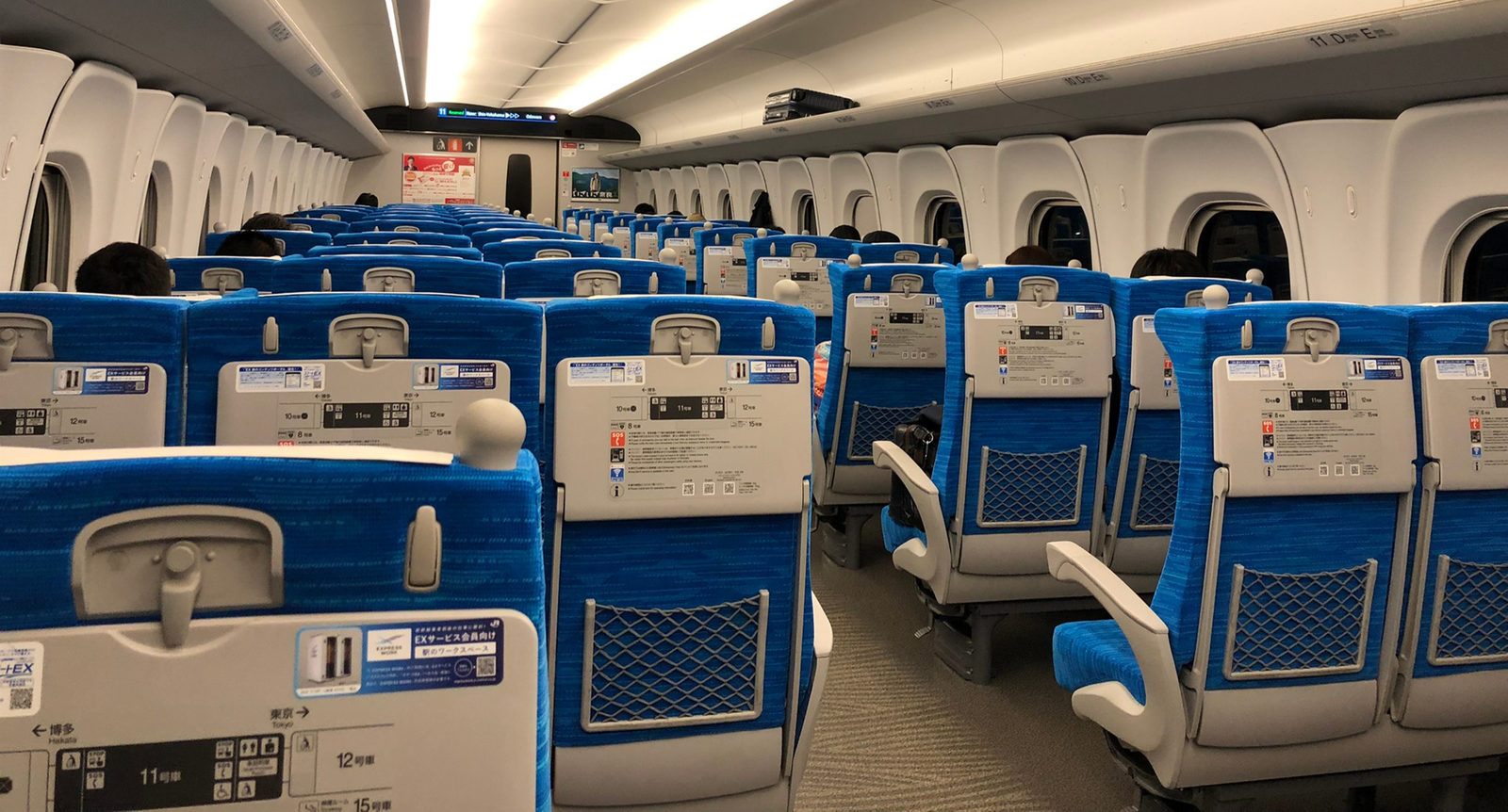
Many Ordinary Class Shinkansen cars use a 3+2 seating layout, while Green Cars commonly use a more spacious 2+2 layout. However, layouts vary by train, route and class.
Important: Always check the actual seat map when you book. The examples below are useful planning patterns, not a guarantee for every Shinkansen.
What Does 3+2 Seating Mean?
In a typical 3+2 Ordinary Class layout, one side of the aisle has three seats and the other side has two.
| Layout | Typical Use | Family Advantage |
|---|---|---|
| 3+2 | Common in Ordinary Class on many Shinkansen | Excellent for families of 3 or 5 |
| 2+2 | Common in Green Car and on some other train types | Comfortable for couples, families of 4 and parent-child pairs |
Family of 2
For one adult and one child, or two family members traveling together, two adjacent seats are usually the simplest option.
Good Arrangement
Window + aisle pair
Give the child the window if they enjoy watching the scenery, while the adult takes the aisle for easier access to the toilet or vestibule.
With a younger child: The adult sitting on the aisle can get up without asking another passenger to move every time the child needs the toilet.
Family of 3
A family of three fits particularly well into the three-seat side of a 3+2 Ordinary Class car.
Ideal Arrangement
Three seats in one row
This keeps everyone together without another passenger sitting between or beside family members.
Who Should Sit Where?
| Seat | Good Choice |
|---|---|
| Window | Child who enjoys watching the scenery |
| Middle | Younger child who benefits from sitting between adults |
| Aisle | Adult who expects to get up most often |
Family of three tip: If the three-seat row is important to you, reserve earlier. Three consecutive seats may disappear before individual seats sell out.
Family of 4
Families of four have several good options.
Option 1: Two Seats + Two Seats in Adjacent Rows
Put one adult and one child in each row.
This works especially well when the children are younger because each child sits directly beside a parent.
Option 2: Three Seats + One Across the Aisle
On a 3+2 layout, three family members can sit together on one side with the fourth directly across the aisle.
This keeps the family in one row while still making conversation easy.
Option 3: Two Pairs Across the Aisle
If four suitable seats are available in the same row, two family members can sit on each side of the aisle.
This can work particularly well with older children.
With young children: We usually prefer one adult beside each child rather than putting both children together while both adults sit elsewhere.
Family of 5
A 3+2 Ordinary Class layout can be almost perfect for a family of five.
Ideal Arrangement: One Complete Row
Three family members sit on one side of the aisle and two sit on the other.
Everyone remains together, and no unrelated passenger needs to share the row.
Reserve early: Finding five seats on the same train may be easy, but finding an entire 3+2 row together is much harder once bookings begin filling up.
Families Larger Than 5
For larger families or multi-generational groups, trying to seat everyone in exactly one row may not be realistic.
Instead, aim for a small cluster of seats in the same car.
Good Larger-Group Strategy
✓ Two adjacent rows
✓ Adults distributed among younger children
✓ Everyone in the same car
✓ Aisle seats for adults who may need to help children
Do not chase perfection: Two rows close together can be much more practical than trying to find six or seven seats in one exact configuration.
What About Green Car for Families?
Green Cars commonly have a 2+2 seating layout, giving each passenger more space than a typical Ordinary Class car.
This can be comfortable for a family of four because you can often sit as two pairs in the same row.
| Family Size | Typical Green Car Arrangement |
|---|---|
| 2 | One pair together |
| 3 | Two together + one across the aisle or nearby |
| 4 | Two pairs in the same row |
| 5 | Usually requires seats across more than one row |
Remember: Green Car gives you more space, but a 3+2 Ordinary Class layout can actually produce a more convenient arrangement for a family of three or five.
Window Seats, Mt. Fuji & Family Priorities
On routes where scenery matters, you may want to request a particular side of the train.
For example, many families traveling between Tokyo and Kyoto or Osaka hope to see Mt. Fuji from the Shinkansen.
However, seating the family together should usually take priority over securing one particular scenic seat.
Our priority order: sit together first → choose a convenient car → then choose window or scenery preferences.
Think About Toilets, Luggage & the Exit Too
The perfect family seat is not always just about who sits next to whom.
Families with young children may value proximity to a toilet, while travelers with large suitcases may need a specific baggage-compatible seat.
Consider All of These When Choosing Seats
✓ Family members sitting together
✓ Window or aisle preference
✓ Toilet access
✓ Stroller storage
✓ Oversized luggage requirements
✓ How quickly you need to get off for a connection
Best family seat is not always the “best” seat on a seat map: A slightly less scenic position near the facilities you need can make the journey much easier.
How to Book Family Seats Together
Families can reserve seats in several ways depending on the train, ticket type and rail pass being used.
The three most common methods are online reservation, a reserved-seat ticket machine, or a staffed JR ticket office.
| Booking Method | Best For | Main Advantage |
|---|---|---|
| Online reservation | Important journeys you want to secure in advance | Reserve before reaching the station where supported |
| Reserved-seat ticket machine | Families who already know the train and preferred seating | Fast and convenient without waiting at a counter |
| JR ticket office | Young children, larger families, luggage or special seating requests | Staff can help find the best available arrangement |
Our recommendation: Use a machine or online booking for straightforward reservations. If your family has a child under 6 who needs their own seat, several children, unusual luggage needs or a complicated seating request, a staffed JR ticket office can be easier.
Option 1: Reserve Family Seats Online
Online reservations can be very useful when your family has one or two important long-distance journeys that you want to secure before travel.
However, Japan does not have one universal online booking system covering every JR train in the country. The reservation system you use depends on the railway operator, route and ticket or pass.
Important: Do not assume that an account or booking system for JR East automatically covers the Tokaido Shinkansen or every other JR route in Japan.
Nationwide JR Pass Holders
If you purchase the nationwide Japan Rail Pass through the official JAPAN RAIL PASS Reservation website, you can also make eligible reserved-seat bookings through that website.
You will still need to receive your JR Pass and collect the required reserved-seat ticket before boarding.
JR Pass family tip: If your family buys the passes through the official reservation website, consider booking your most important long-distance journeys before arriving in Japan — particularly during busy travel periods.
Check the Seat Map Where Available
Some online reservation systems allow you to select specific seats or choose from available seating positions.
When that option is available, first look for seats together, then consider window preference, toilet access and luggage requirements.
Family Seat Selection Priority
1. Keep younger children beside an adult
2. Keep the family in the same row or nearby rows
3. Check luggage requirements
4. Consider toilet access
5. Choose window or scenic preferences
Option 2: Use a Reserved-Seat Ticket Machine
Many major JR stations have reserved-seat ticket machines that can be used to book Shinkansen and Limited Express seats.
These machines are useful when you already know which train you want and do not need complicated advice from staff.
Typical Booking Process
| Step | What to Do |
|---|---|
| 1 | Select the reserved-seat option. |
| 2 | Enter or select your departure station and destination. |
| 3 | Select the travel date and approximate departure time. |
| 4 | Choose the train and seating class. |
| 5 | Select available seats together where the machine offers seat-map selection. |
| 6 | Confirm the reservation and collect the ticket. |
Machine tip: If you cannot find a good family arrangement, do not assume the train is completely full. A staffed counter may be able to suggest another car, departure or seating combination.
Using a Reserved-Seat Machine With a Rail Pass
Eligible rail-pass holders can use compatible reserved-seat ticket machines to make seat reservations after receiving their pass.
Depending on the pass and machine, several travelers can be included in one reservation.
Keep everyone’s passes together: When making a family reservation at a machine or counter, have the relevant rail passes or tickets ready for every traveler who needs a seat.
Option 3: Ask at a JR Ticket Office
For many families, a staffed JR ticket office — often called Midori-no-madoguchi — is the easiest option for a complicated reservation.
Tell the staff your destination, preferred departure time and that you would like your family seated together.
A Staffed Counter Is Particularly Useful When:
✓ You have a child under 6 who needs their own reserved seat
✓ You are booking for a large family
✓ You need oversized baggage-compatible seats
✓ You are unsure which train to take
✓ Your preferred train does not show enough adjacent seats
✓ You have a complicated transfer
✓ You want advice about the best seating arrangement
What Information Should You Have Ready?
| Information | Example |
|---|---|
| Date | October 15 |
| Route | Tokyo → Kyoto |
| Preferred time | Around 9:00 AM |
| Number of travelers | 2 adults + 2 children |
| Child ages | 8 and 4 |
| Seat requirement | Four seats together |
| Luggage | One qualifying oversized suitcase |
Useful approach: Showing the date, route and passenger details on your phone can make the conversation quicker and reduce misunderstandings.
Ask for Nearby Seats If One Perfect Row Is Unavailable
If your first-choice arrangement is unavailable, ask whether the family can be placed in two nearby rows or in the same car.
This is often much better than splitting the family across different cars just to keep the exact departure time.
Be flexible with the train: If sitting together matters more than leaving at exactly 10:03, ask whether the next departure has a better seating arrangement.
Which Booking Method Is Best for Your Family?
| Your Situation | Best Starting Point |
|---|---|
| Simple family of 2–3 | Online reservation or ticket machine |
| Family of 4–5 wanting one seating cluster | Online seat map, machine or staffed office |
| Under-6 child needs own seat | Staffed office can be particularly helpful |
| Oversized baggage | Use a system that clearly lets you reserve the appropriate baggage-compatible seat, or ask staff |
| Complicated itinerary | Staffed JR ticket office |
| Peak holiday journey | Reserve online as early as your ticket or pass allows |
Bottom line: There is no prize for making a family reservation entirely by yourself. If the machine or online seat map becomes confusing, ask JR staff — especially when young children or special seating requirements are involved.
Kids Under 6: Who Needs a Reserved-Seat Ticket?
This is one of the most confusing parts of family train travel in Japan.
A child under 6 can often travel free under JR’s accompanied-child rules, but free travel does not automatically include a separate reserved seat.
Simple rule: If your child under 6 will occupy their own assigned reserved seat, you generally need to purchase the appropriate child ticket for that journey.
Family Examples
| Family | Reserved-Seat Situation | Typical Requirement |
|---|---|---|
| 2 adults + baby | Baby does not need own seat | Reserve 2 adult seats; baby generally travels free. |
| 2 adults + 4-year-old | Child shares accompanying passenger’s seating space | Reserve 2 adult seats; child generally travels free. |
| 2 adults + 4-year-old | Child needs own assigned seat | Reserve 3 seats and purchase the appropriate child ticket for the 4-year-old. |
| 2 adults + children ages 8 and 4 | Everyone wants own seat | 2 adult tickets, 1 child ticket for the 8-year-old, plus a child ticket for the 4-year-old’s reserved seat. |
| Parents using JR Passes + 4-year-old | Child needs own reserved seat | Parents use their JR Passes; purchase a separate child ticket for the 4-year-old’s seat. |
Important: A parent’s JR Pass does not create an extra reserved seat for a preschool-age child.
What About Non-Reserved Seating?
On a train that has non-reserved cars, an eligible young child may generally use an empty seat while one is available.
However, that seat is not assigned or guaranteed to the child.
If guaranteed space matters: Purchase a proper child reserved-seat ticket rather than relying on finding an empty non-reserved seat.
Do You Need to Buy a Child Seat for Every Journey?
No.
You can decide journey by journey. A preschooler may travel free on a short local or regional trip, while you purchase a separate seat for a long Shinkansen journey.
Family strategy: Pay for the extra seat where comfort really matters rather than assuming you need the same arrangement for the entire trip.
Peak Travel Periods: Reserve Family Seats Early
Families benefit more from early reservations than solo travelers because several adjacent seats can disappear before a train is completely sold out.
This matters most during Japan’s busiest domestic travel periods.
When Should Families Be Especially Careful?
| Period | Why It Matters |
|---|---|
| Golden Week | Very heavy domestic travel from late April into early May. |
| Obon | Major summer travel demand around mid-August. |
| New Year | Heavy intercity travel in late December and early January. |
| Three-day weekends | Popular trains and tourist routes can become much busier. |
| School holidays | More families travel domestically, especially to popular leisure destinations. |
Family rule of thumb: If missing your preferred train would create a difficult day, reserve it as early as your ticket or pass allows.
Reserve the Most Important Journeys First
Prioritize These
✓ Long-distance Shinkansen journeys
✓ Trains connected to flights
✓ All-reserved-seat trains
✓ Family journeys where everyone needs to sit together
✓ Trains requiring oversized-baggage-compatible seats
Do not overbook everything: Reserve the journeys that really matter and keep simple local travel flexible.
What If You Can’t Find Seats Together?
Do not panic if the first seat map does not show your ideal arrangement.
There are several ways to improve the situation before accepting seats far apart.
Try These Options in Order
| Option | What to Try |
|---|---|
| 1. Check another car | The same train may have a better family seating cluster elsewhere. |
| 2. Check the next departure | A train 20–30 minutes later may have substantially better availability. |
| 3. Accept two nearby rows | This is often perfectly practical for families of four or more. |
| 4. Ask at a staffed ticket office | Staff may suggest another seating combination or train. |
| 5. Adjust your departure time | Earlier or later trains can be much easier to book together. |
Keep Younger Children Beside an Adult
If the family must split across two rows, prioritize keeping younger children directly beside an adult.
Older children or teenagers can often sit across the aisle or in the row immediately ahead or behind.
Better than perfect: Two parent-child pairs in adjacent rows are often more practical than four seats arranged in a less convenient way just to keep everyone technically in the same row.
Should You Ask Another Passenger to Swap?
It is better to arrange your family seats properly before boarding whenever possible.
You can politely ask another passenger whether they are willing to exchange seats, but they are under no obligation to move from the seat they reserved.
Do not rely on seat swapping: If sitting together is important, solve the arrangement through the reservation system or JR staff before boarding.
Do Not Use an Unassigned Reserved Seat
Even if a reserved seat appears empty after departure, another passenger may board at a later station.
Do not move a child into another reserved seat unless JR staff confirms that you may use it.
Remember: An empty reserved seat is not necessarily an available seat.
Sometimes Changing Trains Is the Best Solution
On routes with frequent Shinkansen service, waiting for another departure may be much easier than forcing the family into an uncomfortable arrangement.
This is especially true when your schedule is flexible and the next suitable train leaves relatively soon.
Choose the Later Train If:
✓ Your current train would split young children from adults
✓ You need specific luggage-compatible seating
✓ The next train has a much better seating arrangement
✓ Waiting does not create a difficult onward connection
Our advice: With children, a comfortable two-hour train ride is usually worth waiting an extra 20 or 30 minutes for.
Luggage, Strollers & Choosing the Best Seats for Your Family
When traveling with children, the best seats are not always simply the seats with the nicest view.
Luggage, strollers, toilet access and how quickly you need to leave the train can all affect which seating position works best for your family.
Family seat priority: First make sure everyone can sit together comfortably, then consider luggage space, toilets and stroller access before choosing a particular window or scenic seat.
Think About Your Luggage Before Choosing Seats
Small and medium suitcases are usually straightforward, but families often travel with more baggage than individual travelers.
If you have several large suitcases, do not wait until boarding to work out where everything will go.
| What You Are Carrying | Seat Planning Advice |
|---|---|
| Small carry-on bags | Usually easy to manage using the available overhead storage and space around your seats. |
| One standard suitcase | Usually manageable, but check the train layout if you also have a stroller. |
| Several large suitcases | Plan storage before booking and consider luggage forwarding. |
| Qualifying oversized baggage | Reserve the appropriate baggage-compatible seat where the special Shinkansen rules apply. |
| Stroller + luggage | Allow more space and consider seats convenient to the vestibule or permitted storage area. |
Oversized Baggage & Family Seat Reservations
On the Tokaido, Sanyo, Kyushu and Nishi-Kyushu Shinkansen, luggage with combined dimensions of more than 160 cm and up to 250 cm generally requires a reservation for an appropriate seat with access to an oversized baggage area.
This matters for families because the baggage requirement can limit which seats you should select.
Measure before you book: Add the suitcase’s length + width + height. If the total exceeds 160 cm, check the applicable oversized-baggage reservation rules before selecting the family’s seats.
Do Not Book the Family First and Think About the Bags Later
If one family member needs an oversized-baggage-compatible seat, try to arrange the rest of the family nearby at the same time.
Otherwise, you may discover that the required baggage seat is available but the surrounding seats are already occupied.
Booking order: Check baggage requirements first → find the appropriate seats → then arrange the rest of the family around them.
What About Strollers?
Strollers can generally be brought onto Japanese trains, and families do not normally need to fold a stroller simply because they are boarding a JR train.
On the Shinkansen, however, a large stroller can take up useful space, so many families find it easier to fold it during the journey.
Stroller Planning Tips
✓ Use a lightweight folding stroller where possible
✓ Remove bags hanging from the stroller before folding it
✓ Do not block the aisle or doors
✓ Consider your stroller when choosing seats and luggage storage
✓ Allow extra boarding and exiting time
Important: Strollers receive special treatment under the oversized-baggage rules and do not automatically require an oversized-baggage reservation simply because their measurements exceed 160 cm.
Can You Use the Oversized Baggage Area for a Stroller?
If you want to use a designated oversized baggage storage area associated with particular seats, reserve the appropriate seat that provides access to that space.
Do not assume that an unused luggage area behind another passenger’s seat is available for your stroller.
Family tip: If you are carrying both a stroller and large luggage, a staffed JR ticket office can be useful because staff can help you choose a practical seating arrangement.
Should Families Sit Near the Toilet?
With babies or young children, being reasonably close to a toilet can be more useful than having the most scenic seat in the train.
Shinkansen car layouts show where toilets and other facilities are located, so check the train diagram when selecting seats if this matters to your family.
| Family Situation | What May Matter Most |
|---|---|
| Toddler | Convenient toilet access |
| Baby | Access to suitable onboard facilities and enough space for essential items |
| Older children | Window seats and sitting together may matter more |
| Large luggage | Appropriate baggage-compatible seating |
| Tight onward connection | Being organized and ready to exit promptly |
Is the Front or Back of a Car Better?
There is no universal answer because Shinkansen layouts differ by train and route.
Seats toward the end of a car may sometimes be convenient for access to the vestibule, toilets or certain luggage areas, but you should always check the actual train layout rather than relying on a fixed rule.
Avoid memorizing car numbers: The “best car” can change depending on the Shinkansen type, seating class and train formation. Use the seat map for your specific service.
Consider Luggage Forwarding for Complicated Family Trips
If you are traveling with several suitcases and a stroller, sending large luggage ahead can make family seat selection much easier.
Japan’s luggage forwarding services allow you to send bags between many hotels and supported delivery locations.
Luggage Forwarding Is Particularly Useful When:
✓ You have several large suitcases
✓ You also have a stroller
✓ Your journey includes several station transfers
✓ You are making a one-night stop between major cities
✓ You want easier Shinkansen boarding and exiting
Example: Send large bags from Tokyo directly to Kyoto, then travel to Hakone for one night with a small family overnight bag. This can be much easier than taking every suitcase through Hakone’s local transport network.
Our Family Seat-Selection Checklist
1. How many passengers need their own seats?
2. Are there any children under 6 traveling free?
3. Does any luggage require a special reservation?
4. Do we need space for a stroller?
5. Would being near a toilet make the journey easier?
6. Can the younger children sit beside an adult?
7. Only after that — which seats have the best view?
Bottom line: The best family Shinkansen seats are the ones that make the entire journey easier — not necessarily the seats that look best on the map.
Japan Train Seat Reservations for Families: FAQ
Do families need to reserve seats on the Shinkansen?
Not always.
Some Shinkansen services offer non-reserved seating, but reservations are strongly recommended when your family wants to sit together, particularly on long journeys or during busy travel periods.
Can families choose specific seats on the Shinkansen?
Often, yes.
Depending on the booking system, train and availability, you may be able to select specific seats from a seat map or ask JR staff for a particular arrangement.
What is the best seating arrangement for a family of four?
Two parent-child pairs in adjacent rows often work very well, especially with younger children.
Another option on a 3+2 seating layout is three family members together with the fourth directly across the aisle.
Can a family of five sit together?
Yes, subject to availability.
On a Shinkansen with a 3+2 Ordinary Class layout, a family of five may be able to reserve an entire row. Reserve early if this arrangement is important to you.
Does a child under 6 get their own reserved seat for free?
No.
An eligible child under 6 may travel free under JR’s accompanied-child rules, but free travel does not automatically include a separate reserved seat.
If you want the child to have their own assigned reserved seat, purchase the appropriate child ticket for that journey.
Can a child under 6 sit in an empty non-reserved seat?
An eligible young child may generally use an available seat in a non-reserved car while space is available.
However, the seat is not guaranteed specifically for the child.
Can JR Pass holders reserve family seats together?
Yes.
Eligible reserved seats can generally be booked for JR Pass holders through supported reservation methods. Families should reserve earlier when several adjacent seats are important.
Do JR Pass seat reservations cost extra?
Standard reserved seats on eligible trains are generally included with the nationwide JR Pass at no additional reservation charge.
Separate charges can apply for services or seating not fully covered by the pass.
Should we use an online booking system or a JR ticket office?
Online booking and reserved-seat machines are convenient for straightforward reservations.
A staffed JR ticket office can be easier when you have young children, a large family, oversized baggage or a specific seating request.
How early should families reserve Shinkansen seats?
Reserve important journeys as early as practical if you are traveling during Golden Week, Obon, New Year or another busy period.
Even outside peak periods, larger families should book earlier than solo travelers if they want several seats together.
What should we do if we cannot find seats together?
Check another car, another departure time or two nearby rows.
You can also ask JR staff whether another train has a better family seating arrangement.
Can we ask another passenger to swap seats?
You can ask politely, but another passenger is not required to give up the seat they reserved.
It is better to arrange suitable seats through the booking system or JR staff before boarding.
Should we reserve seats near the toilet?
For families with babies or young children, being reasonably close to a toilet can be very convenient.
Check the train layout before choosing seats if toilet access is important to your family.
What if we have a stroller or oversized luggage?
Consider your stroller and baggage before finalizing the family seating arrangement.
On Shinkansen routes with special oversized-baggage rules, qualifying luggage may require a particular baggage-compatible seat reservation.
Bottom line: For families, the best seat reservation is not necessarily the seat with the best view. Prioritize keeping younger children with adults, then consider luggage, toilet access and comfort.
Related Guides
Complete Guide to Traveling Japan by Train With Kids
Plan your family rail trip with practical advice on child fares, Shinkansen travel, strollers, luggage, station transfers and family-friendly itinerary planning.
How Kids Ages 0–5 Ride Free on JR Trains
Understand exactly when babies and preschool-age children can travel free, when a child ticket is required and how the rules work with reserved seats.
How JR Pass Holders Can Reserve Shinkansen Seats
Learn how JR Pass seat reservations work online and at stations, including current booking options, ticket collection and important reservation rules.
Before You Buy a JR Pass
Compare the cost of your planned train journeys with the current JR Pass price. Depending on your route, individual tickets or a regional pass may offer better value.
About Train Travel Japan
Train Travel Japan is written from firsthand experience traveling throughout Japan by rail. I am a Japanese native based in Canada and have traveled to all 47 prefectures of Japan over more than 30 years.
My goal is to make Japan train travel easier to understand, especially for international visitors planning JR Pass trips, regional rail journeys and independent itineraries.