
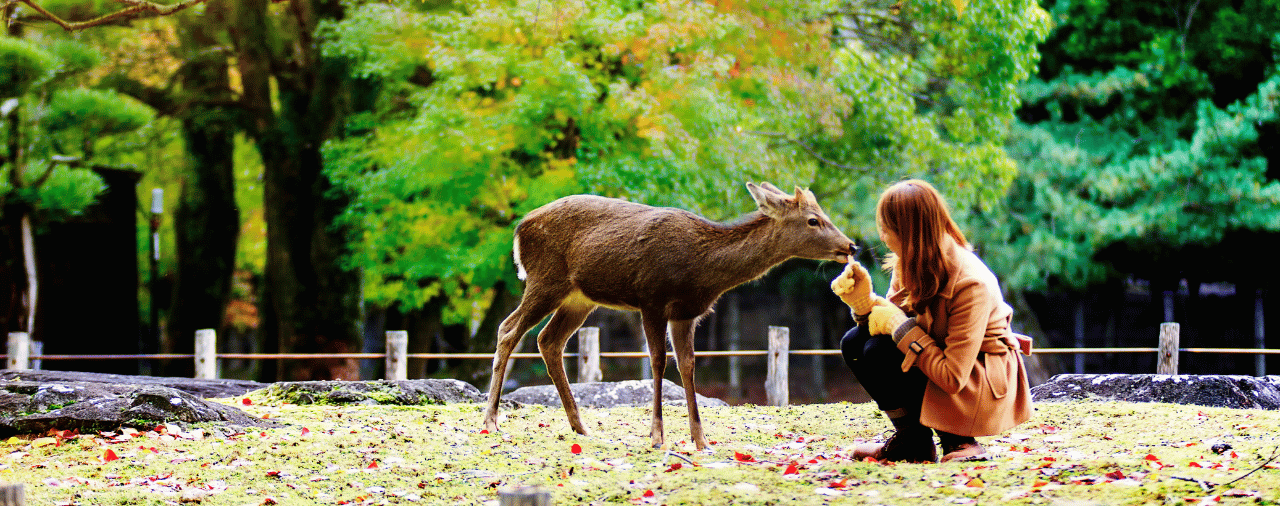
A Nara day trip with kids works best when the return journey is part of the plan. Choose one main attraction, keep lunch simple and decide in advance which extra stops you will skip when little legs get tired.
This itinerary pairs a short walk through the Nara Park area with Todaiji’s Great Buddha Hall. Allow roughly four hours in Nara, plus travel from your hotel. It is a deliberately shortened visit, designed for families who would enjoy Nara but do not want another full sightseeing day.
You can use it as the optional Nara outing in our two-week Japan itinerary with kids. Stay in your Kyoto or Osaka hotel and bring a day bag.
Your relaxed Nara plan
Station → Nara Park and deer watching → Todaiji’s Great Buddha Hall → lunch → return to your hotel.
Allow: about four hours locally, plus return travel.
Keep optional: feeding the deer, extra temples
and souvenir shopping.
Is a half-day enough for your family?
It is enough for this limited plan. It is not enough to explore Nara comprehensively. Families keen on Buddhist art, historic neighborhoods or several temple visits should use our full Nara guide and set aside more time.
For a mixed-age family, agree on a minimum outing before leaving: see the park, visit the Great Buddha if everyone is comfortable, then eat and return. An older child can help choose lunch or navigate the station signs. A younger child does not need to complete a sightseeing checklist.
“Half-day” here means about four hours locally. Hotel transfers, train waits and both rail journeys can make the whole outing considerably longer. Keep the evening free of another major booking.
Choose the station before choosing the train
Nara has two different arrival stations. Kintetsu-Nara is a short walk from the park area; JR Nara requires a longer approach, about 20 minutes to the park according to Nara’s official visitor guide. Neither arrival puts you at the Great Buddha Hall itself. There is still walking within the sightseeing area. Official park access information.
| Your starting point | Route to check first | Family planning note |
|---|---|---|
| Osaka-Namba area | Kintetsu to Kintetsu-Nara | A useful starting option for the shorter park approach. Check the exact service and destination. |
| Osaka Station / Umeda area | JR to JR Nara | Compare this with the extra effort of crossing Osaka to Namba. Keep a bus or taxi option for tired legs at arrival. |
| Kyoto Station area | Compare JR to JR Nara and Kintetsu to Kintetsu-Nara | Balance arrival location, transfers, seat arrangements and the ticket or pass you already hold. |
Nara’s official access guide gives approximate examples of 34 minutes for Kyoto–Kintetsu-Nara by Limited Express, 41 minutes for Kyoto–JR Nara and 52 minutes for Osaka Station–JR Nara. These are route-guide examples, not a timetable for your date. The same guide lists a roughly 34-minute Osaka-Namba–Kintetsu-Nara example; actual departures vary. Add hotel access and waiting time. Check official Nara access information.
On Kintetsu, Limited Express trains have reserved seats and require an additional Limited Express ticket as well as the basic fare. A preschool child occupying a separate Limited Express seat needs the appropriate child fare and Limited Express ticket. Check the operator’s age and accompaniment rules rather than assuming every young child rides free. Kintetsu ticket rules and route-search links.
Do not buy a new rail pass simply for this outing. Price the journeys you will actually take. If you already hold a pass, confirm the operator and route it covers; a Kintetsu pass also requires an extra ticket for a Limited Express.
A four-hour Nara plan with clear stopping points
The following times are suggested planning allowances, not attraction schedules or measured walking times. Start the clock at Kintetsu-Nara. If arriving at JR Nara, add time to reach the park area or use local transport.
| Time in Nara | Plan | Permission to shorten it |
|---|---|---|
| 0:00–0:20 | Station toilet stop, check the route and walk toward the park. | If someone is already exhausted, have a snack and reassess before going farther. |
| 0:20–1:10 | Slow walk toward Todaiji, with short deer-watching pauses. | Watching is enough; buying deer crackers is optional. |
| 1:10–2:20 | Main visit: Todaiji’s Great Buddha Hall and its approach. | Keep to the main hall. Leave extra halls and uphill extensions for another visit. |
| 2:20–3:20 | Return toward the station area and take a proper lunch break. | If everyone needs food earlier, move lunch forward and reduce temple time. |
| 3:20–4:00 | Toilets, a small optional souvenir stop and the journey back to the station. | Take the next suitable return service instead of filling the remaining time. |
Use a map to follow the station–park–Todaiji corridor and retrace it when necessary. A circular route may look more efficient on paper, but returning along a familiar path can be easier when children are tired. Do not add Kasuga Taisha or another museum automatically because they appear nearby on a sightseeing map.
With toddlers: shorten the plan to a park walk and lunch. Visit the Great Buddha only if your child is still comfortable.
With energetic older children: choose one extension after lunch and check the return time before committing.
Make deer watching optional and calm
The deer are wild. Nara’s official tourism guidance warns that small children can feel overwhelmed when deer approach for crackers. You can enjoy the animals without feeding them.
If your family chooses to feed them, use only the designated shika senbei, supervise closely and stop when a child is uncomfortable. Do not tease or grab deer. Keep paper, food packaging and plastic secured inside your bag. The official guide recommends showing empty hands when you have no food. Read Nara’s official deer guidance.
A useful family agreement is that nobody has to pose close to a deer or feed one for a photo. Give each child time to decide whether they are happy watching from farther away.
Todaiji admission: budget for the visit you want
Checked October 26, 2026, the official individual admission price for the Great Buddha Hall is ¥800 for adults and ages 13–18, and ¥400 for ages 6–12. Two adults and two children aged 6–12 therefore pay ¥2,400 for the hall alone. This calculation excludes trains, food and other paid attractions.
The hall’s published opening hours are 7:30–17:30 from April through October and 8:00–17:00 from November through March. Check the current notice before visiting. Our morning-to-early-afternoon plan avoids relying on arrival near closing time. Official Todaiji hours and admission.
Keep the rest of the budget personal: add your actual return rail fares, your lunch allowance and money for a backup bus or taxi. Do not treat a generic “family day-trip total” as a quote when children’s ages, hotel locations and train choices differ.
Pack for a day out, not a hotel move
Leave suitcases at your accommodation if you are returning there. Bring water, a small snack, weather protection and whatever your child needs for toileting or a clothing change. Keep snacks zipped away around deer and choose an appropriate place to eat.
With a stroller, look up the station’s elevator route before departure and ask staff about the accessible temple approach. Do not assume the shortest map route is step-free. Allow time for crowds and a slower return. Nara’s visitor guidance notes that taxis can be useful when buses are crowded; they are a fallback, not a guaranteed vehicle waiting at every point. Official family travel tips.
For the wider trip, see our family train-travel guide. A successful Nara day can end with enough energy left for laundry and an ordinary dinner at your hotel base.
Rain, heat or a tired morning: when to change the plan
This outing includes substantial outdoor walking. An indoor temple visit does not turn the whole route into a rainy-day activity. If the forecast is unpleasant or your family has had a poor night’s sleep, move Nara to another day or stay closer to the hotel.
Before leaving, decide on one turnaround point: before entering Todaiji, after the hall, or immediately after lunch. Choosing in advance makes it easier to stop without negotiating every remaining attraction.
If you are continuing your Kyoto planning, our three-day Kyoto itinerary helps you keep the surrounding days manageable.
Quick answers
Must children feed the deer to enjoy Nara?
No. Build the outing around watching the deer and one chosen attraction. Feeding is optional.
Is this a hotel-transfer day?
No. The recommended plan returns to the same Kyoto or Osaka base, which removes luggage storage and check-in from the day’s tasks.
Should you reserve a special sightseeing train?
Only if the train is a priority for your family. It adds a fixed departure and booking requirements to an otherwise flexible outing. Compare options in our Kansai sightseeing-train guide, but do not make a special service essential to completing this route.
Plan the wider trip
Return to the two-week family itinerary to fit this short Nara visit around your Kyoto and Osaka stays.
Official access, ticket and attraction information checked October 26, 2026. The itinerary sequence, pacing and rest decisions are editorial suggestions. Confirm your travel date’s train times, service status, fares and attraction notices before setting out.