
5 Spectacular Sightseeing Trains to Ride in Kyushu, Japan
No region of Japan takes its sightseeing trains more seriously than Kyushu. JR Kyushu has built an entire category around what it calls D&S (Design & Story) trains — each one conceived around a theme drawn from the landscape, history, and culture of the region it passes through. The designer behind many of them, Eiji Mitooka, has treated every train as a rolling work of architecture. The result is a collection of rail experiences that range from a forest-green onsen express to a jazz-bar coastal ride, a child-filled volcanic adventure to a week-long circuit of an entire island in first-class luxury. Kyushu is also one of the most JR Pass-friendly regions in Japan for sightseeing trains — most D&S trains here are fully covered, with only a free seat reservation required.
TIPS AND SECRETSJR REGIONAL PASSHIDDEN GEMSSIGHTSEEING & JOYFUL TRAINSFAMILY AND KIDSKYOTOFOODHIROSHIMAJR PASS 7 DAYSWESTERN JAPANNATURE GETAWAYSJR PASS 14 DAYS
Josh K
7/4/202615 min read
Here are five Kyushu sightseeing trains that belong on any Kyushu itinerary, including routes, highlights, and booking tips including validity of Japan Rail Pass and JR Regional Passes.
1. YUFUIN NO MORI — Fukuoka to Yufuin & Beppu
Route: Hakata Station (Fukuoka) ↔ Yufuin Station ↔ Beppu Station (Service No. 3/4 only extends to Beppu) Journey time: Approx. 2 hours 15 minutes (Hakata–Yufuin); approx. 2 hours 30 minutes (Hakata–Beppu) Frequency: 3 outbound departures daily from Hakata; 2 return departures from Beppu
Season: Year-round (operates most days; check schedule for closures)
Operator: JR Kyushu
JR Pass Validity: ✅ Fully valid. The Japan Rail Pass and all JR Kyushu Rail Passes (All Kyushu, Northern Kyushu) cover the full fare. A seat reservation is mandatory — there are no unreserved seats on any service. Reservations are free when made in person at a JR Kyushu ticket office (Midori no Madoguchi). If booking online through the JR Kyushu website, a ¥1,500 reservation fee applies. Reservations open one month in advance; this train fills rapidly, especially on weekends and during autumn foliage and cherry blossom seasons.
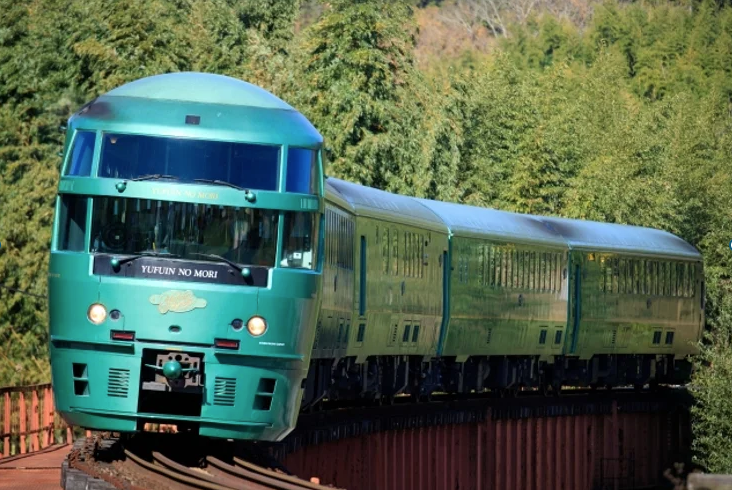
Kyushu's most beloved sightseeing train needs little introduction to anyone who has spent time planning a trip to the island. Since its launch in 1989, the YUFUIN NO MORI — the name means "Forest of Yufuin" — has become an icon of Japanese rail travel, recognised immediately by its deep forest-green exterior and framed portrait windows. The train was designed by Eiji Mitooka as an extension of Yufuin's character: a resort town known for boutique galleries, lakeside walks, and graceful ryokan baths hidden in the mountains of Oita Prefecture.
Step inside and the forest theme continues throughout. Wooden floors, warm timber panelling, green-patterned upholstery, and elevated "high-deck" seating give every passenger an improved vantage point over the passing landscape. The raised floor level is a deliberate design choice: passengers sit higher than the standard carriage floor, improving sightlines across the valley floors and rolling hillsides of central Kyushu. In the five-car formation, Car 4 has its own unique interior design with a distinctive forest-print on the seat fabric — worth requesting when booking.
The route follows the Kagoshima Main Line from Hakata before branching onto the scenic Kyudai Main Line through Tosu, Kurume, and Hita. The Kyudai Main Line section is the heart of the journey: the train climbs steadily through Oita Prefecture's forested mountains, winding above rivers and through deep-cut valleys. One of the most anticipated moments is the passage past Jion-no-taki Falls shortly after Amagase Station — the train slows down here to allow passengers to appreciate the multi-tiered waterfall tumbling through the forest. For the best view of the falls (and to face forward on the outbound journey), choose seats C and D, which sit on the right side travelling from Hakata to Yufuin. These seats book out first.
Each car has a lounge and bar area where cabin attendants serve exclusive onboard food and drinks. The signature items include a rich cheesecake from Yufuin Milch (three layers: biscuit, sponge, and Yufuin milk cheese), a seasonal fruit sandwich using Ukiha City produce, and soft-serve ice cream in matcha or kabosu citrus flavour. Shortly before arriving at Yufuin, a cabin attendant provides a live travel commentary about the resort, easing passengers into the relaxed pace of the destination before they even arrive. Platform One at Yufuin Station features a foot onsen — a free hot-spring footbath — where you can soothe tired feet while waiting for your return service.
Only Service No. 3 (morning departure from Hakata) continues beyond Yufuin to Beppu, arriving just before 13:00. This is the one to take if combining both destinations in a single day trip, and it runs through some of the most dramatic highland scenery on the entire route. Near Bungo-Mori Station, a pudding-shaped dormant volcano called Mt. Kirikuri appears on the left — one of the route's quirky highlights.
Getting there: Hakata Station is directly connected to the Sanyo and Kyushu Shinkansen, making it easy to reach from Hiroshima, Osaka, or Nagasaki. For onward travel, regular JR limited express trains from Yufuin to Beppu are also covered by the JR Pass.
Tips: Reserve as early as possible — the month before your travel date at 10:00 am Japan time. If the train is sold out, the regular Limited Express YUFU runs the same route and is also JR Pass-covered, with some unreserved seats available. For groups of three or four, ask at the JR Kyushu ticket office about booth seating — four seats configured around a shared table — which cannot be reserved online and is extremely popular with families.
2. Seven Stars in Kyushu (Nanatsuboshi in Kyushu) — All Seven Prefectures
Route: Circuit departing and returning to Hakata Station (Fukuoka); various seasonal itineraries
Duration: 2-day/1-night or 4-day/3-night courses
Frequency: Multiple departures per year; applications accepted twice annually (spring–summer and autumn–winter seasons)
Operator: JR Kyushu
JR Pass Validity: ❌ Not valid. The Seven Stars is an entirely separate, all-inclusive luxury product. It cannot be booked as a regular train ticket and is not covered by any rail pass. Pricing starts from approximately ¥402,000 per person (double occupancy, 2-day/1-night regular suite) and approximately ¥855,000 per person (4-day/3-night double occupancy). Since demand far exceeds the 30-passenger capacity, tickets are allocated by lottery application, not first-come-first-served. Applications open several months before each seasonal schedule. International visitors can apply through JTB Royal Road Ginza or via dedicated travel agencies abroad.
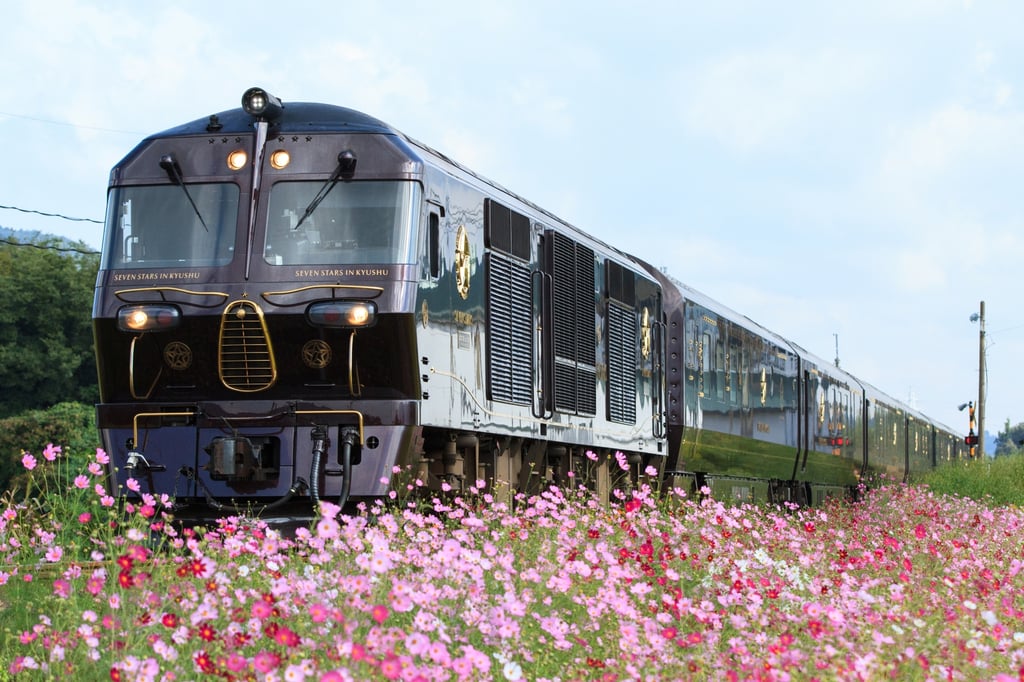
There is, at the apex of Japanese luxury train travel, a train so exclusive you must win a lottery to board it. The Seven Stars in Kyushu — known in Japanese as Nanatsuboshi in Kyushu — launched on October 15, 2013, as Japan's very first cruise train, and it triggered a movement that transformed the entire industry's concept of what a train could be. Today it remains the benchmark: a rolling boutique hotel through which the entirety of Kyushu — its forests, volcanoes, coasts, onsen, and cultural heritage — is experienced at the pace of a long, magnificent exhale.
The name holds multiple meanings. Kyushu comprises seven prefectures — Fukuoka, Saga, Nagasaki, Kumamoto, Oita, Miyazaki, and Kagoshima — and the train visits them all. The seven also represents what JR Kyushu considers the island's greatest gifts: the train system itself, its nature, its hot springs, its sacred power spots, its history, its cuisine, and the warmth of its people.
The train is seven cars long, designed by Mitooka with the splendour of a grand Edwardian railway carriage. The exterior gleams in deep royal wine-red with gold detailing, described by the designer as the colour of "ancient lacquer." The key spaces are breathtaking. The Lounge Car Blue Moon at the rear of the train features an enormous panoramic observation window, facing armchairs arranged around tables, and — on evenings when passengers gather over sake and whisky — a grand piano from which live chamber music drifts through the carriage. The Salon Car Jupiter is lined with comfortable sofas and armchairs for daytime conversation and relaxation. The dining car serves seasonal multi-course meals designed around Kyushu's finest regional ingredients: Hakata beef, Oita buri yellowtail, Kyushu shochu, Arita porcelain dinnerware. The dress code is formal; guests are expected to arrive in evening wear for dinner service.
Accommodation is in one of 14 private suites — in various configurations from twin beds to the opulent DX Suite A, a large double suite with a sitting area and a panoramic bay window. All suites feature handcrafted wood interiors and private bathrooms.
The 4-day/3-night course is the comprehensive experience, criss-crossing all seven prefectures with scheduled shore excursions along the way: sightseeing in Yufuin, a sea cruise to the Shiranui coast, a visit to Miyazaki's mythological sites, an overnight stay at a Kirishima hot spring resort, and a stop at Arita — the birthplace of Japanese porcelain, whose 400-year kiln heritage is still active today. The 2-day/1-night course focuses on northern Kyushu, visiting four prefectures and including an evening tour of Nagasaki's illuminated harbour. Both courses depart from and return to Hakata Station.
Getting there: Hakata Station is the hub of Kyushu's Shinkansen network, accessible directly from Osaka (via Sanyo Shinkansen, fully covered by JR Pass) and from within Kyushu. The JR Pass covers the Shinkansen to Hakata; the Seven Stars experience itself is a fully separate booking.
Tips: Apply at the earliest possible opportunity when each season's applications open — demand consistently exceeds capacity for all dates. The "Yume no Kyujitsu" (Dream Holiday) programme is designed specifically for international guests, offering English-language support and English-speaking itinerary guidance on selected departures. For those who cannot secure a booking, the 36+3 train (covered below) offers a taste of the same luxury heritage — designed by the same team, operated on regular reservations.
3. ASO BOY! — Kumamoto to Beppu via Mount Aso
Route: Kumamoto Station ↔ Beppu Station (via Aso Station) on the Hōhi Main Line
Journey time: Approx. 80 minutes (Kumamoto–Aso); approx. 3 hours 30 minutes (full route, Kumamoto–Beppu)
Frequency: 1 round trip per day of operation; runs mostly on weekends, public holidays, and daily throughout August
Operator: JR Kyushu
JR Pass Validity: ✅ Fully valid. The Japan Rail Pass, All Kyushu Rail Pass, Northern Kyushu Rail Pass, and Southern Kyushu Rail Pass all cover the fare. A seat reservation is mandatory; reservations are free for pass holders when made at a JR Kyushu ticket office. Online reservations incur a ¥1,500 fee. The train runs over the Hōhi Main Line, which was severely damaged in the 2016 Kumamoto Earthquake and fully restored in August 2020 — ASO BOY!'s return to the full route was a celebrated milestone for the region.
If the YUFUIN NO MORI is Kyushu's most elegant train, the ASO BOY! is undoubtedly its most joyful. Named as a play on the Japanese "asobō" (meaning "let's play!") and the volcanic landscape of Mount Aso, this four-car Mitooka-designed train is a rolling theme park for families — though adults without children find themselves entirely charmed by it too. The exterior is white, splashed with 101 illustrated poses of Kuro, the train's beloved black Labrador mascot, each one different. Kuro appears throughout the train's interior too: on headrest covers, stickers, the station announcement screens, and even on the commemorative card every passenger receives.
The four cars each serve a different purpose. Car 1 (panorama car) and Car 4 (rear panorama) feature wide-angle observation windows at the front and rear respectively, giving passengers an almost unobstructed view looking ahead down the track — the best seats for dramatic volcanic scenery. For the best forward-facing view outbound from Kumamoto, try Car 1, rows 1–3. Car 2 offers standard reclining seats, comfortable and spacious. Car 3 — the undisputed star for families with young children — contains a wooden ball pool, a small Japanese-style tatami room, a picture book corner, and child-sized seats with special footrests. A cabin attendant is always stationed in Car 3 to supervise and play with children. The ball pool requires no reservation and is available to all passengers.
The Hōhi Main Line route is one of Kyushu's great scenic journeys. From Kumamoto, the train climbs steadily up through the outer rim of the vast Aso caldera — one of the largest in the world — emerging into a highland plateau of extraordinary scale. The Aso caldera, 25 kilometres wide and 18 kilometres north to south, is so large that a town, farms, and rice paddies exist on its floor, and the still-active inner peaks of the Nakadake crater smoulder visibly on clear days. The train passes through a series of dramatic landscape changes: suburban Kumamoto, forested river valleys, switchback climbs, open caldera grasslands, and — on the Beppu-bound section past Aso — the steep descent toward Oita Prefecture and the coast.
Notable features en route include the famous switchback section between Tateno and Seta stations, where the train reverses direction on the steep hillside rather than taking a hairpin curve — a technical curiosity that draws railway enthusiasts from across Japan. The Aso Crater Line bus from Aso Station can take passengers up to the Nakadake Crater rim (access subject to volcanic activity levels), and outside Aso Station, a One Piece statue of Usopp stands as part of the Kumamoto Earthquake Recovery Project — the manga creator Eiichiro Oda was born in Kumamoto Prefecture.
Onboard food requires advance reservation and includes an exclusive Aso Milk Pudding made with Jersey milk from Aso's dairy farms. A souvenir counter in Car 3 sells Kuro merchandise, local Kumamoto products, and the train's exclusive onboard goods.
Getting there: Kumamoto Station is on the Kyushu Shinkansen line, approximately 30 minutes by Shinkansen from Hakata. Beppu, at the other end of the route, connects easily to Yufuin — allowing the YUFUIN NO MORI and ASO BOY! to be combined into a spectacular multi-day loop through central Kyushu.
Tips: Book as early as possible for weekend and August departures. If the full Kumamoto–Beppu route is sold out, shorter segments — such as Kumamoto to Aso only (around 80 minutes) — are often still available and still offer the most dramatic scenery. Combine an ASO BOY! arrival at Aso with a half-day excursion to the caldera grasslands of Kusasenrigahama and the crater rim before returning to Kumamoto or continuing onward.
4. A-TRAIN — Kumamoto to Misumi
Route: Kumamoto Station ↔ Misumi Station on the Amakusa Misumi Line
Journey time: Approx. 40–50 minutes one-way
Frequency: 2–3 round trips per day, operating mostly on weekends and public holidays Operator: JR Kyushu
JR Pass Validity: ✅ Fully valid. The Japan Rail Pass, All Kyushu Rail Pass, Northern Kyushu Rail Pass, and Southern Kyushu Rail Pass all cover the fare. A mandatory seat reservation is free at a JR Kyushu ticket office; an online reservation fee of ¥1,500 applies. The full one-way fare including seat reservation is approximately ¥2,650 without a pass.
Its name comes from a jazz standard. Duke Ellington's "Take the 'A' Train" plays softly throughout the carriages from the moment passengers board, and it never quite leaves your head after you disembark. The A-TRAIN is one of JR Kyushu's most intimate and stylish D&S trains: just two cars, elegantly conceived around the Southern European culture that took root in the Amakusa region during the 16th century, when Portuguese missionaries arrived on these shores and introduced Christianity to Japan — a faith its converts would practice in secret for over 250 years of persecution.
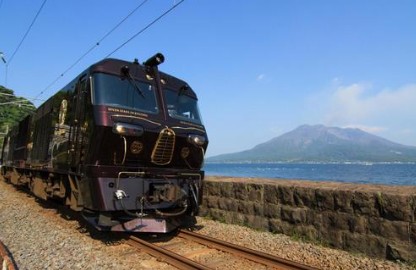
The exterior is dramatic: deep lacquer-black with gold accents, giving the train the bearing of a private salon car from another era. The interior is equally striking. Both cars are panelled in dark hardwood, the seats upholstered in fabric with classical European patterns. Large windows frame the coastal landscape like paintings. Stained glass panels throughout the carriage — inspired by the hidden Christian churches of Amakusa, several of which are now UNESCO World Heritage listed — filter light into the compartment in warm, coloured pools. The overall effect is of boarding a moving piece of early-20th-century cinema design. It is, as JR Kyushu's own description puts it, "a train for adult travellers."
Car 1 houses the A-TRAIN BAR, the social centrepiece of the experience: a counter bar serving cocktails, highballs, soft drinks, and light snacks to passengers perched on bar stools while coastal scenery scrolls past the windows. The unmissable order is the A Highball, made with dekopon — a sweet, seedless citrus variety native to Kumamoto Prefecture — and a spirit, served at ¥530. Small seasonal muffins using organic fruit from Misumi Town are also available, baked in two colours to reflect the black and gold of the train. A cabin attendant stamps passenger memory cards and poses for commemorative photos throughout the journey.
The 40-minute route follows the Amakusa Misumi Line from Kumamoto along the coast of Uto Peninsula in southern Kumamoto, offering views across the Ariake Sea toward the distant volcanic silhouette of Mt. Unzen in Nagasaki Prefecture. On clear days, the view is extraordinary. The line passes the Okoshiki Coast — recognised on Japan's "100 Best Sunsets" and "100 Best Beaches" lists — and its famous tidal flats, which at low tide reveal the outline of a walking path and a bronze Jinbe statue from the One Piece franchise. The terminus, Misumi Station, is a beautifully restored Southern European-style building — specifically renovated to coincide with the A-TRAIN's launch — whose architecture echoes the Catholic heritage of nearby Amakusa. Its veranda overlooks the harbour.
From Misumi Station, a ferry operates to the Amakusa Islands, an archipelago famous for dolphin-watching cruises, hidden Christian village heritage, and one of the most beautiful coastlines in western Japan. The A-TRAIN's timetable is specifically designed to connect with ferry departure times, making the train a natural first leg of an Amakusa day trip.
Getting there: Kumamoto Station is on the Kyushu Shinkansen, approximately 30 minutes from Hakata by bullet train (covered by JR Pass). The A-TRAIN departs from the same station.
Tips: For the best coastal views travelling from Kumamoto to Misumi, choose seats C and D (right side). The Amakusa Sea Cruise from Misumi offers dolphin-watching on the Shiranui Sea — combine the A-TRAIN with a cruise for a full day exploring the Christian heritage and coastal landscape of Kumamoto's southern shore.


5. 36+3 (Sanju-Roku Plus San) — Full Circuit of Kyushu
Routes (5-day circuit):
Thursday: Hakata → Kagoshima-Chuo (via Kumamoto and the East China Sea coast)
Friday: Kagoshima-Chuo → Miyazaki (via Kinko Bay, Sakurajima, and Osumi-Okawara)
Saturday: Miyazaki → Beppu (via the Hyuga-nada Sea coast and Nobeoka)
Sunday: Beppu → Hakata (via Oita and the Oita coast)
Monday: Hakata day-trip circuit (Fukuoka and surrounding area) Journey time per segment: Varies; half-day to full-day per leg Operator: JR Kyushu JR Pass Validity: ⚠️ Partial. The Japan Rail Pass and JR Kyushu Rail Passes can be used to board the 36+3 but only for Green Car (first-class) seating, and a substantial surcharge applies on top of any pass. The surcharge varies by segment (example: Hakata–Kagoshima-Chuo is approximately ¥27,700 per person including lunch, seat reservation, and the Orange Railway section fee of ¥2,670). Reservations must be made in advance — online through the JR Kyushu website (up to 5 days before departure) or by phone (up to 10 days before). You cannot board this train without a prior reservation.
While the Seven Stars in Kyushu occupies the pinnacle of Kyushu's luxury rail world as a once-in-a-lifetime lottery experience, the 36+3 sits just beneath it — accessible to any traveller willing to book in advance, offering a genuinely comparable level of interior luxury, the same first-class all-car configuration, and the extraordinary privilege of watching all seven Kyushu prefectures scroll past the windows over the course of a week.
The name is characteristically layered in meaning. Kyushu is the 36th largest island in the world. "36" is also read san-kyu in Japanese — phonetically close to "thank you" in English, an expression of gratitude to passengers. The "+3" represents the three groups the train brings together: passengers, local communities along the route, and JR Kyushu staff. And 36+3 equals 39 — san-kyu once more. The train runs in a clockwise circuit around the full perimeter of Kyushu over five operating days, each segment covering one edge of the island.
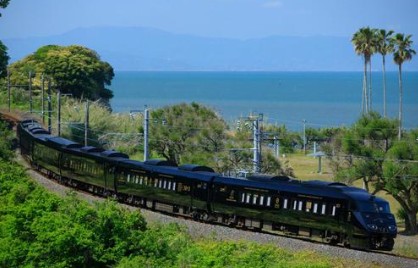
The six-car train (with Car 6 temporarily out of service for renovation until Autumn 2026) is a converted 787 series electric train, redesigned by the same Mitooka-led team responsible for the Seven Stars. The exterior is painted a commanding black with gold detailing. Inside, the atmosphere shifts between cars. Cars 1 and 2 contain private compartments — semi-enclosed booths with western-style sofas accommodating up to six people, wrapped in wood-panelling and shoji-screen dividers that recall a high-end Japanese inn. Car 3 and 4 house the bar counter and the lounge car: an elegant shared space with arched latticework ceilings crafted in the Okawa kumiko woodworking style, originating in Fukuoka Prefecture — where the finest traditional Japanese joinery has been practised for centuries. Cars 5 and 6 offer standard seating (normal seat type) with tatami rush-grass floor matting sourced from Kumamoto Prefecture. All passengers, regardless of seat type, may use the lounge and bar freely.
The experience is as much about the stops as the scenery between them. At Tamana Station (Kumamoto), local artisans board to sell regional specialties. At Osumi-Okawara (Kagoshima) — a quiet station in the forest — local residents gather to welcome the train with warm hospitality, and a café under a towering ginkgo tree serves seasonal refreshments. At Nobeoka (Miyazaki), Miyazaki specialties are available. On board, a rotating programme of onboard activities and events runs throughout each segment: soap-making workshops (no charge, available at your seat), seasonal kompeito candy tasting from regional artisans, and curated events in the lounge car. Gourmet lunch plans (included in the fare for the full-segment booking) feature multi-course meals using seasonal produce from the prefectures being traversed that day — Kagoshima Berkshire pork, Miyazaki mango, Oita buri sashimi, and Kumamoto akaushi wagyu have all featured on recent menus.
Passengers may board for a single segment or string multiple consecutive days together for a longer circuit. A solo leg — such as Miyazaki to Beppu on a Saturday, with views along the Hyuga-nada Pacific coastline — is a magnificent half-day experience that stands entirely on its own. The full five-day circuit is a rare and immersive journey through the breadth of Kyushu.
Getting there: All 36+3 segments begin or end at either Hakata Station or a major Kyushu Shinkansen station. The Japan Rail Pass covers Shinkansen access to Hakata from anywhere in Japan.
Tips: Note that the Thursday segment (Hakata–Kagoshima-Chuo) passes through a section of the Hisatsu-Orange Railway — a third-sector line not owned by JR — and an additional Orange Railway fare of ¥2,670 is charged to all passengers, including pass holders. Car 6 is under renovation until Autumn 2026, reducing some capacity; check availability carefully. The lounge car may be partially reserved for private events on certain departures, so confirm access at booking.
Find the best hotel deals for your Japan trip!
Planning Your Trip
The most practical pass for riding multiple trains is the JR All Kyushu Rail Pass (3-day or 5-day), which covers YUFUIN NO MORI, ASO BOY!, and A-TRAIN with free seat reservations — and provides a meaningful discount on 36+3. For visitors focusing on northern Kyushu only, the Northern Kyushu Rail Pass covers the same D&S trains within that region. Reservations open one month before the travel date at 10:00 am Japan time; for peak periods, set an alarm.
One itinerary that strings several trains together beautifully: arrive in Fukuoka, take the YUFUIN NO MORI (Service No. 3) to Beppu in the morning; spend the night at a Beppu onsen; take a regular JR train to Kumamoto the following morning; board the ASO BOY! to Aso for volcanic scenery and lunch; return to Kumamoto by afternoon; and finish with the A-TRAIN to Misumi for a sunset over the Ariake Sea and a dekopon highball at the bar. Three trains, three very different landscapes, one unforgettable day and a half.
Happy travels.
Also check these guides: The Ultimate Guide to Japan's Sightseeing & Joyful Trains