
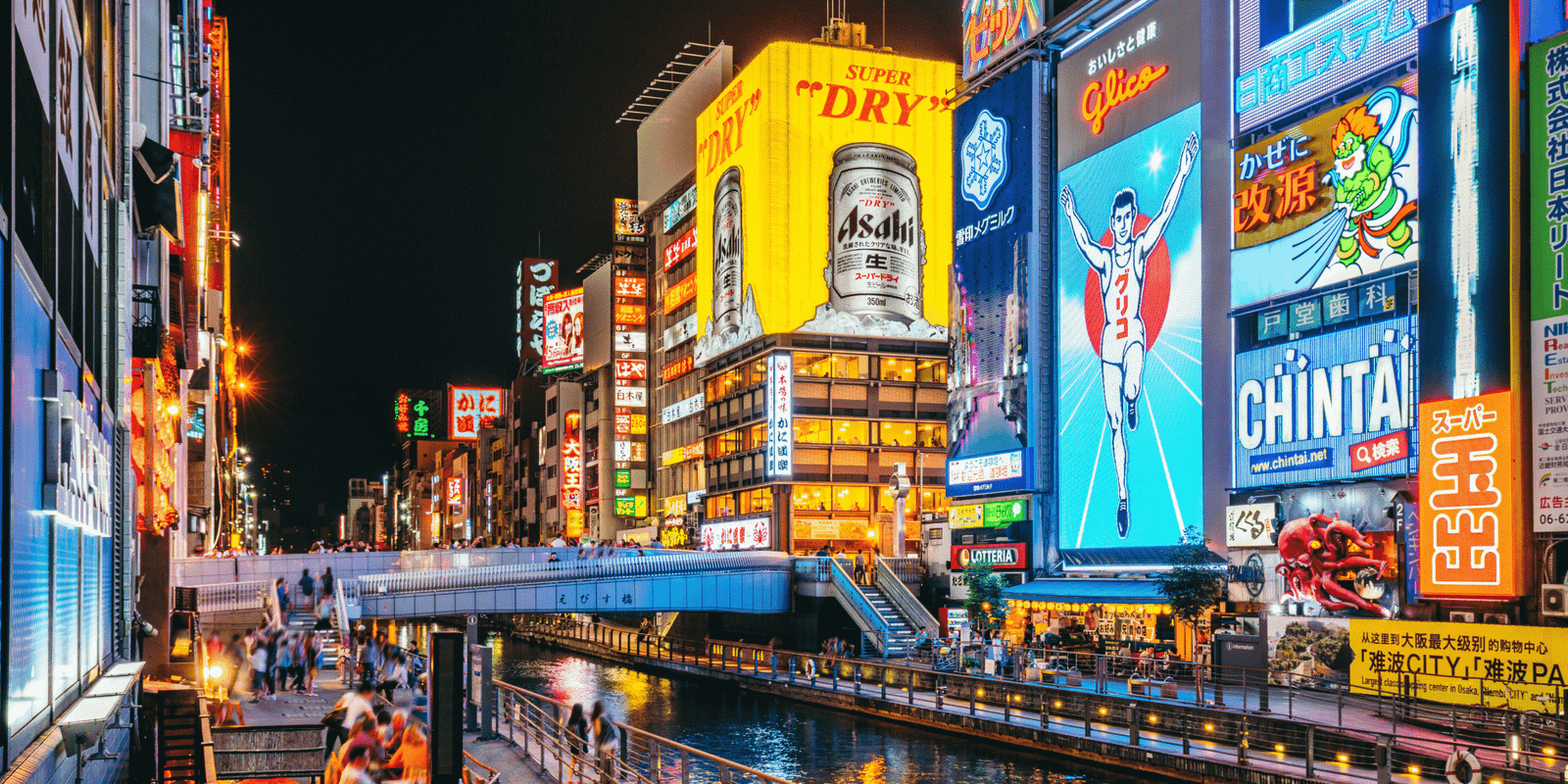
Dotonbori is one of the places that immediately comes to mind when people picture Osaka: giant illuminated signs, crowded streets, takoyaki, restaurants, the canal, and the famous Glico running man overlooking Ebisubashi Bridge.
Located in Osaka’s lively Minami district, Dotonbori is both a major sightseeing destination and one of the city’s best areas for eating, people-watching, shopping, and experiencing Osaka after dark.
It is also extremely convenient for train travelers. Dotonbori sits beside the large Namba transport hub, with access from Osaka Metro, Nankai, Kintetsu, Hanshin, and JR stations.
You do not need an entire day just for Dotonbori. For most first-time visitors, it works best as part of an afternoon and evening exploring Namba and Osaka’s Minami area.
Why Is Dotonbori Worth Visiting?
It’s One of Osaka’s Most Iconic Neighborhoods
Dotonbori is famous for its enormous three-dimensional signs, neon displays, restaurants, and constant street activity.
The best-known landmark is the Glico running man sign beside Ebisubashi Bridge, but you will also see giant crabs, octopuses, dragons, and other extravagant restaurant signs throughout the district.
Few places capture Osaka’s energetic personality as immediately as Dotonbori.
It’s One of Osaka’s Best Places to Eat
Osaka is famous for the idea of kuidaore — enjoying food so enthusiastically that you spend yourself into ruin.
Dotonbori is one of the easiest places to experience that food culture. Takoyaki, okonomiyaki, kushikatsu, ramen, sushi, grilled seafood, desserts, and casual restaurants are packed into a relatively small area.
Rather than planning one enormous meal, I recommend trying several smaller dishes as you walk around.
The Canal Looks Best After Dark
The Dotonbori River runs directly through the entertainment district, with the Tombori Riverwalk following sections of the waterfront.
After sunset, restaurant signs and electronic billboards reflect across the water, creating one of Osaka’s most recognizable nighttime scenes.
You can explore from the riverside promenade, cross the bridges, or see the district from the water on a sightseeing cruise.
There Is More History Than the Neon Suggests
Dotonbori has been an entertainment district for centuries. The canal’s history dates to the early 17th century, and the area later developed around theaters, restaurants, and entertainment.
The Osaka Shochikuza still represents that theatrical tradition, while nearby Hozenji offers a much quieter contrast to the busy streets surrounding it.
It Connects Naturally with Namba & Shinsaibashi
Dotonbori is not an isolated attraction. It sits between some of central Osaka’s busiest shopping, dining, and entertainment districts.
You can easily combine it with Namba, Shinsaibashi, Hozenji, Amerikamura, and the surrounding Minami area without spending much time on transportation.
Train Travel Japan Tip: I would not make Dotonbori your first stop early in the morning. Visit other Osaka attractions during the day, then come to Namba in the late afternoon and stay through the evening when the signs, canal, restaurants, and crowds give the district its characteristic atmosphere.
Dotonbori at a Glance
| Planning Detail | What to Know |
|---|---|
| Area | Minami, central Osaka |
| Nearest Major Transport Hub | Namba |
| Best Known For | Food, neon signs, Glico sign, canal and nightlife |
| Best Time to Visit | Late afternoon through evening |
| Suggested Time | 2–4 hours |
| Best Combined With | Namba, Shinsaibashi and Hozenji |
| Getting Around | Walking |
My recommendation: Give Dotonbori at least one evening on your first Osaka trip. Come hungry, explore the canal and side streets on foot, try a few local foods, and stay long enough to see the district fully illuminated after dark.
How to Get to Dotonbori
Dotonbori is located immediately north of the large Namba transportation hub in central Osaka.
The easiest station for most visitors is Osaka Metro Namba Station, served by the Midosuji, Sennichimae, and Yotsubashi lines.
However, several different railway companies have stations called Namba, so it helps to understand which one you are arriving at.
| Station | Railway | Convenience for Dotonbori |
|---|---|---|
| Osaka Metro Namba | Midosuji / Sennichimae / Yotsubashi | Excellent — one of the closest options |
| Osaka-Namba | Kintetsu / Hanshin | Excellent — very close to Dotonbori |
| Nankai Namba | Nankai Railway | Very good — convenient from Kansai Airport |
| JR Namba | JR West | Useful, but farther west than the other Namba stations |
Important: Don’t assume every station called “Namba” is in exactly the same place. The station complex is large, so allow a few extra minutes to follow signs and find the correct exit.
From Shin-Osaka Station to Dotonbori
If you arrive in Osaka by Shinkansen, the easiest route is the Osaka Metro Midosuji Line.
- Arrive at JR Shin-Osaka Station.
- Follow signs for the Osaka Metro Midosuji Line.
- Take a southbound train toward Nakamozu or Tennoji.
- Ride directly from Shin-Osaka (M13) to Namba (M20).
- Walk north toward Dotonbori and Ebisubashi.
The Metro ride takes approximately 15 minutes and requires no transfer.
Japan Rail Pass users: The Osaka Metro is not covered by the Japan Rail Pass. Even if your Shinkansen journey to Shin-Osaka is covered, you need to pay separately for the Metro ride to Namba.
From Osaka Station / Umeda to Dotonbori
Osaka Station and Umeda form another large transportation district in northern central Osaka.
From JR Osaka Station, follow signs toward Osaka Metro Umeda Station.
- Walk from JR Osaka Station to Osaka Metro Umeda.
- Take the Midosuji Line southbound.
- Get off at Namba (M20).
- Walk to Dotonbori.
The Metro journey from Umeda to Namba takes only about 8 minutes.
Train Travel Japan Tip: Don’t take a taxi from Osaka/Umeda just because Dotonbori looks far away on a city map. The direct Midosuji Line is usually faster, simpler, and much cheaper.
From Kyoto to Dotonbori
There are several ways to travel from Kyoto, but two routes are particularly useful for train travelers.
Option 1 — JR to Osaka + Metro
- Take a JR Special Rapid train from Kyoto Station to Osaka Station.
- Walk to Osaka Metro Umeda Station.
- Take the Midosuji Line directly to Namba.
- Walk to Dotonbori.
The JR journey from Kyoto to Osaka takes roughly 30 minutes, followed by the short Metro ride to Namba.
Option 2 — Shinkansen via Shin-Osaka
- Take the Shinkansen from Kyoto to Shin-Osaka.
- Transfer to the Osaka Metro Midosuji Line.
- Take the Metro directly to Namba.
This can be useful if you already have an eligible JR rail pass, although the Metro section still requires a separate fare.
Which route should you choose? Without a rail pass, I would usually take the JR conventional train to Osaka rather than paying extra for a very short Shinkansen ride. With a valid rail pass, traveling via Shin-Osaka can also be convenient.
From Kansai International Airport to Dotonbori
For Dotonbori and Namba, the Nankai Railway is usually the simplest airport route.
Limited Express Rapi:t
The Nankai Limited Express Rapi:t travels directly from Kansai-Airport Station to Nankai Namba Station.
The fastest services take approximately 34 minutes, and all Rapi:t seats are reserved.
Nankai Airport Express
The regular Airport Express also runs directly to Namba and takes approximately 45 minutes.
It is slower and less luxurious than the Rapi:t but does not require a limited-express reservation.
From Nankai Namba Station, allow roughly 10 minutes on foot to reach the central Dotonbori area, depending on your exit and walking speed.
Airport tip: If your hotel is in Namba or Dotonbori, the Nankai Railway is usually much more convenient than traveling first to Shin-Osaka or Osaka Station and then crossing the city.
Arriving through Kansai Airport? See our complete Kansai Airport transport guide comparing Nankai Rapi:t, Airport Express, HARUKA, buses and other options.
Which Namba Station Is Best for Dotonbori?
Best overall: Osaka Metro Namba or Osaka-Namba on the Kintetsu/Hanshin lines.
Best from Kansai Airport: Nankai Namba.
Best if arriving by JR: JR Namba works, but it is farther from the central Glico/Ebisubashi area than the other Namba stations.
Kintetsu Osaka-Namba is only a few minutes on foot from central Dotonbori, while the Nankai terminal is farther south but still comfortably walkable.
Navigation tip: Namba’s underground passages can be confusing on a first visit. Rather than memorizing one specific exit number, use your map app once you reach Namba and follow signs toward Dotonbori or Ebisubashi.
Is Dotonbori Covered by the Japan Rail Pass?
There is no JR station directly at Dotonbori.
The Japan Rail Pass can cover the JR portion of your journey to Osaka, Shin-Osaka, or JR Namba, but it does not cover Osaka Metro, Nankai, Kintetsu, or Hanshin trains.
In practice, paying for a short Metro ride is usually the easiest way to reach Dotonbori even when you have a Japan Rail Pass.
My recommendation: Don’t design your Osaka sightseeing around using only JR trains just because you have a rail pass. The Midosuji Line connects Shin-Osaka, Umeda, Shinsaibashi, Namba, and Tennoji directly and is often the most convenient way to move through central Osaka.
Staying near Namba? If you are traveling with family or staying several nights, see my guide to Osaka hotels with in-room kitchens for practical apartment-style options near Namba and Shin-Osaka.
Best Things to Do in Dotonbori
Dotonbori is not really a neighborhood where you need to rush from attraction to attraction.
Much of the experience comes from simply walking beside the canal, exploring the side streets, trying local food, and watching the enormous signs light up after dark.
For a first visit, however, there are several places I would make sure you don’t miss.
1. Take the Classic Glico Sign Photo at Ebisubashi
The most famous landmark in Dotonbori is the Glico running man, overlooking the canal beside Ebisubashi Bridge.
The sign has become one of Osaka’s defining images, and Ebisubashi is usually packed with visitors taking photographs in front of it.
The view becomes especially striking after dark when the Glico sign and surrounding billboards illuminate the canal.
Photography tip: Instead of taking only the standard photo from the middle of Ebisubashi, walk down to the riverside promenade. You can often frame the Glico sign together with the canal and surrounding lights from a different angle.
2. Walk Along the Tombori Riverwalk
The Tombori Riverwalk runs beside sections of the Dotonbori River below street level.
It gives you a different perspective from the busy shopping streets above and is one of the easiest ways to enjoy the canal scenery.
In the evening, the reflections from electronic signs, restaurant lights, bridges, and passing boats make this one of the most atmospheric walks in central Osaka.
Walk both sides of the canal rather than staying only around Ebisubashi. The crowds become noticeably lighter once you move away from the most famous photo spot.
3. Take the Tombori River Cruise
If you want to see Dotonbori from a different perspective, consider the Tombori River Cruise.
The sightseeing cruise lasts approximately 20 minutes and travels along the Dotonbori River, passing beneath several bridges while a guide introduces the area.
Looking upward at the enormous signs and crowded riverwalk from water level is very different from seeing them from the street.
| Tombori River Cruise | Current Information |
|---|---|
| Duration | About 20 minutes |
| Adult Fare | ¥2,000 |
| Student Fare | ¥1,000 |
| Elementary School Child | ¥500 |
| Boarding Point | Tazaemonbashi Pier |
The boarding point is beside the Dotonbori Don Quijote store, easily recognizable by its large yellow Ferris wheel.
Cruises generally depart at regular intervals when operating, but schedules can change because of weather, events, maintenance, or seasonal operating arrangements.
Important: Popular evening departures can sell out. Check current availability earlier in the day if taking the cruise is a priority, rather than waiting until you arrive after sunset.
4. Look for Dotonbori’s Giant Restaurant Signs
Part of the fun of Dotonbori is spotting the oversized signs competing for your attention above the streets.
The most famous include the giant moving Kani Doraku crab, along with enormous octopuses, dragons, kushikatsu characters, and other elaborate displays.
These are not simply advertisements — they have become part of Dotonbori’s visual identity.
Don’t worry about following a checklist. Walk slowly and see how many unusual signs you discover.
5. Escape the Crowds at Hozenji Temple
Only a few minutes from Dotonbori’s neon signs is Hozenji Temple, a small temple that feels remarkably peaceful compared with the surrounding entertainment district.
Its best-known feature is the Mizukake Fudoson statue. Visitors pour water over the statue while praying, and over many years it has become almost completely covered in green moss.
The transition from crowded Dotonbori to this quiet temple is one of the most interesting contrasts in the Minami district.
6. Walk Through Hozenji Yokocho
Beside Hozenji Temple is Hozenji Yokocho, a narrow stone-paved alley lined with traditional restaurants, bars, and small eateries.
The alley developed from food stalls serving visitors to Hozenji and still retains a much more traditional atmosphere than the brightly illuminated streets of Dotonbori.
It is especially atmospheric in the evening when lanterns and restaurant lights illuminate the stone paving.
Train Travel Japan Tip: Don’t leave Minami after seeing only the Glico sign. Walk through Hozenji Yokocho as well. It takes only a few minutes to reach but shows a completely different side of Osaka.
7. See Osaka Shochikuza
Near Ebisubashi stands the distinctive Osaka Shochikuza Theatre.
The theater originally opened in 1923 as Kansai’s first major Western-style theater and reflects Dotonbori’s much older history as an entertainment district.
Today, the theater hosts performances including kabuki, contemporary theater, musicals, concerts, and other productions.
Even if you are not attending a performance, take a moment to look at its unusual European-inspired facade while walking through Dotonbori.
8. Explore the Side Streets
Some of the most enjoyable parts of Dotonbori are not major landmarks at all.
Walk away from the busiest canal-side streets and you will find narrow alleys filled with izakaya, ramen shops, bars, cafés, small restaurants, and quieter corners of old Osaka.
Dotonbori connects almost seamlessly with Namba, Sennichimae, Hozenji, and Shinsaibashi, so there is little reason to follow one rigid route.
Suggested Dotonbori Walking Route
- Arrive at Osaka Metro Namba or Osaka-Namba Station.
- Walk past Osaka Shochikuza toward Ebisubashi.
- Take your Glico sign photos.
- Walk down to the Tombori Riverwalk.
- Take the river cruise if you have tickets.
- Explore the giant restaurant signs and food streets.
- Walk south to Hozenji Temple.
- Explore Hozenji Yokocho.
- Continue toward Namba or north toward Shinsaibashi.
How Much Time Do You Need in Dotonbori?
| Time Available | What You Can Do |
|---|---|
| 1 hour | Glico sign, Ebisubashi and quick canal walk |
| 2 hours | Add Hozenji and explore the main streets |
| 3–4 hours | Add food, river cruise and relaxed exploration |
| Full evening | Dotonbori, Hozenji, Namba and Shinsaibashi at a relaxed pace |
My recommendation: Arrive around late afternoon, explore Dotonbori before sunset, eat as you walk, visit Hozenji, and then return to the canal after dark. Seeing the district both before and after the lights come on gives you a much better feel for Osaka’s Minami area.
What to Eat in Dotonbori
Food is one of the main reasons to visit Dotonbori. The district is packed with restaurants, street-food counters, ramen shops, sushi restaurants, izakaya, cafés, and dessert shops.
On a first visit, I would focus on a few foods strongly associated with Osaka rather than trying to eat at every famous restaurant you see online.
My priorities would be takoyaki, okonomiyaki, and kushikatsu, followed by whatever else looks good as you explore.
1. Takoyaki — The Essential Osaka Street Food
Takoyaki is probably the easiest Osaka specialty to try while exploring Dotonbori.
These round snacks are made from a savory batter cooked in special molds, with a piece of octopus inside each one. They are commonly topped with sauce, mayonnaise, aonori seaweed, and bonito flakes.
Dotonbori has numerous takoyaki stands, and part of the fun is watching the cooks rapidly turn each piece on the hot plate.
Fresh takoyaki can be extremely hot inside, so don’t bite straight into an entire piece immediately after receiving it.
Train Travel Japan Tip: You do not necessarily need to join the longest takoyaki line in Dotonbori. There are many good shops in the Namba area, and trying a place with a shorter queue can save a surprising amount of sightseeing time.
2. Okonomiyaki — Osaka’s Savory Pancake
Okonomiyaki is another Osaka classic and makes a better sit-down meal than takoyaki.
The Osaka style typically combines flour-based batter, dashi, cabbage, and ingredients such as pork, squid, shrimp, cheese, or other toppings.
It is cooked on a hot griddle and usually finished with okonomiyaki sauce, mayonnaise, aonori, and bonito flakes.
At some restaurants, the staff cook it for you. At others, part of the experience may involve cooking or finishing the dish on the hot plate at your table.
Good choice for dinner: If you want one proper Osaka meal rather than several street-food snacks, I would choose okonomiyaki.
3. Kushikatsu — Deep-Fried Skewers
Kushikatsu consists of meat, seafood, vegetables, cheese, and other ingredients placed on skewers, coated in batter and breadcrumbs, and deep-fried.
Shinsekai is particularly famous for kushikatsu, but you will also find many kushikatsu restaurants around Dotonbori and Namba.
Ordering several different skewers makes it easy to try a mixture of ingredients without committing to one large dish.
About the famous “no double dipping” rule: Traditionally, communal sauce containers meant you dipped each skewer only once. Many restaurants now use individual sauce bottles or other serving systems, so simply follow the instructions provided by the restaurant.
4. Ramen
Dotonbori has a huge number of ramen restaurants, making ramen a useful option if you want something fast, inexpensive, and filling.
Unlike takoyaki or okonomiyaki, ramen is not specifically an Osaka specialty, so I would not make a famous Dotonbori ramen shop your highest priority if the queue is extremely long.
If you already plan to eat ramen elsewhere in Japan, use your limited Dotonbori appetite for something more distinctly Osaka.
5. Sushi & Seafood
Dotonbori and nearby Namba have everything from inexpensive conveyor-belt sushi to traditional sushi counters and seafood restaurants.
Sushi can be a good choice for families or groups because everyone can order different items according to their appetite.
Osaka also has its own traditional pressed sushi, or hakozushi, although standard nigiri and modern conveyor-belt sushi are much easier to find around Dotonbori.
6. Pork Buns & Other Quick Snacks
If you still have room between larger dishes, look for steamed pork buns, grilled seafood, gyoza, sweets, soft-serve ice cream, and seasonal snacks.
Dotonbori works particularly well for this style of eating because you can share one item, continue walking, and try something different later.
Don’t Try to Eat Everything at One Restaurant
One of the most enjoyable ways to experience Dotonbori is to eat several smaller things over a few hours.
Simple Dotonbori Food Plan
- Start with one serving of takoyaki to share.
- Explore the canal and main streets.
- Stop for okonomiyaki or kushikatsu as your main meal.
- Walk through Hozenji and nearby side streets.
- Finish with dessert, coffee, or another small snack.
This approach gives you more variety and avoids becoming too full after the first restaurant.
How to Avoid Spending Your Evening in Restaurant Lines
Dotonbori’s most famous restaurants can develop long queues, particularly during dinner hours, weekends, and holiday periods.
1. Don’t Assume the Longest Line Means the Best Food
Some restaurants are famous because they appear repeatedly on social media and travel websites.
Dotonbori and Namba contain hundreds of food options, so walking another block can often lead to a similar meal with much less waiting.
2. Eat Outside Peak Dinner Time
Consider eating your main meal in the late afternoon or later in the evening rather than arriving at the most popular restaurants at the busiest dinner period.
3. Use Side Streets
Restaurants immediately beside the canal and main pedestrian streets receive the most tourist traffic. Explore Hozenji, Sennichimae, and the smaller streets around Namba for additional choices.
4. Be Flexible
Instead of building your entire evening around one specific restaurant, keep two or three possibilities in mind and choose based on the queue when you arrive.
My recommendation: Unless a particular restaurant is an important part of your trip, I would not spend an hour of a short Osaka evening standing in line. Dotonbori’s appeal is the entire food district, not just one famous shop.
Food Etiquette in Busy Dotonbori
Dotonbori can become extremely crowded. When buying street food, avoid stopping suddenly in the middle of the pedestrian flow.
Many food stands provide a small area nearby where customers can eat. Finish your food there when possible and dispose of packaging in the bins provided by the shop.
Carrying food through dense crowds is also inconvenient, particularly when the food is hot or covered in sauce.
Train Travel Japan Tip: Come to Dotonbori hungry, but don’t arrive with a rigid restaurant checklist. Try one or two classic Osaka foods, explore the neighborhood, and let the rest of your meal develop as you walk.
Best Time to Visit Dotonbori
Dotonbori is lively throughout the day, but for a first visit I strongly recommend coming in the late afternoon and staying into the evening.
Arriving before sunset lets you explore the neighborhood while there is still daylight, find your way around the canal and side streets, and then watch the atmosphere change as the illuminated signs begin to dominate the streets.
Dotonbori is particularly memorable after dark, when the lights from the Glico sign, restaurants, and billboards reflect across the river.
| Time | What Dotonbori Feels Like |
|---|---|
| Morning | Quieter, but much less atmosphere and some businesses may not yet be open |
| Afternoon | Good for sightseeing, shopping, photos and exploring side streets |
| Sunset | Excellent transition from daylight to illuminated Dotonbori |
| Evening | Best overall atmosphere for neon, food and nightlife |
| Late Evening | Still lively, but individual restaurant and attraction hours vary |
My Favorite Time: About an Hour Before Sunset
If your Osaka schedule is flexible, arrive in the Dotonbori area roughly one hour before sunset.
Use the daylight period to see Ebisubashi, the Glico sign, Tombori Riverwalk, Hozenji Temple, and the surrounding streets.
Then have food, take a river cruise if you want one, and return to the canal after darkness falls.
This gives you two very different versions of Dotonbori without requiring a separate visit.
Train Travel Japan Tip: Sunset changes dramatically by season, so don’t build your itinerary around a fixed clock time. Check sunset for your travel date and aim to arrive about 45–60 minutes beforehand.
Weekday or Weekend?
Weekdays
If you have a choice, a weekday generally makes sightseeing easier. You still get Dotonbori’s lively atmosphere, but moving through the main pedestrian streets and taking photographs can be more comfortable.
Weekends
Friday and Saturday evenings can feel considerably busier, particularly around Ebisubashi, popular food shops, and the main canal-side streets.
That energy can be fun if nightlife is part of what you want, but allow more time for queues and crowded sidewalks.
If you dislike crowds: Visit on a weekday and arrive before the main dinner period. You can experience Dotonbori in daylight, eat early, and then see the illuminated canal before the area becomes busier later in the evening.
Is Dotonbori Worth Visiting in the Rain?
Yes. Rain does not ruin a Dotonbori visit.
In fact, the illuminated signs reflecting on wet streets and the canal can make the neighborhood especially photogenic after dark.
However, much of Dotonbori itself is outdoors, so bring an umbrella or rain jacket and expect the riverside paths to be wetter underfoot.
If the rain becomes heavy, nearby Shinsaibashi-suji and other covered shopping arcades provide useful places to continue shopping and sightseeing under cover.
Rainy-day tip: Don’t automatically cancel your Dotonbori evening because of light rain. Neon, wet pavement, and reflections on the canal can produce excellent night photographs.
Visiting Dotonbori in Summer
Osaka summers are hot and humid, and Dotonbori’s dense streets can feel especially uncomfortable during the hottest part of the afternoon.
If you visit between June and September, I would avoid planning several hours of outdoor Dotonbori sightseeing in the middle of the day.
Better Summer Strategy
- Spend midday at an indoor attraction or shopping area.
- Stay hydrated throughout the day.
- Take air-conditioned breaks when necessary.
- Come to Dotonbori in the late afternoon or evening.
- Use Osaka Metro instead of making unnecessarily long walks in the heat.
Osaka’s rainy season also generally occurs from early June through late July, although the exact timing varies each year.
Summer recommendation: Dotonbori is actually one of the easier Osaka attractions to shift into the evening. Use the hottest hours for indoor sightseeing and save Minami for later in the day.
Visiting Dotonbori in Winter
Winter evenings can be cold, but Dotonbori remains a good year-round destination.
The colder weather can make walking much more comfortable than Osaka’s humid summer, provided you dress warmly.
Winter also has the advantage of earlier sunsets, so you do not need to wait until late in the evening to see Dotonbori fully illuminated.
Winter Tip
Wear enough layers to stay comfortable outside beside the canal, but remember that restaurants, department stores, trains, and underground shopping areas are heated.
Layers that are easy to remove indoors work better than one extremely heavy outfit.
How Late Should You Stay in Dotonbori?
There is no single closing time for Dotonbori because it is a neighborhood rather than one attraction.
Restaurant, shop, entertainment, and cruise hours all vary. Some businesses remain open late, while others close much earlier.
For most sightseeing-focused visitors, there is no need to stay until midnight just to experience Dotonbori.
A Good First-Time Evening
- Arrive around one hour before sunset.
- Explore Ebisubashi and the canal in daylight.
- Visit Hozenji and nearby side streets.
- Have takoyaki or another small snack.
- Eat your main Osaka meal.
- Return to the canal after dark.
- Take photographs or a river cruise.
- Continue to Namba or Shinsaibashi if you want more nightlife or shopping.
When Should You Avoid Dotonbori?
There is no season when Dotonbori needs to be completely avoided, but there are times when adjusting your visit makes sense.
Very hot summer afternoons: visit later in the day.
Major holiday periods and busy weekend evenings: expect heavier pedestrian traffic and restaurant queues.
Heavy rain or severe weather: move more of your sightseeing indoors and check whether outdoor activities such as river cruises are operating.
My recommendation: For your first visit, choose a weekday evening if possible. Arrive before sunset, eat your way through the neighborhood, explore Hozenji and the riverwalk, and stay until Dotonbori is fully illuminated. That gives you the classic Osaka experience without needing to devote an entire day to the area.
How to Combine Dotonbori with Namba & Shinsaibashi
One of the best things about Osaka’s Minami district is that Dotonbori, Namba, Hozenji, Shinsaibashi, and Amerikamura are all close enough to explore largely on foot.
Instead of taking trains between each neighborhood, treat the entire area as one long sightseeing walk.
For a first visit, I recommend starting around Namba, gradually walking north through Dotonbori and Shinsaibashi, and then returning to Dotonbori after dark if you want to experience the illuminated canal.
Namba — Start Around the Transport Hub
Namba is one of Osaka’s largest shopping and transportation districts and an excellent starting point for exploring Minami.
The area contains department stores, underground shopping streets, restaurants, Namba Parks, Nankai Namba Station, and several Osaka Metro and private railway stations.
You do not need to visit every shopping complex. Use Namba as the starting point and then gradually work your way toward Dotonbori.
Optional: Namba Yasaka Shrine
If you have extra time, make a short detour to Namba Yasaka Shrine.
The shrine is best known for its enormous lion-head stage, measuring roughly 12 meters high.
It is only around a six-minute walk from the Namba Station area and makes an interesting contrast with the commercial streets nearby.
Time-saving tip: If you have only an evening, skip Namba Yasaka Shrine and concentrate on Hozenji, Dotonbori, and Shinsaibashi instead.
Hozenji — The Quiet Transition into Dotonbori
From Namba, walk toward Hozenji Temple and Hozenji Yokocho.
The narrow stone-paved alley and moss-covered Mizukake Fudoson statue provide a surprisingly traditional atmosphere just minutes from Dotonbori’s giant signs.
From Hozenji, continue north toward the Dotonbori River.
Dotonbori — Canal, Food & Neon
Cross into Dotonbori and spend time around Ebisubashi, the Glico sign, Tombori Riverwalk, and the surrounding food streets.
If you arrive before dark, don’t worry that you are too early. Explore the area in daylight, continue north toward Shinsaibashi, and return later once the signs are illuminated.
Train Travel Japan Tip: This is one reason I like arriving in Minami during the afternoon. You can see Dotonbori briefly in daylight, continue sightseeing, then walk back after dark without making a special second trip across Osaka.
Walk from Dotonbori to Shinsaibashi
From Ebisubashi, simply continue north into Shinsaibashi-suji Shopping Street.
The covered shopping arcade extends for roughly 600 meters and contains fashion stores, cosmetics, drugstores, cafés, restaurants, traditional retailers, and major international brands.
Because much of the arcade is covered, this is also a useful part of the route during rain or very strong summer sun.
Don’t Feel You Need to Shop
Shinsaibashi-suji is worth walking through even if you are not planning to buy anything.
The pedestrian traffic, mixture of old and new shops, and continuous arcade make it part of the Minami experience itself.
Optional Detour: Amerikamura
From Shinsaibashi, walk west of Midosuji Avenue into Amerikamura, usually shortened to Amemura.
The neighborhood became associated with imported American clothing and goods in the 1970s and later developed into one of Osaka’s centers for youth fashion, vintage clothing, music, street art, and alternative culture.
The center of the neighborhood is Mitsu Park, better known as Triangle Park.
Amerikamura is most worthwhile if you enjoy vintage clothing, street fashion, record shops, cafés, or simply seeing a less traditional side of Osaka.
Skip it if: Shopping and youth culture are not priorities. Spend the extra time eating and exploring Dotonbori instead.
Half-Day Minami Walking Itinerary
If you have roughly 4–6 hours, this is the route I would use for a first visit.
-
Start at Namba
Explore the station area and Namba Parks if interested. -
Optional — Namba Yasaka Shrine
Take a short detour to see the giant lion-head stage. -
Walk to Hozenji
Visit the temple and stroll through Hozenji Yokocho. -
Enter Dotonbori
See Ebisubashi, the Glico sign, giant restaurant signs, and the canal. -
Try an Osaka snack
Have takoyaki or another small dish rather than a large meal yet. -
Walk north through Shinsaibashi-suji
Browse the covered shopping arcade at your own pace. -
Optional — Amerikamura
Explore Triangle Park, vintage shops, and side streets. -
Return toward Dotonbori
Walk back after sunset. -
Have dinner
Try okonomiyaki, kushikatsu, or another Osaka specialty. -
Finish beside the canal
Enjoy the illuminated signs, riverwalk, or a river cruise.
Shorter Evening Itinerary
If you have only 2–3 hours, don’t try to cover every neighborhood.
- Arrive at Namba in the late afternoon or early evening.
- Walk through Hozenji Yokocho.
- Visit Ebisubashi and photograph the Glico sign.
- Walk along the Tombori Riverwalk.
- Try takoyaki or another small Osaka snack.
- Walk part of Shinsaibashi-suji.
- Return to Dotonbori after dark.
- Finish with dinner or a river cruise.
Best short itinerary: If this is your only evening in Osaka, prioritize Hozenji → Dotonbori → Shinsaibashi → Dotonbori after dark. Namba Yasaka Shrine and Amerikamura are good additions, but neither is essential if time is limited.
What About Kuromon Market?
Kuromon Market is also within walking distance of Namba and Dotonbori and can easily be added earlier in the day.
Known as “Osaka’s Kitchen,” the covered market contains around 150 shops selling seafood, meat, fruit, prepared food, and other products.
I would visit Kuromon during the morning or around lunchtime rather than making it part of a late-evening route, because individual market shops keep different hours and many are oriented toward daytime trade.
Full Minami Day
If you want to spend most of a day in this part of Osaka, a very practical sequence is:
- Kuromon Market
- Namba
- Namba Yasaka Shrine
- Hozenji
- Dotonbori
- Shinsaibashi
- Amerikamura
- Return to Dotonbori after dark
Do You Need the Metro Between These Areas?
Usually, no.
Once you reach Namba or Shinsaibashi, the main Minami sightseeing areas are compact enough that walking is generally more useful than repeatedly entering and exiting subway stations.
Save the Metro for reaching Minami from another part of Osaka or returning to your hotel after sightseeing.
My recommendation: Think of Namba, Dotonbori, and Shinsaibashi as one large walkable district. Start in Namba, explore northward at a relaxed pace, and make Dotonbori your final stop after dark. This is much more enjoyable than treating every neighborhood as a separate destination connected by trains.
Dotonbori Practical Tips & Common Mistakes
Dotonbori is easy to visit, but a little planning can make the experience much more enjoyable — especially during busy evenings.
The biggest issues are usually not transportation or admission tickets. They are crowds, luggage, restaurant queues, confusing Namba stations, and trying to fit too much into one evening.
1. Don’t Bring Large Luggage into Dotonbori
Dotonbori’s sidewalks, bridges, food streets, and riverside areas can become extremely crowded.
Pulling a large suitcase through these streets is inconvenient for you and for everyone walking around you.
If you arrive in Osaka before hotel check-in, leave your luggage at your hotel if possible or use a coin locker or staffed baggage-storage facility around Namba.
Nankai Namba Station has numerous lockers in different sizes as well as staffed storage options nearby.
Train Travel Japan Tip: Store your luggage before starting your Minami sightseeing. Dotonbori, Hozenji, Shinsaibashi, and Namba are much more enjoyable when you can explore freely on foot.
2. Don’t Depend on One Specific Coin Locker
Lockers at busy stations can fill, particularly during weekends, holidays, and popular travel periods.
If the first locker area is full, look for another bank of lockers within the station or use a staffed baggage-storage counter.
Large suitcases may also require larger lockers, which are naturally fewer in number.
Better strategy: If you know you will have luggage, don’t leave only five minutes in your schedule to find storage. Allow extra time before starting sightseeing or catching your next train.
3. Remember Which Namba Station You Used
One of the easiest mistakes to make is assuming that every station called Namba is the same station.
- Osaka Metro Namba — very convenient for Dotonbori.
- Osaka-Namba — used by Kintetsu and Hanshin.
- Nankai Namba — particularly useful for Kansai Airport.
- JR Namba — farther west than central Dotonbori.
If you store luggage in one station, make sure you remember exactly which railway and station area you used before wandering around Minami for several hours.
Simple trick: Take a photo of the locker area, locker number, nearby exit signs, and station name before leaving. Namba’s underground passages can look very different when you return several hours later.
4. Don’t Try to Use Only JR Trains
If you have a Japan Rail Pass, it can be tempting to avoid paying for Osaka Metro.
In central Osaka, that can make sightseeing unnecessarily complicated.
The Midosuji Line directly connects Shin-Osaka, Umeda, Shinsaibashi, Namba, and Tennoji. Paying for a short Metro journey is often much more convenient than designing an indirect JR-only route.
Common mistake: Don’t waste 30 minutes trying to save a small local transit fare simply because your JR Pass covers another, less convenient route.
5. Carry More Than One Payment Option
Major stores and restaurants around Dotonbori commonly accept cards and cashless payments, but payment methods vary between individual businesses.
Smaller food shops, older restaurants, ticket counters, and temporary stalls may have different rules.
Carrying a small amount of Japanese yen in cash alongside your credit card or IC card avoids unnecessary problems.
Practical rule: Don’t assume the payment method you used at one takoyaki shop will automatically work at the next. Check before ordering if you are short on cash.
6. Know Where to Find Toilets & Family Facilities
Large railway stations, department stores, shopping complexes, and major commercial facilities around Namba provide toilets.
Osaka Metro Namba Station also has toilets, multipurpose toilets, elevators, and a nursing room.
If you are traveling with children, use these larger facilities rather than waiting until you are deep inside a crowded food street.
Family tip: Before beginning a long evening walk, use the facilities at Namba Station or a shopping complex. Finding a convenient toilet becomes less relaxing once everyone is hungry and the streets are crowded.
7. Dotonbori with Children
Dotonbori can be fun for families because of the giant signs, riverboats, food stalls, desserts, and bright nighttime atmosphere.
However, the central streets around Ebisubashi can become extremely crowded in the evening.
For Families, I Recommend:
- Arriving before the peak evening crowds.
- Keeping young children close around Ebisubashi.
- Using a compact stroller if one is necessary.
- Taking food breaks before children become overtired.
- Avoiding unnecessarily long restaurant queues.
- Knowing which Namba station you will use to return to your hotel.
Families do not need to stay extremely late. Arriving before sunset and staying until the lights come on is usually enough to experience Dotonbori’s nighttime atmosphere.
8. Don’t Stop in the Middle of Busy Walkways
Ebisubashi and the main Dotonbori streets can carry a huge volume of pedestrian traffic.
If you need to check your phone, organize your group, eat something, or decide where to go next, move toward the side rather than stopping suddenly in the middle of the flow.
This is particularly important if you are traveling as a family or larger group.
9. Don’t Spend the Entire Evening in Restaurant Lines
Some famous Dotonbori restaurants attract long queues simply because they appear frequently on social media and travel websites.
Unless one particular restaurant is essential to your trip, be flexible.
Walk another street, check a second restaurant, or eat outside the busiest dinner period. There are far too many food choices in Namba and Dotonbori to spend most of a short visit standing in one line.
My rule: I would rather spend an extra 45 minutes exploring Osaka than spend those 45 minutes waiting for a dish that has several good alternatives nearby.
10. Don’t Try to See All of Osaka from Dotonbori
Dotonbori combines naturally with Namba, Hozenji, Shinsaibashi, Amerikamura, and Kuromon Market.
It does not make sense to keep bouncing between Minami and distant attractions elsewhere in Osaka during the same few hours.
Good Geographic Combination
Kuromon Market → Namba → Hozenji → Dotonbori → Shinsaibashi → Amerikamura → Dotonbori after dark
Less Efficient
Dotonbori → Osaka Castle → Dotonbori → Umeda → Shinsaibashi → Dotonbori
Group attractions by neighborhood and use the Metro only when moving to another part of Osaka.
11. Don’t Visit Only for the Glico Photo
The Glico sign is iconic, but Dotonbori is much more interesting when you explore beyond Ebisubashi.
Walk along the river, look at the giant restaurant signs, visit Hozenji, explore the side streets, and try some local food.
Even an extra hour changes Dotonbori from a quick photo stop into an actual Osaka experience.
12. Have a Backup Plan for Bad Weather
Light rain is usually manageable and can make Dotonbori’s nighttime reflections especially attractive.
During heavier rain, move more of your time into Shinsaibashi-suji, Namba’s underground shopping areas, department stores, restaurants, cafés, and other covered spaces.
River cruises may also be affected by poor weather, so do not build your entire evening around one outdoor activity.
Quick Dotonbori Checklist
- Store large luggage before sightseeing.
- Know which Namba station you need.
- Carry some cash as a backup.
- Wear comfortable walking shoes.
- Arrive before sunset if possible.
- Don’t spend too long in famous restaurant queues.
- Explore Hozenji and the side streets, not only Ebisubashi.
- Use Osaka Metro when it is more practical than JR.
- Keep children close during busy evening periods.
- Check the last train if you are staying outside central Osaka.
My recommendation: Keep your Dotonbori visit simple. Arrive without heavy luggage, explore Minami on foot, eat wherever looks good without becoming obsessed with one famous restaurant, and give yourself enough time to wander. Dotonbori is much more enjoyable when it is not treated like a tightly scheduled checklist.
Dotonbori FAQ
Is Dotonbori worth visiting?
Yes. Dotonbori is one of Osaka’s most distinctive neighborhoods, especially if you want to experience the city’s food culture, nightlife, canal scenery, giant signs, and busy street atmosphere.
It is particularly worthwhile on a first trip to Osaka.
What is Dotonbori famous for?
Dotonbori is best known for the Glico running man sign, giant restaurant displays, the Dotonbori River, street food, restaurants, and nightlife.
It has also been an entertainment district for centuries, with theaters and restaurants forming an important part of its history.
What is the nearest station to Dotonbori?
Osaka Metro Namba Station and Osaka-Namba Station are among the most convenient options for central Dotonbori.
Nankai Namba is also convenient, particularly if you are arriving from Kansai International Airport.
How long should you spend in Dotonbori?
Allow around 2–4 hours for a first visit.
That gives you enough time to see the canal and Glico sign, try local food, visit Hozenji, and explore some of the surrounding streets without rushing.
Is Dotonbori better during the day or at night?
Dotonbori is most atmospheric after dark, when its signs and billboards illuminate the canal.
My favorite approach is to arrive before sunset so you can see the area in daylight and then stay until the lights come on.
Is Dotonbori free to visit?
Yes. Dotonbori is a public neighborhood, so there is no admission fee to walk around the canal, Ebisubashi, Hozenji, or the surrounding streets.
You only pay for food, shopping, cruises, entertainment, or other optional activities.
How do you get from Shin-Osaka to Dotonbori?
Take the Osaka Metro Midosuji Line directly from Shin-Osaka to Namba.
The Metro ride takes roughly 15 minutes, followed by a short walk to Dotonbori.
Does the Japan Rail Pass cover travel to Dotonbori?
Not directly.
The Japan Rail Pass can cover eligible JR trains to Osaka, Shin-Osaka, or JR Namba, but it does not cover Osaka Metro, Nankai, Kintetsu, or Hanshin.
For most visitors, paying separately for the short Metro ride to Namba is the easiest option.
What food should you try in Dotonbori?
Start with takoyaki and okonomiyaki, two of Osaka’s best-known specialties.
Kushikatsu is another good option, while ramen, sushi, seafood, pork buns, and desserts are also easy to find.
Is the Dotonbori river cruise worth it?
It can be, especially on a first visit.
The Tombori River Cruise takes about 20 minutes and gives you a different view of the signs, bridges, riverwalk, and crowds from water level.
If your time is limited, however, walking the riverfront is already enough to experience Dotonbori well.
Can you walk from Dotonbori to Shinsaibashi?
Yes. Dotonbori and Shinsaibashi are directly connected by the central Minami shopping district.
From Ebisubashi, simply walk north into Shinsaibashi-suji Shopping Street.
Can you walk from Dotonbori to Kuromon Market?
Yes. Kuromon Market is within comfortable walking distance of Dotonbori and Namba.
I recommend visiting the market earlier in the day and saving Dotonbori for the late afternoon and evening.
Is Dotonbori good for families?
Yes, particularly earlier in the evening. Children often enjoy the giant signs, riverboats, food stalls, desserts, and bright atmosphere.
However, the area around Ebisubashi can become extremely crowded, so keep young children close and avoid the busiest periods if large crowds are difficult for your family.
Can you visit Dotonbori with luggage?
You can, but I strongly recommend storing large luggage first.
Namba has coin lockers and staffed baggage-storage options, and sightseeing is much easier without pulling a suitcase through crowded pedestrian streets.
What should you combine with Dotonbori?
The easiest nearby combination is Namba, Hozenji, Shinsaibashi, Amerikamura, and Kuromon Market.
These areas are close enough to explore largely on foot, making them much more efficient to combine than attractions elsewhere in Osaka.
Is Dotonbori safe at night?
Dotonbori is a very busy entertainment district and remains heavily populated into the evening.
As in any crowded nightlife area, keep normal awareness of your belongings, avoid following aggressive touts, and know how you are getting back to your accommodation.
Train Travel Japan Tip: Dotonbori does not need to consume an entire Osaka day. Give it one good afternoon or evening, combine it with Namba and Shinsaibashi, and spend the rest of your Osaka time exploring other parts of the city.
Related Guides
Himeji Castle, Hyogo
Himeji is an easy rail trip west of Osaka and one of the best castle day trips to add to a Kansai itinerary.
JR Regional Passes Guide
Compare regional rail passes that can be useful for exploring Osaka, Kyoto, Nara, Himeji, Okayama, Hiroshima, and other destinations across western Japan.
Japan Rail Pass Guide
Learn what the nationwide Japan Rail Pass covers and where separate local transportation, such as Osaka Metro, is still needed when sightseeing in Osaka.
Before You Buy a JR Pass
Compare the cost of your planned train journeys with the current JR Pass price. Depending on your route, individual tickets or a regional pass may offer better value.
Check Current JR Pass PricesAbout Train Travel Japan
Train Travel Japan is written from firsthand experience traveling throughout Japan by rail. I am a Japanese native based in Canada and have traveled to all 47 prefectures of Japan over more than 30 years.
My goal is to make Japan train travel easier to understand, especially for international visitors planning JR Pass trips, regional rail journeys and independent itineraries.