
The most useful way to compare scenic train rides in Japan is to start with your itinerary, not a ranking. A short river-valley excursion near Kyoto and a five-hour coastal journey in northern Honshu can both be memorable, but they ask very different things of your trip.
This guide compares five rides by departure area, scenery, time on the train, booking requirements and how naturally they fit into an ordinary holiday. Four are named sightseeing or premium trains; the fifth, Hakone’s mountain railway, shows that a scenic ride does not have to be a special reserved-seat service.
If you want a broader regional list, start with our sightseeing trains in Japan hub. Use this comparison when you are ready to choose one.
Quick answer: which ride fits your trip?
- Already visiting Kyoto and Arashiyama? Look first at the Sagano Romantic Train.
- Planning Hakone? Use the Hakone Tozan Train as part of the visit, rather than adding a separate scenic-train destination.
- Want a premium coastal escape from Tokyo? Consider Saphir Odoriko with an Izu overnight stay.
- Already exploring Akita and Aomori? Give Resort Shirakami a proper travel day.
- Travelling between Fukuoka and Yufuin? Check Yufuin no Mori before fixing your departure time.
These are itinerary-based recommendations, not an objective ranking of Japan’s scenery.
Five scenic train rides compared
Train time and total outing time are different. The ride times below refer to the stated rail segment. The suggested commitment is our planning allowance, not an operator guarantee; it includes time for the destination and, where indicated, access travel. Check the exact service and date before booking.
| Ride | Departure area / segment | Scenery | Approximate rail time, one way | Suggested commitment | Booking style |
|---|---|---|---|---|---|
| Sagano Romantic Train | Kyoto: Torokko Saga – Torokko Kameoka | Hozu River gorge and wooded valley | About 25 minutes | Half an Arashiyama day, including access and the return plan | Book the train and seat; check operating calendar |
| Hakone Tozan Train | Hakone-Yumoto – Gora | Forested mountain slopes and switchbacks | About 40 minutes | Half a day locally; a full day or overnight if coming from Tokyo | Ordinary local mountain train; not a premium seat-reservation product |
| Saphir Odoriko | Tokyo – Izukyu-Shimoda, via Yokohama and Atami | Coastal scenery on the approach to and along eastern Izu | 2 hours 29 minutes on the daily outbound example | Preferably an Izu overnight; a same-day return needs careful planning | Reserved Green Car or higher accommodation |
| Resort Shirakami | Akita – Aomori area via the Gono Line; some services end at Hirosaki | Sea of Japan coast and rural Tohoku | About 5 hours for the full Akita – Aomori journey; varies by service | A full travel day within a northern Japan itinerary | Reserved seats only; selected operating dates |
| Yufuin no Mori | Hakata – Yufuin; selected service continues to Beppu | Kyushu countryside and mountains | About 2 hours 10-25 minutes to Yufuin in the published examples | A full day from Fukuoka or, more comfortably, a Yufuin overnight | Reserved seats only; confirm train identity and calendar |
Time references: Sagano operator overview; Hakone Navi access information; Saphir timetable; JR East’s Resort Shirakami route account; JR Kyushu’s Yufuin no Mori timetable. Checked October 16, 2026. Resort Shirakami’s five-hour figure is approximate; confirm the current calendar and exact departure separately.
1. Sagano Romantic Train: the straightforward Kyoto addition
Choose the Sagano scenic train in Kyoto when Arashiyama is already on your route. Its short journey through the Hozu River valley is an excursion, not a transfer between Kyoto and another major city.
Do not confuse Torokko Saga with JR Saga-Arashiyama, or Torokko Kameoka with JR Kameoka. For a one-way ride toward Kameoka, the operator gives a walk of about 10 minutes from Torokko Kameoka to JR Umahori. Build that walk into a return by ordinary JR train. See the official station access.
Family fit: The brief ride is a useful starting point for children who have not tried a sightseeing train. Station choice matters: the operator lists 60 steps and no lift at Torokko Arashiyama. It also lists a nursing room at Torokko Saga. Check access needs before choosing where to board.
Booking: The operator sells reserved-seat tickets, with limited same-day standing tickets when seats sell out. For families, reserve seats rather than making standing availability your plan. Advance online sales open at midnight Japan time one month before the ride, under the current Sagano FAQ. The nationwide JR Pass is not valid for this train.
If it does not fit: Keep your Arashiyama visit and use ordinary JR transport. You can still enjoy the area without making the sightseeing train the condition for a successful day. Our Kansai sightseeing-train guide covers other regional choices.
2. Hakone Tozan Train: scenery built into local transport
The Hakone-Yumoto to Gora mountain section is a good reminder that scenic train routes in Japan are not limited to branded luxury services. The railway climbs through forested slopes using three switchbacks, according to the official Hakone transport guide.
Choose it when you want Hakone’s scenery, museums or hot-spring accommodation as well as a train ride. If you arrive from outside Hakone, allow for reaching Hakone-Yumoto first; the roughly 40-minute mountain ride is not the travel time from central Tokyo.
Family fit: As a planning judgement, the shorter ride and ability to organise a modest local outing make this easier to scale down than an all-day rail excursion. Crowding can still make it tiring. Allow time for a later departure if the first train is uncomfortable, and check station access if you use a stroller or wheelchair.
Booking and budget: This is an ordinary mountain-railway journey rather than a reserved premium-train experience. Compare single fares with the Hakone tickets or passes that cover the rest of your actual route; do not buy a pass simply for its name. The mountain railway is separate from the onward cable car and ropeway. Do not promise a Mount Fuji view from the railway itself.
If it does not fit: Shorten the Hakone visit rather than forcing a complete sightseeing loop. A mountain-train ride and one stop can be enough. For an overnight alternative, compare our Hakone hotels with private open-air baths, checking each property’s actual station connection.
3. Saphir Odoriko: choose it for an Izu stay, not a rushed turnaround
Saphir Odoriko combines a journey toward the Izu coast with an intentionally premium train interior. JR East confirms Green Car accommodation throughout, with Premium Green seats and private Green compartments among the options. There is no Ordinary Car option. See the official train overview.
It works naturally when Izu is a destination in its own right. The published daily Saphir Odoriko 1 leaves Tokyo at 11:00 and reaches Izukyu-Shimoda at 13:29. The daily Saphir Odoriko 2 returns from Shimoda at 14:18. Pairing those two daily trains on the same day leaves only 49 minutes at Shimoda, before allowing for boarding. That is a train-focused turnaround, not a relaxed visit. Other services or a different return train may help, but an overnight stay is the simpler recommendation. Check the date-specific timetable.
Family fit: Private compartments provide a group option, but cost the actual party configuration before choosing one. A private room is not automatically the cheapest or most convenient solution.
Booking and budget: JR East’s ticket page lists regular Green and Premium Green bookings online, while private compartments use JR ticket offices or suitable reserved-seat machines. As a reference, the linked March 2026 fare table lists Tokyo-Shimoda standard-period adult totals of ¥10,540 in regular Green and ¥12,940 in Premium Green. Date, destination and accommodation affect the quote.
If it does not fit: Price a regular Odoriko service for the Izu trip and spend the difference where it matters to your family. For the full seat, route and booking explanation, use our detailed Saphir Odoriko guide.
4. Resort Shirakami: a full coastal travel day in Tohoku
Choose Resort Shirakami when northern Honshu is already part of your holiday and the rail journey is one of the day’s main activities. Its Gono Line route follows the Sea of Japan side of Tohoku. JR East lists Akita-Aomori services as well as services between Akita and Hirosaki; check the endpoint of the specific train.
The full journey is roughly five hours, rather than a quick side trip. JR East’s route account gives 5 hours 10 minutes for its example. Treat that as a scale-of-journey guide, not a promise for every departure. Use the operator’s linked current timetable and calendar for the exact train and day.
Family fit: JR East documents box seating and observation/event spaces on the Buna train. Those are useful features to consider, not proof that a five-hour ride suits every child. Pack food and quiet activities, and do not promise a particular performance: events vary by date and route.
Booking: All seats are reserved. JR East requires a basic fare ticket or valid pass plus the reserved-seat ticket. Eligible passes valid for the route can include the reservation without an extra charge, but you must still reserve. See official Resort Shirakami information.
If it does not fit: Choose a shorter segment only after checking both onward and return connections. Do not assume frequent local trains will make an improvised return easy. If your trip is limited to Tokyo, Kyoto and Osaka, save this ride for a northern Japan itinerary. Our Tohoku and Kanto sightseeing-train guide provides regional context.
5. Yufuin no Mori: turn a Kyushu transfer into the experience
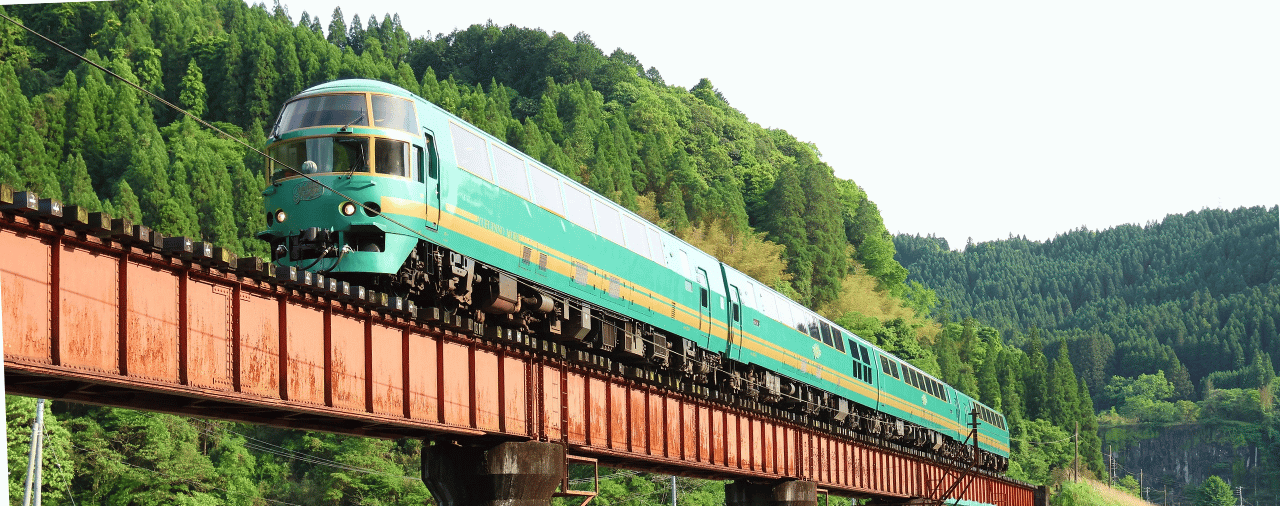
Yufuin no Mori makes particular sense when you already plan to travel from Hakata, Fukuoka’s main intercity station, to Yufuin. The green resort train runs through Kyushu countryside, with a warm wood-toned interior. In JR Kyushu’s published timetable, Hakata-Yufuin departures take around 2 hours 12 minutes to 2 hours 21 minutes; the longer service continues to Beppu.
Rather than returning immediately, consider making Yufuin an overnight stop. That is an itinerary recommendation, not a requirement of the train ticket.
Family and access fit: JR Kyushu recommends reservable table booths for parties of three or four. It also warns of boarding steps and narrow aisles. Contact the operator in advance about mobility requirements instead of assuming the resort-style interior is step-free.
Booking: All seats are reserved. Check the calendar as well as the departure time: on some dates, the ordinary Yufu train runs in place of Yufuin no Mori. A matching timetable does not guarantee the named green sightseeing train. Use the official train page and operating calendar.
If it does not fit: Check the regular Yufu or another route offered by JR Kyushu. Preserve the destination plan even if the special train is unavailable. For more choices in the same region, see our Kyushu sightseeing-train guide.
Reservations and rail passes: five different situations
“Scenic” describes the experience, not the ticket rules. Compare the exact operator, route, seat category and booking channel before buying a pass or paying for a premium seat.
| Ride | What to remember |
|---|---|
| Sagano Romantic Train | Separate sightseeing-train ticket; nationwide JR Pass is not accepted. Reserve the seat you need. |
| Hakone Tozan Train | Local railway fare or a suitable Hakone ticket/pass, rather than a special luxury-train reservation. Check which transport your chosen pass covers. |
| Saphir Odoriko | An Ordinary nationwide JR Pass does not provide a complete Green Car ticket. Seat-class charges and the non-JR Ito-Shimoda section need separate consideration; Premium Green and private compartments have additional rules. |
| Resort Shirakami | Reserved-seat ticket required even with a valid eligible pass; coverage does not reserve a seat automatically. |
| Yufuin no Mori | Reserved seats only. All Kyushu and Northern Kyushu passes cover eligible travel, not Southern Kyushu. The pass holder’s advance online booking option can carry an extra fee. |
For Saphir, consult the nationwide pass’s route rules and accommodation rules. For Yufuin no Mori, JR Kyushu currently lists a ¥1,500 adult Design & Story train advance online reservation charge per section for its KRP Option service, with half-price child charges. Reservations made in Kyushu can be free within the relevant pass’s limits. This is a booking-channel distinction, not a statement that every ticket costs an extra ¥1,500. Check the current JR Kyushu pass conditions.
Do not buy a nationwide or regional pass solely because a scenic train appears in a covered-train list. Compare the whole route with individual tickets, including non-JR sections, booking charges and the days you will actually travel.
How to fit one ride into your itinerary
For a first Tokyo-Kyoto-Osaka trip
Sagano is the easiest first shortlist if Arashiyama is already planned. Hakone works when you actively want a Hakone visit. Izu means a different side trip; decide what you would remove before adding it. Yufuin no Mori and Resort Shirakami belong to different regional plans, rather than being quick additions to the classic route.
For a trip with children
Choose the total outing, not just the train. A 25-minute ride can still create a long day once you add access, queues and lunch. A scenic train with a reserved seat can reduce uncertainty, but it does not remove the need to check stairs, toilets, luggage space and meal plans. Our family train-travel guide explains the wider planning issues.
For a premium experience
Decide whether the extra payment is for the scenery, the seat, privacy or dining. These are different reasons to book. A regular train may share much of a route’s landscape, while a private compartment changes the onboard experience. Check dining separately; do not assume a seat ticket includes a meal.
For flexible or weather-sensitive travel
Keep one ordinary-transport alternative. Rain can change the view, and severe weather or operational changes can affect the service. Avoid a tight flight or other critical connection after an excursion. If you are taking a short side trip, leaving large luggage at your main hotel can simplify it, subject to the hotel’s agreement.
A short checklist before booking
- Match the region. Is the departure point already on your route, or are you adding a major detour?
- Count the full day. Add station access, the return or onward journey, meals and destination time.
- Check the named service. Confirm operating date, endpoint, carriage and any substitution.
- Reserve correctly. A rail pass, seat reservation and dining reservation may be three separate things.
- Check family and access needs. Look at the precise boarding station and train facilities, not a general “family-friendly” label.
- Keep a fallback. Know whether you would use an ordinary train, move the outing or skip it.
FAQ: choosing scenic train rides in Japan
Which are the best train journeys in Japan for a first trip?
The best choice is usually a ride near places you already intend to visit. For the five compared here, Sagano fits Kyoto and Hakone’s railway fits a Hakone visit. An Izu overnight makes Saphir more purposeful. The northern and Kyushu options are better when those regions are part of the holiday.
Can you enjoy scenery without booking a sightseeing train?
Yes. Hakone’s ordinary mountain railway is one example. Elsewhere, compare local or regular limited express services along the route you want. The scenery may overlap with a special service, but seating, stopping patterns, comfort and travel time can differ.
Do all scenic trains run every day?
No. Named services can have seasonal calendars, non-operating dates or replacement trains. Check the actual travel date on the official operator’s site before making non-refundable arrangements.
Should you choose a special train if it makes the itinerary harder?
Only if that train is genuinely a priority. Otherwise, a scenic ride that fits a planned destination is usually more useful than a famous one that adds another hotel move and a long detour.
Start with your route, choose the amount of rail time you will enjoy, then check seats and tickets. That approach makes a scenic train part of the holiday rather than another complicated task to fit into it.
Official operator information checked October 16, 2026. Timetable examples, booking fees and fares are not live availability or quotes for your chosen date. Confirm current calendars, service status, accessibility arrangements and ticket conditions before booking.
Before You Buy a JR Pass
Compare the cost of your planned train journeys with the current JR Pass price. Depending on your route, individual tickets or a regional pass may offer better value.
Check Current JR Pass PricesAbout Train Travel Japan
Train Travel Japan is written from firsthand experience traveling throughout Japan by rail. I am a Japanese native based in Canada and have traveled to all 47 prefectures of Japan over more than 30 years.
My goal is to make Japan train travel easier to understand, especially for international visitors planning JR Pass trips, regional rail journeys and independent itineraries.
Affiliate disclosure: This article contains affiliate links. If you book through these links, I may earn a commission at no additional cost to you.