
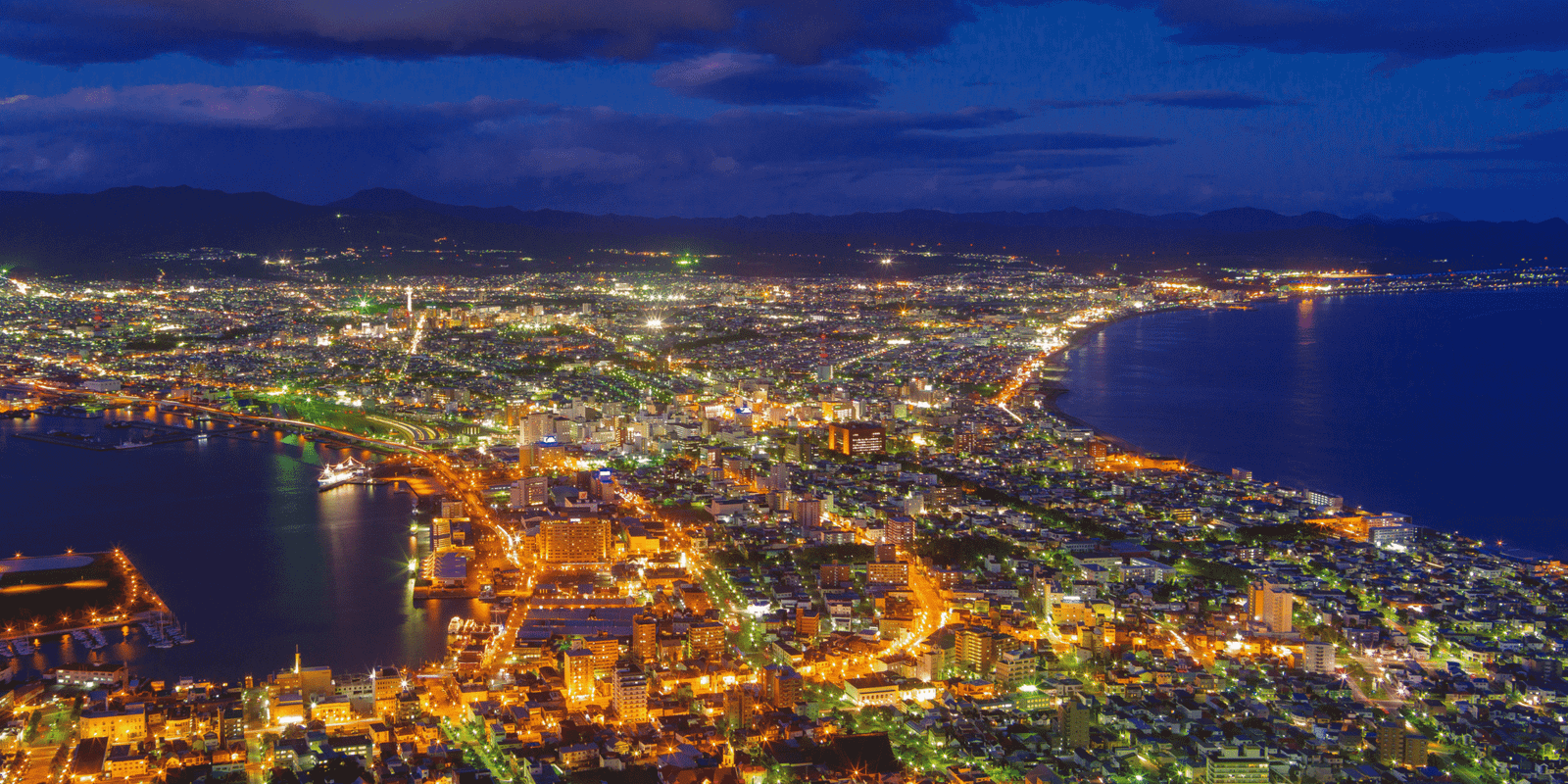
This Hakodate travel guide covers one of Hokkaido’s most enjoyable cities to explore by train and an excellent first or final stop on a journey through Japan’s northern island.
Located in southern Hokkaido, Hakodate combines a historic port, Western-influenced architecture, excellent seafood, a star-shaped fortress, traditional tram travel, and one of Japan’s most famous night views.
It also fits naturally into a rail itinerary. The Hokkaido Shinkansen connects Honshu with Shin-Hakodate-Hokuto Station, from where JR trains continue into central Hakodate.
Whether you are traveling north toward Sapporo or arriving in Hokkaido from Tokyo and Tohoku, I recommend spending at least one night in Hakodate rather than treating it only as a transfer point.
Why Is Hakodate Worth Visiting?
One of Japan’s Most Beautiful Night Views
The view from Mount Hakodate is the city’s signature sightseeing experience.
From the summit, Hakodate’s illuminated city stretches between the sea on both sides, creating the distinctive narrow shape that makes the night view so recognizable.
Sunset and early evening are especially popular, but the mountain also offers impressive daytime views across Hakodate Bay and the Tsugaru Strait.
Fresh Seafood Steps from Hakodate Station
Hakodate Morning Market is located immediately beside JR Hakodate Station and is one of the easiest places in Hokkaido to enjoy fresh seafood.
Restaurants and market stalls serve specialties such as squid, crab, salmon roe, sea urchin, and seafood rice bowls.
Its location makes it especially convenient for train travelers: you can have a seafood breakfast before starting sightseeing or before boarding an onward train.
Goryokaku — Japan’s Star-Shaped Fortress
Goryokaku is one of Hakodate’s most distinctive historic attractions.
Built during the final years of the Tokugawa shogunate, the Western-style fortress is shaped like a five-pointed star. Today, the site is a spacious public park surrounded by its original moat.
The best way to appreciate the unusual shape is from Goryokaku Tower, which overlooks the entire fort.
A Historic International Port City
Hakodate was one of the Japanese ports opened to international trade during the 19th century.
That history is still visible around Motomachi, where churches, former consulates, Western-style residences, stone-paved slopes, and traditional Japanese buildings sit close together above the waterfront.
Hakodate Bay and the Red Brick Warehouses
The waterfront around the Kanemori Red Brick Warehouses preserves the atmosphere of Hakodate’s trading-port history while offering shops, cafés, restaurants, and attractive harbor views.
It is particularly enjoyable in the late afternoon before heading toward Mount Hakodate for the evening view.
Easy to Explore Without a Car
Hakodate is very manageable for independent travelers. JR Hakodate Station, the Morning Market, waterfront, Motomachi, and Mount Hakodate area are relatively close together.
The city’s historic tram network also connects many of the major sightseeing districts, including the station area, Motomachi, Goryokaku, and Yunokawa.
Hakodate at a Glance
| Planning Detail | What to Know |
|---|---|
| Region | Southern Hokkaido |
| Main City Station | JR Hakodate Station |
| Shinkansen Station | Shin-Hakodate-Hokuto |
| Best Known For | Night view, seafood, Goryokaku, historic port |
| Recommended Stay | 1–2 nights |
| Getting Around | Tram, JR, bus, and walking |
Train Travel Japan Tip: Hakodate deserves more than a quick transfer between the Hokkaido Shinkansen and a train to Sapporo. Stay at least one night so you can explore the city during the day, enjoy seafood, and see the Mount Hakodate night view after sunset.
How to Get to Hakodate by Train
Hakodate is connected with Honshu by the Hokkaido Shinkansen and with Sapporo by the Limited Express Hokuto.
One important detail for first-time visitors is that the Shinkansen station is Shin-Hakodate-Hokuto, not Hakodate Station in the city center.
From Shin-Hakodate-Hokuto, transfer to the Hakodate Liner for the short journey into central Hakodate.
| Starting Point | Recommended Route | Approx. Time |
|---|---|---|
| Tokyo | Hokkaido Shinkansen + Hakodate Liner | About 4 hr 15–30 min |
| Sendai | Hokkaido Shinkansen + Hakodate Liner | About 2 hr 45 min |
| Shin-Aomori | Hokkaido Shinkansen + Hakodate Liner | About 1 hr 15–30 min |
| Shin-Hakodate-Hokuto | Hakodate Liner | 15–22 min |
| Sapporo | Limited Express Hokuto | About 3 hr 30 min–4 hr |
Tokyo to Hakodate by Shinkansen
Step 1: Tokyo to Shin-Hakodate-Hokuto
Take a Hayabusa service on the Tohoku and Hokkaido Shinkansen from Tokyo to Shin-Hakodate-Hokuto Station.
The fastest current services make the journey in approximately 3 hours 57 minutes.
Step 2: Shin-Hakodate-Hokuto to Hakodate
At Shin-Hakodate-Hokuto, transfer to the Hakodate Liner.
The ride to JR Hakodate Station takes approximately 15–22 minutes.
Connections are designed around Shinkansen arrivals and departures, making the transfer relatively straightforward.
Important: When searching train schedules or booking tickets, do not confuse Hakodate Station with Shin-Hakodate-Hokuto Station. The Shinkansen stops only at Shin-Hakodate-Hokuto.
From Sendai to Hakodate
Sendai is directly connected with Shin-Hakodate-Hokuto by Hokkaido Shinkansen services.
The fastest journey from Sendai to Shin-Hakodate-Hokuto is approximately 2 hours 25 minutes. Transfer there to the Hakodate Liner for central Hakodate.
This makes Hakodate a natural next stop after Sendai, Morioka, or Aomori on a northbound Tohoku itinerary.
From Aomori to Hakodate
From the Aomori area, first travel to Shin-Aomori Station.
The Hokkaido Shinkansen crosses the Tsugaru Strait through the Seikan Tunnel and reaches Shin-Hakodate-Hokuto in as little as approximately 57 minutes.
Transfer to the Hakodate Liner to complete the journey to central Hakodate.
Train Travel Japan Tip: Traveling from Tohoku into Hokkaido by train is a memorable part of the journey itself. Rather than flying directly to Sapporo, consider entering Hokkaido through Hakodate and gradually continuing north.
From Sapporo to Hakodate by Train
From Sapporo, take the Limited Express Hokuto directly to Hakodate.
The fastest current services take approximately 3 hours 30 minutes, although journey times vary depending on the train and stops.
The Hokuto follows a scenic route through southern Hokkaido, including views around Mount Komagatake and Uchiura Bay.
All Hokuto Seats Are Reserved
JR Hokkaido’s limited express trains, including the Hokuto, currently operate with all seats reserved.
If you are traveling with a rail pass, obtain a reserved-seat ticket before boarding rather than assuming there will be a non-reserved car.
Does the Japan Rail Pass Cover Hakodate?
Yes. The Japan Rail Pass covers eligible JR travel to Hakodate, including:
- Hokkaido and Tohoku Shinkansen services to Shin-Hakodate-Hokuto
- Hakodate Liner between Shin-Hakodate-Hokuto and Hakodate
- Limited Express Hokuto between Hakodate and Sapporo
- Other eligible JR trains within Hokkaido
JR Pass tip: The nationwide Japan Rail Pass is particularly useful if Hakodate is part of a long-distance itinerary from Tokyo or Tohoku rather than your only train journey.
What About the Hokkaido Rail Pass?
The Hokkaido Rail Pass covers JR Hokkaido conventional trains, including the Hakodate Liner and Limited Express Hokuto.
However, it does not cover the Hokkaido Shinkansen.
This is an important difference from the nationwide Japan Rail Pass. If you are arriving from Honshu by Shinkansen, the Hokkaido Rail Pass alone will not cover the Shin-Aomori–Shin-Hakodate-Hokuto section.
Which pass is better? If your trip begins in Tokyo and continues through Tohoku into Hokkaido, compare the nationwide Japan Rail Pass with regional options. If most of your long-distance rail travel is entirely within Hokkaido, the Hokkaido Rail Pass may be a better fit.
Arriving at Hakodate Station
JR Hakodate Station is extremely convenient for sightseeing. Hakodate Morning Market is immediately beside the station, and the Bay Area and historic Motomachi district are easily reached by tram or on foot.
If you arrive before hotel check-in, consider leaving your luggage at your accommodation or in station-area storage and beginning with the Morning Market or waterfront.
Train Travel Japan Tip: If you are arriving from Tokyo or Tohoku, stay at least one night in Hakodate before continuing to Sapporo. The journey north is long enough that squeezing Hakodate into a short connection would miss one of Hokkaido’s most interesting cities.
Getting Around Hakodate
Hakodate is a very convenient city to explore without a rental car. The main sightseeing areas are connected by Hakodate’s historic streetcar network, and several attractions around Hakodate Station and the waterfront are also easy to reach on foot.
For most first-time visitors, the best combination is: tram + walking.
Hakodate Tram Fares
| Ticket | Current Adult Price | Best For |
|---|---|---|
| Single Tram Ride | ¥250–¥300 | One or two short trips |
| 1-Day Tram Pass | ¥800 | Several sightseeing trips in one day |
| 24-Hour Tram Pass | ¥1,130 | Travel spread across parts of two days |
| Tram + Bus 1-Day Pass | ¥1,600 | Using both city trams and eligible buses |
Best value for most visitors: If you plan to take the tram three or four times during the day, compare your expected fares with the ¥800 one-day tram pass.
Can You Use Suica or Other IC Cards?
Yes. Major Japanese transportation IC cards such as Suica, PASMO, ICOCA, and Kitaca can be used on Hakodate trams.
Tap your card when boarding and again when getting off. If paying cash instead, take a numbered ticket when you board and pay the displayed fare when exiting.
How to Ride the Hakodate Tram
- Board through the rear door.
- Tap your IC card or take a numbered ticket.
- Press the stop button when your destination is announced.
- Exit through the front door.
- Tap your IC card again or pay the correct cash fare.
Check the destination displayed on the tram before boarding, particularly where the streetcar routes divide.
Hakodate Station to the Bay Area
The waterfront around the Kanemori Red Brick Warehouses is close enough to Hakodate Station that many travelers simply walk.
If you prefer the tram, take it toward Jujigai. From there, the Bay Area is approximately a five-minute walk.
Train Travel Japan Tip: If the weather is good, walk between Hakodate Station, the Morning Market, and the Bay Area. Save your tram rides for places such as Goryokaku and Motomachi where they save more time.
Getting to Motomachi
For the historic Motomachi district, use either Jujigai or Suehiro-cho tram stop, depending on which part of the neighborhood you want to explore.
From Jujigai, you can walk uphill toward the famous stone-paved slopes, churches, former consulates, and Mount Hakodate Ropeway.
Be prepared for hills. The Motomachi area sits on the lower slopes of Mount Hakodate, so walking here involves more elevation than around Hakodate Station or the waterfront.
Getting to Mount Hakodate
One of the simplest routes from Hakodate Station is:
- Take the tram to Jujigai.
- Walk uphill for approximately 10 minutes to the ropeway base station.
- Take the Mount Hakodate Ropeway to the summit.
The ropeway ride itself takes only about three minutes.
Seasonal warning: Mount Hakodate transportation changes during the year. The ropeway has scheduled maintenance periods, and buses, taxis, and private vehicles can face seasonal road restrictions. Check the current Mount Hakodate access information before your evening visit.
Getting to Goryokaku
From Hakodate Station, take the tram to Goryokaku-koen-mae.
The tram journey takes approximately 17 minutes. From the stop, allow another 13 minutes on foot to reach Goryokaku Tower and the fortress area.
Important: Despite its name, Goryokaku-koen-mae tram stop is not directly beside the park. Allow time for the additional walk.
Getting to Yunokawa Onsen
Hakodate’s tram network also continues east to Yunokawa Onsen, one of Hokkaido’s best-known hot-spring districts.
If you are staying in Yunokawa, the tram provides a straightforward connection to central Hakodate, Goryokaku, and the station area.
Do You Need a Rental Car in Hakodate?
Not for the main city sights.
Hakodate Station, the Morning Market, Bay Area, Motomachi, Mount Hakodate, and Goryokaku can all be reached comfortably using trams, buses, and walking.
A rental car becomes more useful if Hakodate is your base for exploring rural southern Hokkaido destinations that are poorly served by public transportation.
My recommendation: For a first one- or two-night Hakodate visit, skip the rental car. Stay near Hakodate Station or a tram stop and use the streetcars for sightseeing.
What to See and Do in Hakodate
Hakodate’s major attractions are spread across several neighborhoods, but the tram makes them easy to combine.
For a first visit, I recommend starting around Hakodate Station and the Morning Market, visiting Goryokaku during the day, then exploring the waterfront and Motomachi before finishing at Mount Hakodate around sunset.
1. Hakodate Morning Market
Start your day at Hakodate Morning Market, located immediately beside JR Hakodate Station.
Around 250 shops and restaurants sell fresh seafood, fruit, vegetables, sweets, and other Hokkaido specialties.
Seafood rice bowls are especially popular for breakfast. Depending on the season and availability, you may find squid, crab, salmon roe, sea urchin, scallops, and other fresh seafood.
Shops begin opening early in the morning and many finish by early afternoon, so this is better as your first stop than something to leave until later in the day.
Train Travel Japan Tip: If your hotel does not include breakfast, Hakodate Morning Market is one of the best places to start the day. It is only about a minute on foot from Hakodate Station.
2. Goryokaku and Goryokaku Tower
Next, take the tram toward Goryokaku-koen-mae and walk to Goryokaku.
Completed in 1864, Goryokaku was Japan’s first Western-style fortress and played an important role during the final years of the samurai era.
Today, the fortress grounds are a spacious public park surrounded by the original star-shaped moat.
Entry to Goryokaku Park itself is free. However, the unusual five-pointed design is difficult to appreciate from ground level.
Go Up Goryokaku Tower
I strongly recommend going up Goryokaku Tower on your first visit.
The observation decks overlook the entire star-shaped fortress, as well as Mount Hakodate, the Tsugaru Strait, and the surrounding city.
This is where the distinctive geometry of Goryokaku really becomes obvious.
Seasonal highlight: Goryokaku is particularly beautiful during cherry blossom season, when more than a thousand cherry trees around the fort transform the star-shaped park.
3. Hakodate Bay Area and Red Brick Warehouses
Return toward central Hakodate and spend some time around the Hakodate Bay Area.
The historic Kanemori Red Brick Warehouses reflect Hakodate’s past as an international trading port. Today, the renovated buildings contain shops, restaurants, cafés, and souvenir stores.
The harbor, warehouses, old brick buildings, and views toward Mount Hakodate make this one of the most pleasant areas of the city for a relaxed walk.
4. Explore Historic Motomachi
From the waterfront, continue uphill into Motomachi.
Hakodate was one of the first Japanese ports opened to international trade in the 19th century, and Motomachi still reflects that unusual mixture of Japanese and Western influences.
You will find historic churches, former consulates, Western-style residences, temples, stone walls, and attractive streets climbing toward Mount Hakodate.
Don’t Miss Hachimanzaka
Hachimanzaka is one of Hakodate’s best-known streets and photo spots.
The tree-lined slope runs directly downhill toward Hakodate Bay, creating a beautiful view of the harbor framed by the historic neighborhood.
If photography is important to you, earlier in the day can be quieter than the busy afternoon period.
Walking tip: Motomachi is considerably hillier than the station and waterfront areas. Wear comfortable shoes and allow extra time rather than trying to rush between sights.
5. Finish at Mount Hakodate
Finish your sightseeing day at Mount Hakodate.
From the summit, the city spreads across the narrow land between Hakodate Bay and the Tsugaru Strait, producing the famous hourglass-shaped night view.
If possible, arrive before sunset. This lets you see Hakodate in daylight, watch the sky change color, and then experience the city lights appearing gradually below.
Train Travel Japan Tip: Don’t arrive at the summit only after it is completely dark. Watching Hakodate transform from daylight through sunset into the full night view is much more memorable.
Suggested First-Time Hakodate Sightseeing Order
- Hakodate Morning Market for breakfast
- Tram to Goryokaku
- Goryokaku Tower and fortress grounds
- Return to the Hakodate Bay Area
- Explore the Red Brick Warehouses
- Walk through Motomachi and Hachimanzaka
- Head to the Mount Hakodate Ropeway
- Finish with the sunset and night view
How Much Time Do You Need for Hakodate’s Main Sights?
| Time Available | Recommended Plan |
|---|---|
| Half day | Morning Market, waterfront, Motomachi, and Mount Hakodate |
| 1 full day | Add Goryokaku and explore the main sights comfortably |
| 2 days | Main sights plus Yunokawa, museums, shopping, or a slower pace |
My recommendation: Give Hakodate at least one full sightseeing day and one night. That is enough for the city’s main attractions without making every tram ride and meal feel rushed.
Mount Hakodate: Ropeway, Night View & Practical Tips
The Mount Hakodate night view is the sightseeing experience I would prioritize most on a first visit to Hakodate.
From the 334-meter summit, the city stretches across a narrow strip of land between Hakodate Bay and the Tsugaru Strait, creating the distinctive shape that makes the view so famous.
The scenery is beautiful during the day, but the best experience is usually to arrive before sunset and watch Hakodate gradually change from daylight to blue hour and then full night.
How to Get to the Mount Hakodate Ropeway
- Take the Hakodate tram from the station area to Jujigai.
- Walk uphill for approximately 10 minutes to the Mount Hakodate Ropeway base station.
- Take the ropeway to the summit.
The ropeway journey itself takes only about 3 minutes.
Mount Hakodate Ropeway Fare
| Passenger | Round Trip | One Way |
|---|---|---|
| Adult | ¥1,800 | ¥1,200 |
| Child | ¥900 | ¥600 |
Access to the summit observatory itself is free. The fare above is for transportation on the ropeway.
Mount Hakodate Ropeway Hours
| Period | First Departure | Last Up | Last Down |
|---|---|---|---|
| Apr 20–Sep 30, 2026 | 10:00 AM | 9:30 PM | 10:00 PM |
| Oct 1, 2026–Apr 19, 2027 | 10:00 AM | 8:30 PM | 9:00 PM |
Ropeway schedules can change because of weather, strong winds, maintenance, or other operating conditions, so check the current information shortly before your visit.
Important for autumn travelers: The ropeway normally closes for annual inspection and maintenance for several weeks in late October and early November. For 2026, the scheduled closure period is currently October 20–November 8. Use an alternative way to the summit during this period and confirm the latest information before traveling.
What Is the Best Time to Visit Mount Hakodate?
If the weather is clear, I recommend reaching the summit around 30–60 minutes before sunset.
That gives you three different views during the same visit:
- Daylight — see the geography of Hakodate clearly.
- Sunset and blue hour — watch the sky and city change color.
- Night — see the full illuminated cityscape.
Photography tip: Blue hour, shortly after sunset but before the sky becomes completely dark, can be especially beautiful because you can still see the coastline and mountains while the city lights are already glowing.
Expect Crowds Around Sunset
Sunset and the early evening are the busiest periods at Mount Hakodate. During popular travel seasons, large numbers of visitors can arrive at roughly the same time.
This can mean queues for the ropeway and crowded viewing areas at the summit.
How to Make the Visit More Comfortable
- Arrive before the main sunset rush.
- Allow extra time for the ropeway queue.
- Stay after the first wave of visitors begins leaving.
- Explore more than just the busiest rooftop viewing position.
- Check the current ropeway congestion information before going.
The summit has several viewing areas, so you do not necessarily need to remain in the most crowded position for the entire visit.
What If the Ropeway Is Closed?
Depending on the season, Mount Hakodate can also be reached by bus, taxi, sightseeing bus, or hiking.
Mount Hakodate Climbing Bus
During its operating season, Route 1 connects JR Hakodate Station and the summit, passing through parts of the central sightseeing area.
The journey takes approximately 30 minutes without heavy traffic and currently costs ¥700 one way for adults.
Bus and road access changes seasonally, so this should not be treated as a guaranteed year-round alternative.
Driving to Mount Hakodate
A rental car is generally unnecessary for visiting the summit. Private vehicles are restricted during busy evening periods and the mountain road closes completely during winter.
In 2026, private-car restrictions apply during the evening from spring through autumn, and the mountain road is scheduled to close for winter from November 9, 2026.
My recommendation: If you are sightseeing in central Hakodate without a car, use the tram and ropeway. It is simpler than dealing with parking and seasonal road restrictions.
Dress Warmer Than You Expect
The summit is higher, windier, and noticeably cooler than the streets around Hakodate Station.
Even during warmer months, bring an extra layer if you plan to spend time outside after sunset. In autumn, winter, and early spring, warm clothing is particularly important.
What If the Weather Is Poor?
Cloud, fog, rain, and snow can dramatically reduce visibility from Mount Hakodate.
If you are staying for two nights, keep the Mount Hakodate visit flexible and choose the evening with the clearest forecast rather than locking yourself into one particular night.
Train Travel Japan Tip: Check visibility and weather shortly before heading up. On a completely foggy evening, it can be better to postpone the summit visit and enjoy Hakodate’s restaurants, waterfront, or onsen instead.
How Long Should You Spend at Mount Hakodate?
Allow around 1.5–2 hours for the complete visit, including travel from Jujigai, the ropeway, viewing time, and the return.
During peak sunset periods, allow longer because queues can add significant waiting time.
My recommendation: Visit Motomachi during the late afternoon, walk to the ropeway base station, and then head up Mount Hakodate before sunset. The two areas fit naturally together and avoid unnecessary backtracking across the city.
What to Eat in Hakodate
Hakodate is one of Hokkaido’s best food cities, particularly if you enjoy seafood.
For a first visit, I would prioritize a seafood rice bowl, fresh squid, Hakodate-style shio ramen, and one casual local meal at Lucky Pierrot.
The good news for train travelers is that several of Hakodate’s signature foods are easy to fit naturally into sightseeing without making special trips across the city.
1. Seafood Donburi at Hakodate Morning Market
The easiest local meal to build into your itinerary is a kaisen-don, or seafood rice bowl, at Hakodate Morning Market.
Depending on the season and restaurant, bowls may include salmon roe, sea urchin, crab, scallops, tuna, salmon, squid, and other fresh seafood.
The market’s Donburi Yokocho area has numerous restaurants specializing in seafood bowls, making it easy to compare menus before choosing.
Best timing: Have your seafood bowl for breakfast or an early lunch. Hakodate Morning Market is immediately beside JR Hakodate Station, so this works especially well on the morning after you arrive or before an onward train.
2. Hakodate Squid
Hakodate has long been associated with fresh squid, known locally as ika.
You may encounter squid served as sashimi, grilled, in rice dishes, or prepared in other styles depending on the season and restaurant.
Hakodate Morning Market is also famous for its live squid fishing experience. Visitors catch a squid from a tank, after which it is prepared immediately for eating.
Availability and price vary with the season, weather, and catch, so treat this as a fun option rather than something guaranteed every day.
Train Travel Japan Tip: If fresh squid is particularly important to you, visit the Morning Market earlier in the day. Some seafood experiences finish once the day’s supply is sold out.
3. Hakodate Shio Ramen
While Sapporo is famous for miso ramen, Hakodate is best known for shio ramen.
Shio means “salt,” and Hakodate-style ramen typically features a relatively clear, light-colored broth rather than the heavier miso-based soup associated with Sapporo.
It is a particularly good choice if you want a warm, inexpensive meal after sightseeing or after spending time outside at Mount Hakodate.
4. Lucky Pierrot — Hakodate’s Local Burger Chain
For something completely different from seafood and ramen, try Lucky Pierrot, a fast-food chain that originated in Hakodate and has become something of a local institution.
Its best-known item is the Chinese Chicken Burger, filled with fried chicken and a sweet-savory sauce.
Lucky Pierrot has several locations around Hakodate, including convenient branches near major sightseeing areas. The colorful interiors are also part of the experience.
Easy sightseeing combination: A Lucky Pierrot meal fits naturally into a visit to the Bay Area and Kanemori Red Brick Warehouses, so there is no need to travel across town just to try it.
What Should You Eat If You Only Have One Day?
Breakfast — Seafood at the Morning Market
Start with a seafood rice bowl or fresh squid beside Hakodate Station. This is the meal I would prioritize most.
Lunch — Shio Ramen or Lucky Pierrot
Choose Hakodate shio ramen if you want another traditional local specialty, or Lucky Pierrot if you want something casual and distinctly Hakodate.
Dinner — Seafood, Sushi, or Izakaya
For dinner, look for sushi, sashimi, grilled seafood, or a local izakaya where you can try several smaller Hokkaido dishes.
If you are visiting Mount Hakodate around sunset, eat dinner afterward rather than rushing your night-view visit to make an early reservation.
Food Tips for Train Travelers
- Arriving in Hakodate: Leave your luggage and explore the Morning Market or station area first.
- Leaving in the morning: Have breakfast at the Morning Market before boarding the Hakodate Liner or Hokuto.
- Bay Area sightseeing: Combine lunch or a snack with the Red Brick Warehouses.
- Evening: Plan dinner around your Mount Hakodate visit rather than the other way around.
My recommendation: Don’t try to eat every Hakodate specialty in one day. Start with seafood at the Morning Market, then choose either shio ramen or Lucky Pierrot later. If you have two nights, you can enjoy the city’s food much more comfortably.
How Many Days Do You Need in Hakodate?
Hakodate is compact enough to see the major attractions in one full day, but I recommend staying two nights if your itinerary allows.
One full sightseeing day is enough for the Morning Market, Goryokaku, the Bay Area, Motomachi, and Mount Hakodate. A second day gives you time to slow down, enjoy Yunokawa Onsen, explore additional neighborhoods, or simply avoid planning every part of the trip around a tight schedule.
| Time in Hakodate | What You Can Realistically See |
|---|---|
| Half day | Waterfront, Motomachi, and Mount Hakodate |
| 1 full day | Morning Market, Goryokaku, Bay Area, Motomachi, and Mount Hakodate |
| 2 days | Main sights at a relaxed pace plus Yunokawa Onsen or additional attractions |
Train Travel Japan Tip: If you are arriving from Tokyo or Tohoku on the Hokkaido Shinkansen, try to reach Hakodate by early afternoon and stay two nights. That gives you an arrival afternoon, one complete sightseeing day, and an easy departure toward Sapporo the following morning.
One-Day Hakodate Itinerary
If you have only one full day, this route covers Hakodate’s major first-time attractions without unnecessary backtracking.
7:30–9:00 AM — Hakodate Morning Market
Start beside Hakodate Station with a seafood breakfast. Try a kaisen-don, fresh squid, or another local seafood specialty.
Beginning here also lets you visit while the market is at its liveliest rather than returning after many stalls have started closing.
9:15 AM–12:00 PM — Goryokaku
Take the tram from Hakodate-Ekimae to Goryokaku-koen-mae, then walk to the fortress.
Visit Goryokaku Tower first for the aerial view of the star-shaped fort, then walk through Goryokaku Park and the reconstructed Hakodate Magistrate’s Office area if time allows.
12:00–1:30 PM — Lunch
Have lunch around Goryokaku or return toward central Hakodate. This is a good opportunity to try Hakodate shio ramen.
1:30–3:00 PM — Hakodate Bay Area
Explore the harbor and Kanemori Red Brick Warehouses. Browse the shops, stop for coffee, or simply walk along the waterfront.
3:00–5:00 PM — Motomachi
Walk uphill from the Bay Area into historic Motomachi. Visit Hachimanzaka and explore the neighborhood’s churches, Western-style buildings, stone-paved streets, and harbor views.
Gradually work your way toward the Mount Hakodate Ropeway base station.
Late Afternoon & Evening — Mount Hakodate
Time your visit so that you reach the summit around 30–60 minutes before sunset.
Enjoy the daylight view, sunset, blue hour, and famous illuminated Hakodate night view before returning to the city.
Evening — Dinner in Central Hakodate
Finish with sushi, seafood, an izakaya meal, shio ramen, or Lucky Pierrot.
Avoid making an unnecessarily early dinner reservation if it means cutting your Mount Hakodate visit short.
Important: Sunset changes significantly by season. Treat the times above as a sightseeing sequence rather than a rigid timetable, and adjust the afternoon around the sunset time on your travel date.
Two-Day Hakodate Itinerary
With two days, Hakodate becomes much more relaxing. You can divide the main sights geographically instead of crossing the city several times in one day.
Day 1 — Goryokaku, Bay Area, Motomachi & Night View
- Arrive or start the morning around Hakodate Station.
- Take the tram to Goryokaku.
- Visit Goryokaku Tower and walk through the fortress.
- Return toward the Bay Area for lunch or afternoon sightseeing.
- Explore the Kanemori Red Brick Warehouses.
- Walk through Motomachi and Hachimanzaka.
- Finish at Mount Hakodate before sunset.
- Return downtown for dinner.
Day 2 — Morning Market & Yunokawa Onsen
- Start with breakfast at Hakodate Morning Market.
- Spend additional time around the waterfront or station area.
- Take the tram east to Yunokawa Onsen.
- Enjoy a day-use hot spring, footbath, or a slower afternoon in the onsen district.
- Return to central Hakodate for your final evening.
Yunokawa Onsen is approximately 30 minutes by tram from Hakodate Station, so it is easy to include without renting a car.
Alternative: If hot springs are not a priority, use your second day for museums, cafés, additional historic neighborhoods, seasonal attractions, or a nearby rail excursion.
Should You Stay One Night or Two?
Stay One Night If…
- You have limited time in Hokkaido.
- You arrive early enough to get a useful sightseeing day.
- Your priorities are the main city sights and Mount Hakodate.
- You want to continue to Sapporo the next morning.
Stay Two Nights If…
- You are arriving after a long train journey from Tokyo or Tohoku.
- You want to explore without rushing.
- You want time for Yunokawa Onsen.
- You enjoy seafood and want more than one meal in Hakodate.
- You want a second chance at Mount Hakodate if the first evening is cloudy.
My recommendation: For a longer train journey through northern Japan, I would stay two nights in Hakodate. The city is interesting enough to justify the time, and the extra evening also gives you valuable flexibility if weather obscures the Mount Hakodate night view.
Best Time to Visit Hakodate
Hakodate is a genuine year-round destination, and each season gives the city a very different atmosphere.
For most first-time visitors, I would choose spring for cherry blossoms or autumn for comfortable sightseeing and clear night views. Summer is an excellent escape from the heat farther south in Japan, while winter is beautiful if you are comfortable traveling in snow.
| Season | Best For | What to Expect |
|---|---|---|
| Spring | Cherry blossoms | Cool weather, sakura from late April into early May |
| Summer | Comfortable sightseeing | Mild temperatures, festivals, long evenings |
| Autumn | Foliage and night views | Cooler weather, clear air, colors from around mid-October |
| Winter | Snow scenery and illuminations | Cold, snowy streets and a completely different atmosphere |
Spring — Best for Cherry Blossoms
Hakodate’s cherry blossom season arrives noticeably later than Tokyo, Kyoto, and much of Honshu.
Blossoms generally appear from late April into early May, although the exact dates vary considerably from year to year depending on the weather.
The most famous place for sakura is Goryokaku Park, where roughly 1,500 cherry trees surround the star-shaped fortress.
Looking down from Goryokaku Tower when the moat is surrounded by pink blossoms is one of Hakodate’s most distinctive seasonal views.
Other Spring Highlights
- Cherry blossoms at Hakodate Park
- Cool temperatures for walking around Motomachi
- Clear spring views from Mount Hakodate
- Spring flowers appearing as the snow disappears
Cherry blossom planning tip: Do not rely on the same sakura dates every year. Hakodate’s bloom timing can shift by a week or more, so check the current forecast shortly before your trip.
Summer — Best for Comfortable Sightseeing
Hakodate is an excellent summer destination if you want to escape the intense heat and humidity found in many other parts of Japan.
From June through August, daytime temperatures are generally much more comfortable than Tokyo, Kyoto, or Osaka, and maximum temperatures historically rarely exceed the mid-20s Celsius.
Mornings and evenings can still feel surprisingly cool, particularly at Mount Hakodate, so bring a light jacket even during summer.
Summer Highlights
- Long daylight hours for sightseeing
- Hakodate Port Festival in early August
- Cooler evenings than much of mainland Japan
- Seasonal seafood and squid
- Fishing-boat lights visible offshore on some summer evenings
One thing to know: Sea fog can occasionally obscure the Mount Hakodate view during summer. If you are staying two nights, keep your summit visit flexible and choose the clearer evening.
Autumn — My Favorite Overall Season
Autumn is probably the best all-around season for a first visit to Hakodate.
September is still relatively mild, while October brings cooler walking weather and increasingly colorful foliage. Autumn colors can begin appearing from around mid-October and continue into November.
The air also tends to be clear in autumn, making this an especially good season for the Mount Hakodate night view.
Autumn Highlights
- Fall colors around parks and historic neighborhoods
- Comfortable daytime sightseeing
- Clearer conditions for Mount Hakodate
- Excellent seasonal seafood and produce
- Fewer summer heat concerns when walking Motomachi’s hills
Important: The Mount Hakodate Ropeway normally has an annual maintenance closure during part of autumn. If your visit falls in late October or early November, check that year’s operating schedule before planning your evening.
Winter — Best for Snow Scenery
Winter gives Hakodate a completely different appearance. Snow covers Motomachi, the waterfront, Goryokaku, and the slopes around Mount Hakodate, while seasonal illuminations brighten the city.
January and February are particularly snowy, and nighttime temperatures regularly fall below freezing.
Bring a warm coat, gloves, hat, and waterproof footwear with good grip. Snow and ice can make Hakodate’s hills and sidewalks much slower to walk than they appear on a map.
Why Visit in Winter?
- Snow-covered historic streets in Motomachi
- Winter illuminations around central Hakodate
- Atmospheric snow views from Mount Hakodate
- Warm seafood, ramen, and onsen after sightseeing
- Yunokawa Onsen is especially enjoyable in cold weather
Train travel tip: Winter is very rewarding, but do not plan extremely tight connections. Snow and severe weather can make transportation and walking less predictable, so leave extra time between activities and onward journeys.
Which Season Should You Choose?
Choose late April or early May if seeing Goryokaku surrounded by cherry blossoms is your priority.
Choose June through August if you want cooler summer sightseeing during a longer Japan trip.
Choose September or October for perhaps the best balance of comfortable weather, clear night views, and autumn scenery.
Choose January or February if you specifically want a snowy Hokkaido experience and are comfortable with winter conditions.
My recommendation: For a first Hakodate trip focused on train travel and sightseeing, I would choose late September through mid-October. The weather is generally comfortable for walking, the evenings are cool, and the clearer autumn air can be excellent for the Mount Hakodate night view.
Where to Stay in Hakodate for Train Travelers
Hakodate has several good accommodation areas, but the best choice depends on whether you prioritize train convenience, sightseeing atmosphere, or an onsen stay.
For most travelers arriving and leaving by JR, I recommend staying near Hakodate Station. The Bay Area is a more atmospheric alternative, while Yunokawa Onsen is best if hot springs and a ryokan experience are an important part of your trip.
| Area | Best For | Main Advantage |
|---|---|---|
| Hakodate Station | Most train travelers | Easy JR access, Morning Market, trams and buses |
| Bay Area / Motomachi | Sightseeing and atmosphere | Waterfront, historic streets and Mount Hakodate nearby |
| Yunokawa Onsen | Onsen and ryokan stays | Hot springs and a more relaxing resort atmosphere |
1. Hakodate Station Area — Best Overall for Train Travelers
If Hakodate is one stop on a longer rail itinerary, this is the area I would choose most often.
Staying close to JR Hakodate Station makes arriving with luggage straightforward and makes it much easier to catch an early Hakodate Liner or Limited Express Hokuto when you leave.
Hakodate Morning Market is immediately beside the station, and tram and bus connections make it easy to reach Goryokaku, Motomachi, the Bay Area, Mount Hakodate and Yunokawa.
Best For
- Travelers arriving and departing by JR
- One- or two-night visits
- Early-morning train departures
- Travelers carrying larger luggage
- Easy access to Hakodate Morning Market
Train Travel Japan Tip: If you are continuing to Sapporo on the Limited Express Hokuto, staying near Hakodate Station removes unnecessary tram or taxi travel with your luggage on departure morning.
2. Bay Area & Motomachi — Best for Atmosphere
If sightseeing atmosphere matters more than being directly beside the railway station, consider the Bay Area or lower Motomachi area.
You will be close to the Kanemori Red Brick Warehouses, Hakodate’s historic waterfront, Motomachi, Hachimanzaka, and the lower station of the Mount Hakodate Ropeway.
This is an especially attractive area in the evening, when the waterfront buildings are illuminated and you can walk back after dinner without immediately returning to the station district.
Best For
- Couples
- Photography and evening walks
- Visitors focused on Motomachi and Mount Hakodate
- Travelers staying two nights or longer
Trade-off: The Bay Area is still convenient, but it is not quite as effortless as staying beside Hakodate Station when arriving or departing with large suitcases.
3. Yunokawa Onsen — Best for Hot Springs
Choose Yunokawa Onsen if you want your Hakodate stay to include a traditional hot-spring experience.
The district has numerous hotels and Japanese-style inns, many with large communal baths and some with ocean views or private bathing options.
Yunokawa Onsen is connected directly with central Hakodate by tram. The journey from Hakodate Station to the Yunokawa-onsen tram stop takes about 30 minutes.
Best For
- Ryokan and onsen experiences
- Couples and relaxing trips
- Travelers spending two or more nights in Hakodate
- Winter visits
- Anyone who values the accommodation experience itself
Trade-off: Yunokawa is less convenient for an early JR departure because you first need to travel back toward Hakodate Station.
Should You Stay at Shin-Hakodate-Hokuto Station?
For sightseeing in Hakodate, generally no.
Shin-Hakodate-Hokuto is convenient for the Hokkaido Shinkansen, but it is outside central Hakodate. You would need to take the Hakodate Liner into the city for most sightseeing.
Unless you have a very specific early Shinkansen connection, staying in central Hakodate gives you a much better travel experience.
Which Hakodate Area Should You Choose?
Choose Hakodate Station if convenience is your priority and Hakodate is part of a longer rail itinerary.
Choose the Bay Area or Motomachi if you want the most attractive surroundings and enjoy evening walks.
Choose Yunokawa Onsen if relaxing in a hot spring is more important than being beside the railway station.
My recommendation: For a first Hakodate visit by train, I would stay within easy walking distance of JR Hakodate Station. It makes arrival and departure simple, puts the Morning Market on your doorstep, and the tram can take care of almost all your sightseeing transportation.
Hakodate FAQ
Is Hakodate worth visiting?
Yes. Hakodate offers a very different experience from Sapporo and is particularly worthwhile if you are traveling into Hokkaido by train.
The combination of the Mount Hakodate night view, Goryokaku, historic Motomachi, the waterfront, seafood, and easy tram travel makes it one of Hokkaido’s most rewarding city stops.
How many days do you need in Hakodate?
Allow at least one full day and one night to see Hakodate’s main attractions.
I prefer two nights if your itinerary allows. This gives you a more relaxed sightseeing day, time for Yunokawa Onsen, and a second opportunity to visit Mount Hakodate if the first evening has poor visibility.
Is Hakodate Station the same as Shin-Hakodate-Hokuto?
No. This is one of the most important things for first-time train travelers to understand.
Shin-Hakodate-Hokuto is the Hokkaido Shinkansen station outside central Hakodate. Hakodate Station is the main JR station in the city center.
The Hakodate Liner connects the two stations in approximately 15–22 minutes.
Can you take the Shinkansen directly to Hakodate Station?
No. Hokkaido Shinkansen trains terminate at Shin-Hakodate-Hokuto Station.
Transfer there to the Hakodate Liner for the final journey into central Hakodate.
Is Hakodate a good day trip from Sapporo?
I do not recommend Hakodate as a day trip from Sapporo.
The Limited Express Hokuto journey takes roughly 3.5–4 hours each way, which would leave relatively little time for sightseeing after spending most of the day on trains.
Stay at least one night in Hakodate instead.
Does the Japan Rail Pass cover Hakodate?
Yes. The nationwide Japan Rail Pass covers eligible JR trains used to reach Hakodate, including the Hokkaido Shinkansen, Hakodate Liner, and Limited Express Hokuto.
Does the Hokkaido Rail Pass cover the Hokkaido Shinkansen?
No. The Hokkaido Rail Pass covers eligible JR Hokkaido conventional trains, but it does not cover the Hokkaido Shinkansen.
This matters if you are entering Hokkaido by train from Aomori, Sendai, or Tokyo.
Do you need a car in Hakodate?
No. A rental car is unnecessary for the main city attractions.
Hakodate Station, the Morning Market, Bay Area, Motomachi, Mount Hakodate, Goryokaku, and Yunokawa Onsen can all be reached using a combination of trams, buses, and walking.
Is Hakodate walkable?
Central Hakodate is very walkable. The station, Morning Market, waterfront, Bay Area, and Motomachi can be combined largely on foot.
However, use the tram for longer journeys such as Goryokaku or Yunokawa Onsen.
Is Goryokaku free to visit?
Goryokaku Park is free to enter.
Goryokaku Tower charges a separate admission fee. The current adult observatory fare is ¥1,200.
I recommend paying for the tower on a first visit because the star-shaped fortress is much easier to appreciate from above.
What time should you visit Hakodate Morning Market?
Go in the morning, ideally for breakfast or an early lunch.
The market generally operates from early morning until around 2:00 PM, although opening hours vary between individual shops and restaurants.
What is the best time to visit Mount Hakodate?
Arrive around 30–60 minutes before sunset if conditions are clear.
This lets you enjoy the daytime panorama, sunset, blue hour, and illuminated night view during one visit.
Can you reach Mount Hakodate without the ropeway?
Yes. Depending on the season, alternatives can include bus, taxi, sightseeing bus, or hiking.
However, road access changes during the year and some options stop operating during winter, so check current access information before relying on an alternative to the ropeway.
What is the best season to visit Hakodate?
There is no single best season.
Late April and early May are popular for cherry blossoms, summer offers cooler weather than much of Honshu, autumn is excellent for walking and clear views, and winter provides beautiful snow scenery and onsen experiences.
For a first train-focused sightseeing trip, I particularly like late September through mid-October.
Where should train travelers stay in Hakodate?
For convenience, stay near JR Hakodate Station.
You will be close to the Morning Market, city trams, buses, the Hakodate Liner, and Limited Express Hokuto services. It is especially convenient if you are traveling with luggage or continuing toward Sapporo.
Train Travel Japan Tip: Hakodate works best as part of the journey rather than simply as a connection point. If you are traveling north from Tokyo or Tohoku, stop for at least one night before continuing deeper into Hokkaido.
Related Guides
Tokyo to Sapporo by Train: The Ultimate 9-Day Northern Japan Itinerary
See how Hakodate fits naturally into a longer rail journey from Tokyo through Tohoku and into Hokkaido, with stops including Sendai, Yamadera, Hakodate, and Sapporo.
JR Regional Passes Guide
Compare regional rail passes for Hokkaido and other parts of Japan to see whether a regional option makes more sense than the nationwide Japan Rail Pass for your itinerary.
Japan Rail Pass Guide
Learn how the nationwide JR Pass works and whether it can save money on a longer journey connecting Tokyo, Tohoku, Hakodate, and other destinations across Hokkaido.
Before You Buy a JR Pass
Compare the cost of your planned train journeys with the current JR Pass price. Depending on your route, individual tickets or a regional pass may offer better value.
Check Current JR Pass PricesAbout Train Travel Japan
Train Travel Japan is written from firsthand experience traveling throughout Japan by rail. I am a Japanese native based in Canada and have traveled to all 47 prefectures of Japan over more than 30 years.
My goal is to make Japan train travel easier to understand, especially for international visitors planning JR Pass trips, regional rail journeys and independent itineraries.