
Okayama: The Hidden Gem Most Travellers Skip — And Shouldn't
Must-see Okayama Crow Castle and Korakuen, one of the Three Great Gardens in Japan. A great option for a Shinkansen stopover or a day trip from Osaka or Kyoto.
JR PASS 7 DAYSJR PASS 14 DAYSJR REGIONAL PASSWESTERN JAPANHISTORICAL SITEHIROSHIMAHIDDEN GEMS
Josh K
5/18/202615 min read


Photo: Traditional boat tour of Kurashiki Canal
The Sanyo Shinkansen passes through Okayama on almost every route between Osaka and Hiroshima, and most travellers do exactly the same — pass through it. They glance up from their ekiben as the city slides past, note the name on the platform sign, and return to their book. In a country with so many extraordinary destinations competing for a fixed number of days, Okayama gets bypassed.
That is a mistake, and a consistent one. Okayama is the city that rewards the traveller who stops. It has one of the three greatest landscape gardens in Japan, a striking black feudal castle rebuilt after wartime destruction and comprehensively renovated in 2022, a preserved Edo-period canal quarter twenty minutes away by train, a world-class contemporary art island accessible by ferry across the Seto Inland Sea, and a cycling trail through rice paddies and ancient shrines that is one of the most peaceful half-days anywhere in Japan. The pace is slow, the crowds are thin, and the food — Okayama's barazushi, its seasonal fruit, its oyster dishes from the inland sea — is specific and excellent.
Okayama is also exceptionally easy to reach. It sits directly on the Sanyo Shinkansen line, about 50 minutes from Osaka, 40 minutes from Hiroshima, and 3.5 hours from Tokyo on the Hikari. If you have a Japan Rail Pass, stopping here costs you nothing extra but a night's accommodation. The city makes a natural addition to any western Japan itinerary, and with one to two nights you can cover everything on this list comfortably.
Planning your train journey through western Japan? Our 17-day Central and Western Japan JR Pass itinerary includes Okayama as a dedicated stop alongside Hiroshima, Himeji, and Kyoto. For the full Tokyo-to-Fukuoka route, see our 7-day JR Pass itinerary from Tokyo to Fukuoka.
Getting to Okayama by Train
All Shinkansen services between Osaka and Hiroshima stop at Okayama, making it one of the easiest places in Japan to reach from almost anywhere. JR Okayama Station is a major hub where the Sanyo Shinkansen line meets the Seto Ohashi Line connecting to Shikoku — which means that travellers heading to or from Takamatsu on Shikoku pass through here as well.
From Tokyo: Approximately 3 hours 20 minutes on the Hikari Shinkansen (fully covered by the JR Pass). The Nozomi is faster (about 2 hours 50 minutes) but not covered by the standard JR Pass.
From Osaka (Shin-Osaka): Approximately 50 minutes on the Hikari or Kodama. A fast and easy connection — short enough to visit Okayama as a day trip from Osaka, though one night is better.
From Hiroshima: Approximately 35–40 minutes on the Hikari or Kodama. Similarly short — Okayama and Hiroshima work well as consecutive overnight stops.
From Kyoto: Approximately 45–55 minutes on the Hikari. Direct and convenient.
JR Pass note: All Hikari and Kodama Shinkansen services to Okayama are fully covered by the Japan Rail Pass. Seat reservations are free with the pass and recommended for peak season travel. See our guide on how to reserve Shinkansen seats online for a step-by-step walkthrough.
Getting Around Okayama City
Okayama Station is the main hub. The city's sights divide into two categories: those within the city itself (Korakuen, Okayama Castle, the Kibiji Cycling Trail) and those requiring a short onward journey (Kurashiki, Naoshima). Within the city, the main attractions are a 20-minute walk from the station or reachable by the Okayama Electric Tramway — a retro streetcar network that has been running since 1912 and is covered by a flat ¥100 fare per ride. For Kurashiki, take the JR Sanyo Line (about 15 minutes, covered by the JR Pass). For Naoshima, the JR Uno Line from Okayama Station connects to Uno Port (about 55 minutes), from where ferries depart to the island.
1. Korakuen Garden
Korakuen is not merely the most important thing in Okayama — it is one of the three most celebrated landscape gardens in Japan, ranked alongside Kanazawa's Kenrokuen and Mito's Kairakuen. The name means 'garden for enjoying later', a reference to the Confucian ideal that a ruler should work hard for his people before relaxing. It was built by the feudal lord Ikeda Tsunamasa between 1687 and 1700, and the garden you walk today is, in most respects, the garden he designed. Subsequent lords made minor adjustments, but the essential structure — the central pond, the elevated tea fields, the open lawns, the mountain of pine trees known as En'yo-tei — has remained intact for over three hundred years.
What distinguishes Korakuen from most Japanese gardens is its variety and its scale. Where many famous gardens are designed to be viewed from a fixed position — a veranda, a rock, a specific gate — Korakuen is a kaiyushiki, or strolling garden: it is meant to be walked through, and the experience changes at every turn. You will pass a pond with stone bridges and miniature shrines, a stretch of open lawn almost unheard-of in Japanese garden design, rice and tea fields that are actually harvested each autumn, a bamboo grove, several teahouses, and an extraordinary panoramic view of Okayama Castle across the Asahi River from the garden's southern edge.
Cherry blossoms (late March–early April): Korakuen's cherry grove is one of the finest in the region. Arrive early for the best experience before the crowds.
Autumn foliage (mid-November): The maples and gingko trees within the garden turn in mid-November. Evening illumination events are held in late November and transform the atmosphere entirely.
Summer Night Fantasia (August): A famous evening illumination event when lanterns, lights, and projections are used throughout the garden. One of the most atmospheric events on Okayama's calendar.
Tip: Buy the combined ticket for Korakuen and Okayama Castle (¥720 adults) rather than separate admission (¥500 + ¥400). The castle is a 10-minute walk from the garden's south gate across the Tsurumi Bridge.
Admission: ¥500 adults, ¥100 children. Open daily 07:30–18:00 (until 17:00 November–March).
2. Okayama Castle (Ujo — Crow Castle)
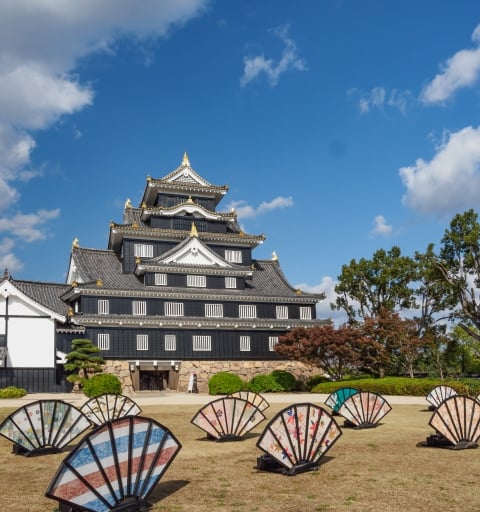
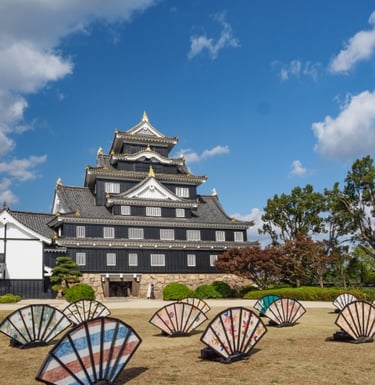
Okayama Castle stands directly across the Asahi River from Korakuen, and the sight of its black walls and gold accents reflected in the water — particularly at night, when the castle is floodlit — is one of the most striking images in western Japan. The castle earned its nickname Ujo — Crow Castle — from the distinctive black lacquered roof tiles that cover the exterior, in deliberate contrast to Himeji's famous White Heron Castle 80 kilometres to the east. The two castles make a fascinating comparison, and many travellers visit both on the same itinerary.
The original castle was completed in 1597 under the warlord Ukita Hideie, and the Ikeda clan — who commissioned Korakuen — later added the moon-viewing turret (Tsukimi Yagura) that still stands today as one of the only original surviving structures. The main keep was destroyed in wartime bombing in 1945 and reconstructed in concrete in 1966. A major renovation completed in 2022 significantly improved the interior, adding thoughtful multimedia exhibits on the castle's history, the Sengoku period, and the lords who governed from here. Visitors can also dress in feudal lord and princess costumes, try hands-on Bizen pottery making, and climb to the top floor for views over the city and Korakuen.
Best view: Rather than the interior, many visitors find the exterior view from Korakuen's south gate — the castle framed across the river against the garden's trees — the most memorable image of both sites. Aim to visit the garden in the morning and the castle in the early afternoon.
Admission: ¥400 adults, ¥100 children. Open daily 09:00–17:30. Combined ticket with Korakuen available.


3. Kurashiki Bikan Historical Quarter
Fifteen minutes west of Okayama on the JR Sanyo Line, Kurashiki is a different city entirely — and one of the most beautiful urban streetscapes in Japan. The Bikan Historical Quarter is a preserved district of Edo-period merchant architecture centred on the Kurashiki River canal, its white-walled kura (storehouses) reflected in the slow-moving water below willow trees. The area developed as a major rice trading hub in the 17th century, when Kurashiki was under direct Tokugawa shogunate control and the canals were used to transport rice to Osaka. The merchant wealth that resulted was invested in architecture, and what remains is extraordinary.
Walking through the Bikan Quarter, you pass buildings that have been converted from rice warehouses into museums, cafes, galleries, and craft shops — but whose exterior walls remain intact, the black-tiled roofs and white plaster unchanged from the Edo period. The canal itself is narrow enough to feel intimate rather than grand, and the combination of weeping willows, traditional architecture, and slow river boats creates one of the most atmospheric scenes in Japan.
Ohara Museum of Art: Japan's first Western art museum, opened in 1930 and housed in a beautifully converted kura. The collection includes works by El Greco, Monet, Matisse, Picasso, and a strong selection of Japanese modern and ceramic art. One of the best small art museums in the country.
Kurashiki River Boat Tour: 30-minute guided punting tours of the canal run daily from 09:00. Seeing the quarter from the water level gives a completely different perspective on the buildings and bridges. Book on-site or online.
Ivy Square: The former Kurashiki Spinning Mill — a late Meiji-era brick factory — converted into a hotel, event space, and restaurant complex with ivy-covered walls that are particularly beautiful in late October when they turn crimson.
When to visit: Kurashiki is very popular at weekends. Arriving by the first train from Okayama (around 08:00) gives you 60–90 minutes before the crowds arrive — the canal in the early morning light, with almost no one else there, is one of the finest experiences the region offers.
Access: JR Sanyo Line from Okayama Station to Kurashiki Station (about 15 minutes, covered by JR Pass). The Bikan Historical Quarter is a 15-minute walk south from the station.
4. Naoshima — Art Island in the Seto Inland Sea
Naoshima is one of the most talked-about art destinations in the world, and its reputation is deserved. A small, mostly rural island in the Seto Inland Sea — about 1.5 hours from Okayama via train and ferry — it has been transformed since the 1990s by the Benesse Corporation and architect Tadao Ando into a living installation of contemporary art where museum buildings, outdoor sculptures, and art-house hotels are integrated into the island's farms, fishing villages, and forested hills with remarkable sensitivity.
The effect is unlike anything else in Japan. You cycle past a pumpkin by Yayoi Kusama sitting at the end of a pier. You descend into a Tadao Ando bunker sunk into a hillside to find Monet's Water Lilies displayed in a pool of natural light. You walk through an old house in a traditional village neighbourhood to find the interior transformed into a site-specific artwork. The whole island is the museum, and the ferry journey across the inland sea — low islands, fishing boats, a sky that seems larger than usual — is part of the experience.
Chichu Art Museum: The centrepiece of the island — a Tadao Ando building constructed entirely underground, with natural light as the primary design element. Houses five Claude Monet Water Lilies paintings and works by James Turrell and Walter De Maria. Advance booking required; spaces are strictly limited. Admission ¥2,100.
Benesse House Museum: An art museum and hotel in a dramatic cliff-side location designed by Ando. The permanent collection includes major works by Richard Serra, Bruce Nauman, and Hiroshi Sugimoto. Accessible to day visitors and overnight guests.
Art House Project: Seven traditional houses in the Honmura village, each converted by a different artist into a permanent site-specific installation. The area is walkable and the contrast between the old village architecture and the contemporary works inside is quietly extraordinary. ¥1,050 for a combined ticket.
Yayoi Kusama's Pumpkins: The iconic yellow-and-black dotted pumpkin sculpture on the south pier is the island's most photographed image. A second red pumpkin sits at the ferry terminal. Both are free to see.
Planning your visit: Book Chichu Art Museum tickets well in advance on the official website — they sell out weeks ahead. A full day is the minimum for Naoshima; an overnight stay at Benesse House or one of the island's guesthouses allows you to experience the island after the day visitors leave, which is when it is most beautiful.
Access: JR Uno Line from Okayama Station to Uno Station (about 55 minutes, covered by JR Pass). Ferry from Uno Port to Naoshima (Miyanoura Ferry Terminal) takes about 20 minutes. Ferry fare is not covered by the JR Pass.
5. The Kibiji Cycling Trail
The Kibiji Cycling Trail is one of the most pleasant half-days in western Japan — a 17-kilometre cycling route through the Kibi Plain between Okayama and Soja, passing rice paddies, ancient burial mounds, lotus ponds, and a sequence of shrines and temples linked to the legend of Momotaro, Japan's beloved 'Peach Boy' folk hero. The route is almost entirely flat and well-signposted, running along quiet lanes and dedicated paths well away from main roads. Most cyclists cover it in two to three hours in one direction.
The route connects Bizen-Ichinomiya Station (a few minutes from Okayama by JR) to Soja Station (from where JR trains return to Okayama). Rental bicycles are available from shops adjacent to both stations for around ¥1,000–¥1,500 for a half-day. Most travellers cycle one direction only and take the train back.
Kibitsu Jinja Shrine: The oldest and most important shrine on the route — a sprawling 15th-century complex dedicated to Kibitsuhiko-no-Mikoto, the real-world warrior who is believed to have inspired the Momotaro legend. The covered 360-metre veranda connecting the main hall to the subsidiary shrine is designated a National Treasure.
Kibitsu-Hiko Jinja Shrine: A quieter, more intimate shrine just up the road from Kibitsu Jinja, with ancient camphor trees and a serene cedar forest approach. Often overlooked by cyclists rushing to the next stop — worth pausing at.
Tsukuriyama Kofun (Burial Mound): A 5th-century keyhole-shaped burial mound — one of the largest in Japan — visible from the trail. The scale is unexpected; it reads more as a forested hill than a man-made structure until you look at it from above on a map.
Kaya Shrine: A small, mossy Shinto shrine set back from the path in a bamboo grove. Quiet and atmospheric in a way that the more prominent shrines on the route are not.
Best time: The Kibiji Trail is particularly beautiful in spring (late March to early April) when the lotus ponds and rice paddies are beginning to green, and in autumn (October to November) when the fields are golden and the air is cool. Avoid summer midday heat — start before 09:00 or wait until late afternoon.
Access: JR Okayama Line from Okayama Station to Bizen-Ichinomiya Station (4 minutes). Bicycle rental shops are adjacent to the station.
6. Kibitsu Jinja — The Shrine at the Heart of the Momotaro Legend
If you are not cycling the full Kibiji Trail, Kibitsu Jinja deserves a visit in its own right — it is one of the most significant and architecturally unusual Shinto shrines in Japan, and one that receives a fraction of the visitors that comparably important shrines elsewhere in the country attract. The main hall, completed in 1425, uses a unique roof style found nowhere else in Japan — the kibitsu-zukuri style, combining two linked gabled roofs in a way that is completely distinct from the standard shrine architecture you will have seen elsewhere on your trip.
The shrine is dedicated to Kibitsuhiko-no-Mikoto, a legendary warrior who is believed to be the historical basis for Momotaro — the Peach Boy who defeats an oni (demon) with his animal companions. Okayama takes the Momotaro legend seriously and pervasively: statues of him stand outside the station, his face appears on local sweets, and the main shopping street running from the station is named Momotaro Avenue. Kibitsu Jinja is where the story begins.
The shrine's 360-metre roofed corridor connecting the main hall to the subsidiary Onametsu Shrine is designated a National Treasure and is the most atmospheric part of the complex. Walking its length — the wooden boards creaking underfoot, the corridor turning gently through the forest — is a specific and memorable experience. The surrounding garden, particularly the lotus pond, is beautiful in early summer.
Access: JR Kibi Line from Okayama Station to Bizen-Ichinomiya Station (about 10 minutes, covered by JR Pass), then a 15-minute walk. Can be combined with the start of the Kibiji Cycling Trail or visited independently.
Admission: Free. Open daily, grounds accessible at all times.
What to Eat in Okayama
Okayama has a food culture that is specific to the region in ways that are not always reflected in guidebooks. The city calls itself the 'Kingdom of Fruits' — and with good reason: the warm, sunny climate and fertile Kibi Plain produce Muscat grapes, white peaches, and strawberries that are considered among the finest in Japan. Beyond the fruit, there are several dishes that belong specifically to this region.
Barazushi: Okayama's most famous dish and one that is genuinely unlike anything else in Japan. A broad, shallow bowl of vinegared rice topped with a generous scatter of sashimi pieces, grilled conger eel, vegetables, eggs, and pickles — more a composed salad than sushi in the conventional sense. It is colourful, fresh, and deeply satisfying. Order it at lunch at any of the restaurants near Korakuen.
Mamakari (Sappa) pickled fish: A small fish — a kind of herring — pickled in sweetened vinegar and eaten with rice. The name means 'so delicious you have to borrow rice from the neighbours'. A Seto Inland Sea specialty that appears on most izakaya menus in the city.
Seasonal fruit: White peaches (late July to August) and Pione Muscat grapes (August to October) from the Kibi Plain are worth seeking out at the Okayama Central Market or at stands near the station. Fruit parlours serving elaborate parfaits with fresh local produce are found throughout the city.
Demi-katsu don: Okayama's version of the Japanese tonkatsu rice bowl, topped with a thick, slightly sweet demi-glace sauce rather than the usual egg-and-onion mixture. A local comfort food with its own devoted following.
Seafood from the Seto Inland Sea: Oysters, sea bream (tai), and octopus from the sheltered waters of the inland sea are available at fish markets and izakaya throughout the city. The calm, warm waters of the Seto Inland Sea produce particularly sweet seafood.
A One-Day Okayama Itinerary
One full day is enough for the city's core sights, with a half-day for Kurashiki or a morning on the Kibiji Trail. Here is a suggested sequence:
09:00 — Korakuen Garden. Arrive when the gates open and walk the full circuit before the crowds arrive. Allow 90 minutes.
10:30 — Okayama Castle. Cross the Tsurumi Bridge from the garden's south gate. Allow 45 minutes inside the main keep and grounds.
12:00 — Lunch near the castle. Try barazushi at one of the restaurants along Korakuen's approach street, or return toward the station and explore the Omotecho covered arcade for a wider choice.
13:30 — Train to Kurashiki. Take the JR Sanyo Line (15 minutes). Walk south to the Bikan Historical Quarter. Walk the canal, visit the Ohara Museum of Art, explore the converted warehouse shops. Allow 2.5–3 hours.
17:00 — Return to Okayama. Train back to Okayama Station.
18:00 — Evening in the city. Okayama Castle is illuminated after dark and worth a second look from the riverbank. Dinner at a seafood izakaya near the station — mamakari pickled fish and Seto Inland Sea oysters if available.
Two days: Use the second day for either Naoshima Island (allow a full day, start early to make the first ferry from Uno Port) or the Kibiji Cycling Trail with a visit to Kibitsu Jinja. If art is a priority, Naoshima is one of the most extraordinary experiences Japan offers and warrants the full day. If you prefer quiet, unhurried countryside, the Kibiji Trail is the better choice.
Which Rail Pass Is Right for Okayama?
If Okayama is part of a wider Japan trip from Tokyo or Osaka, the standard Japan Rail Pass covers all Shinkansen and JR local trains to and from Okayama, the JR Sanyo Line to Kurashiki, and the JR Uno Line to Uno Port for the Naoshima ferry. The Kibiji Cycling Trail access trains (JR Kibi Line) are also covered.
7-day JR Pass: Ideal for a Tokyo–Kyoto–Osaka–Hiroshima–Okayama route. Buy the 7-day JR Pass here
14-day JR Pass: Covers the longer itinerary that includes Kanazawa, Kyoto, Osaka, Okayama, Hiroshima, and the Sanyo corridor. Buy the 14-day JR Pass here
For a full comparison of pass options and how to calculate whether the pass pays for itself on your specific route, see our complete guide to the Japan Rail Pass.
Where to Stay in Okayama
The most convenient location is within walking distance of Okayama Station — easy Shinkansen connections in both directions and tram access to the castle and garden area. Hotel Granvia Okayama, directly connected to the station, is one of the most practical options; mid-range business hotels are plentiful in the immediate station area.
For those who prefer to base themselves in Kurashiki and make Okayama a day trip in reverse, the Bikan Historical Quarter has several ryokan and boutique hotels set in converted traditional buildings — a more atmospheric base, though slightly less convenient for Shinkansen connections.
Practical Tips for Visiting Okayama
Okayama is Japan's sunniest prefecture. It receives less rainfall than almost anywhere else in the country. This makes it a reliably good choice in seasons when other regions may be affected by rain, but also means sun protection is important in summer.
The combined Korakuen and Okayama Castle ticket saves money. ¥720 vs ¥900 for separate admission. Buy it at either entrance.
Book Chichu Art Museum on Naoshima well in advance. Tickets are released online and sell out weeks ahead, particularly at weekends. This is the one thing on this list that requires advance planning.
Kurashiki is busiest at weekends and during Golden Week. Arriving on the first train of the morning gives the best experience of the canal before the crowds.
Use your Suica card for the Okayama tram. The Okayama Electric Tramway accepts IC cards including Suica and Welcome Suica Mobile. ¥100 flat rate per ride.
The Naoshima ferry is not covered by the JR Pass. Budget approximately ¥1,200 for the return ferry fare from Uno Port to Naoshima.
Best season. Okayama is good year-round. Cherry blossoms at Korakuen in late March to early April are exceptional. The summer evening illuminations at Korakuen (August) and Okayama Castle are worth timing your visit around if you are in the region. Autumn foliage in November is excellent throughout the Bikan Quarter and Korakuen.
Why Okayama Is Worth the Stop
The argument for stopping in Okayama is not that it will overwhelm you. It will not. The city is not trying to overwhelm — it is not Kyoto, it is not Tokyo, it is not even Hiroshima. What it offers instead is a specific quality of Japanese city life that the most visited places on the Shinkansen route have largely lost: space, quiet, a sense that you are experiencing something on its own terms rather than as part of a managed tourist experience.
Korakuen is as fine a garden as Kenrokuen in Kanazawa, and it is considerably less crowded. The Kurashiki canal at 08:00 before the tour groups arrive is as beautiful as anything you will see in western Japan. The Kibiji Trail at any time of day is simply peaceful in a way that most of this country's famous sights are not. And Naoshima, for those willing to make the ferry journey, is genuinely extraordinary — a place that does not feel like the rest of Japan and is unlike anywhere else on earth.
Add one night. You have the JR Pass, the train stops here anyway, and the city rewards the traveller who bothers to get off. See our 17-day Central and Western Japan itinerary for the full route, and our complete JR Pass guide for everything you need to plan the journey. Buy your JR Pass here
Happy travels.