
Ashiyu in Tokyo: 7 Foot Bath Spots to Soak Tired Feet Between Sights
There is a particular kind of tiredness that only Tokyo produces. It comes not from any single thing but from the accumulation of everything: the sensory richness of Shinjuku at night, the long pavements of Asakusa, the distances between train exits and the places you actually wanted to be. By mid-afternoon on a Tokyo sightseeing day, your feet know about it before the rest of you does. Japan has a solution for this that is elegant, inexpensive, and genuinely effective. Ashiyu — the Japanese foot bath — is a small pool of hot water in which you soak your feet for ten or fifteen minutes while sitting on a bench and looking at something pleasant. You remove your shoes and socks, roll up your trousers, ease your feet in, and let the heat do what hot water has always done. No changing rooms, no nudity, no commitment. Just the immediate, uncomplicated relief of warm water on tired feet.
JR REGIONAL PASSKYOTOHOKURIKUCENTRAL JAPANFOODTOKYOOSAKA
Josh K
5/16/202610 min read
In traditional Japan, ashiyu were found at onsen towns — small pools beside railway stations or along river walks where travellers could rest between journeys. The tradition has survived in modern Tokyo in a variety of forms: rooftop gardens overlooking the bay, café settings where you can drink herbal tea while soaking, Shinjuku wellness centres with floor-to-ceiling windows over the neon, and one of the most dramatically located foot baths in the country — on a volcanic island that belongs, administratively, to Tokyo Metropolitan.
What follows is a guide to seven ashiyu spots in and around Tokyo, ranging from free public installations to paid café experiences. Some are stops you can build into a sightseeing day without much detour. Others are destinations worth visiting in their own right.
Before you go: Some ashiyu do not provide towels. Bring a small hand towel or pack a compact travel towel. A small bag to carry your socks is also useful. Sandals or easy slip-on shoes make the whole process considerably smoother.
Planning your Tokyo travel and beyond? Our Welcome Suica Mobile guide covers the IC card that makes navigating Tokyo's trains seamless — useful for reaching all of the spots below.
Visiting Tokyo with kids? Check this post as well: 20 Most Popular Things to Do in Tokyo for Families Using Trains
1. Senkyaku Banrai Ashiyu Garden — Toyosu
The newest and in many ways the most spectacular ashiyu in Tokyo is on the 8th floor of Toyosu Senkyaku Banrai, the Edo-themed food and entertainment complex that opened in February 2024 next to Toyosu Fish Market. The ashiyu garden is on an outdoor terrace with a 360-degree panoramic view over Toyosu, the waterfront, and central Tokyo. At night, the illuminated Rainbow Bridge and the glittering skyline of Tokyo Bay spread out before you as you soak.
The water at the Senkyaku Banrai foot bath is sourced from the famous hot springs of Hakone and Yugawara — genuine onsen water transported to the city. The 8th-floor Senkyaku Banrai Ashiyu Garden is free to use and open to the public without paying the Manyo Club onsen admission. Towels can be purchased on-site for ¥200 from a vending machine near the elevator. The terrace tends to get busy, particularly on weekends and on fine evenings — check the crowd indicator screen near the elevator before heading up.
Cost: Free (towel rental ¥200)
Hours: 10:00–20:00
Access: 2-minute walk from Ichiba-mae Station (Yurikamome Line)
Best for: Evening views of Tokyo Bay; combining with a seafood meal at the Toyosu Outer Market below
Combine your visit: The Edo-era food market at Toyosu Senkyaku Banrai has over 70 restaurants and stalls. Come for dinner at the market, then head upstairs for the foot bath with the night view. The nearby Toyosu Fish Market (Toyosu Shijo) is worth visiting on the same trip — tours of the inner market are available in the mornings.
2. Mominoki House — Shibuya
One of the most distinctive foot bath experiences in Tokyo. Mominoki House is a wellness café in the Dogenzaka area of Shibuya — a five-minute walk from the famous crossing — that offers Ayurvedic treatments alongside a foot bath that looks out over one of Tokyo's most kinetic streetscapes. The ashiyu pools are built into the seating along a large glass window on the upper floors, so you sit with your feet in warm water while Shibuya's streets and lights move below you.
The standard plan is ¥1,100 for a 45-minute foot bath with an Ayurvedic herbal tea. A ¥2,200 package adds a 45-minute shoulder or back massage. The atmosphere is calm, the staff are attentive and English-friendly, and the combination of the hot water, the tea, and the view of Shibuya from above creates a particularly effective counterpoint to the intensity of the streets below. This is the foot bath to visit if you want an actual pause in the day rather than a quick rest — 45 minutes is long enough to genuinely recover.
Cost: ¥1,100 for foot bath + herbal tea (45 min); ¥2,200 with massage
Hours: Check official website; generally 11:00–21:00
Address: 7F–8F Dogenzaka Crastos Building, 2-28-3 Dogenzaka, Shibuya
Access: 5 minutes from Shibuya Station Hachiko Exit
Best for: A proper mid-day or evening rest; solo travellers; couples
Book ahead: Mominoki House is popular and the foot bath seats are limited. Walk-ins are welcomed when space is available, but calling ahead or checking online is recommended for weekend visits.
3. Mominoki House — Ueno
The same concept as the Shibuya branch, but in a neighbourhood that could not be more different. The Ueno branch of Mominoki House is ideally positioned for anyone spending time in the Asakusa–Ueno–Akihabara corridor — three of Tokyo's most walked-on neighbourhoods, and consequently three of its most foot-tiring.
The Ueno ashiyu seats are arranged along windows looking out over the street below, with the same Ayurvedic herbal tea and the same 45-minute structure as the Shibuya branch (¥1,100). The area around Ueno is dense with sights — Senso-ji Temple is about 15 minutes walk, Ueno Park and its museums are around the corner — making this a natural midpoint rest on a full day in the eastern part of the city.
Cost: ¥1,100 for foot bath + herbal tea (45 min); ¥2,200 with massage
Access: 3-minute walk from Okachimachi Station (JR Yamanote Line); 2-minute walk from Ueno-Hirokoji Station (Tokyo Metro Ginza Line)
Best for: Mid-afternoon rest during a Ueno, Asakusa, or Akihabara day
4. Hogushiya Honpo Riraku — Shinjuku
Shinjuku is one of the most energetically overwhelming places in the world, and Hogushiya Honpo Riraku is the antidote. Located on Yasukuni-dori avenue, a few minutes from the neon towers of Kabukicho, this relaxation and massage centre offers foot bath sessions in seats positioned along large glass windows with a direct view of Shinjuku's streetscape below.
The foot bath session here runs for 70 minutes — considerably longer than most — at ¥1,540, and includes all-you-can-drink corn silk tea, rooibos tea, or hojicha (roasted green tea). An additional ¥880 adds a ten-minute shoulder or foot massage. The extended session makes this particularly good for anyone with genuinely sore feet who wants more than a quick soak — 70 minutes in warm water with unlimited tea is a serious recovery experience.
The contrast between the busy nightlife street visible through the window and the interior calm of the session is specifically enjoyable in Shinjuku. It is worth doing in the evening, when the neon is fully on and the street below is at its most theatrical.
Cost: ¥1,540 for 70-minute foot bath with unlimited tea; ¥880 extra for massage
Access: 6 minutes from JR Shinjuku Station East Exit; 7 minutes from Shinjuku-sanchome Station (Exit B3)
Best for: Evening visits; after a long day of walking in western Tokyo; anyone who wants maximum soak time
5. Ashiyu Café near Okachimachi — Ueno Area
In the streets around Ueno and Okachimachi — the retail district between Ueno and Akihabara famous for its electronics and outdoor goods shops — there is a small, traditional-style ashiyu café that runs on a simple and appealing model: the foot bath is free as long as you order something from the café, and a flat fee of ¥200 applies if you want to use the ashiyu without ordering.
The setting is warm and unhurried — wooden interior, a traditional atmosphere quite different from the glass-and-view aesthetic of the Mominoki House branches — and the staff are happy to explain the benefits of the bath in both Japanese and English. The café serves Japanese teas and light sweets. Bring a small towel; they are not provided. The foot bath water is changed regularly throughout the day.
This is the closest thing to a genuinely neighbourhood-scale ashiyu café in central Tokyo — less polished than the Mominoki or Riraku operations, more local, and all the better for it.
Cost: Free with any menu purchase; ¥200 foot bath only
Access: Yamanote Line to Okachimachi Station (South Exit); Metro Hibiya Line to Naka-Okachimachi (Exit 1); Metro Oedo Line to Ueno-Okachimachi (5 min walk)
Best for: A quiet mid-day break during a Ueno or Akihabara day; budget-conscious travellers
Note: Hours and specific location can vary — search 'ashiyu café Okachimachi' or check local listings before visiting, as smaller independent cafés in this category sometimes change operating hours.
6. Ashiyu Sky Deck — Haneda Innovation City
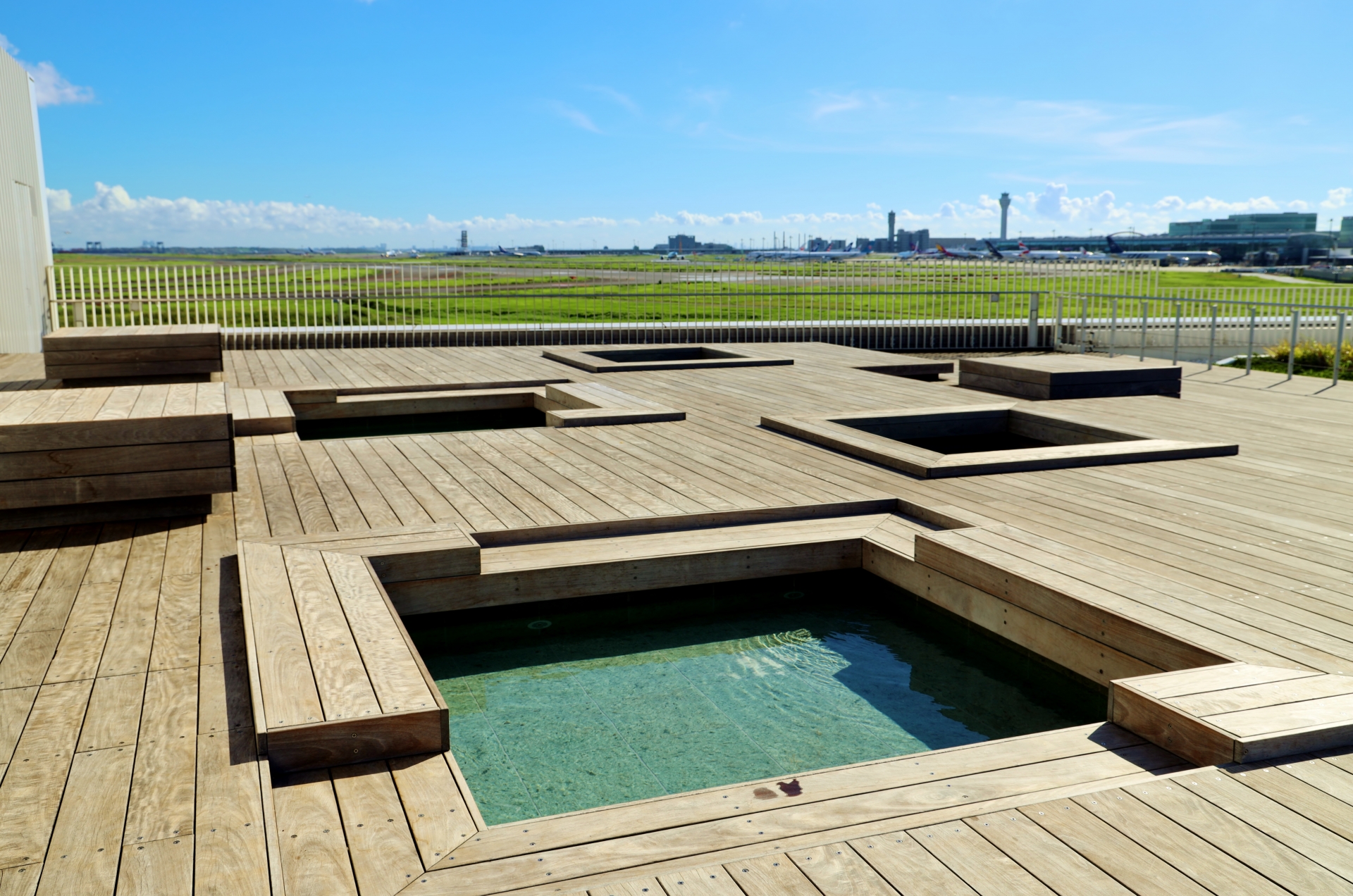
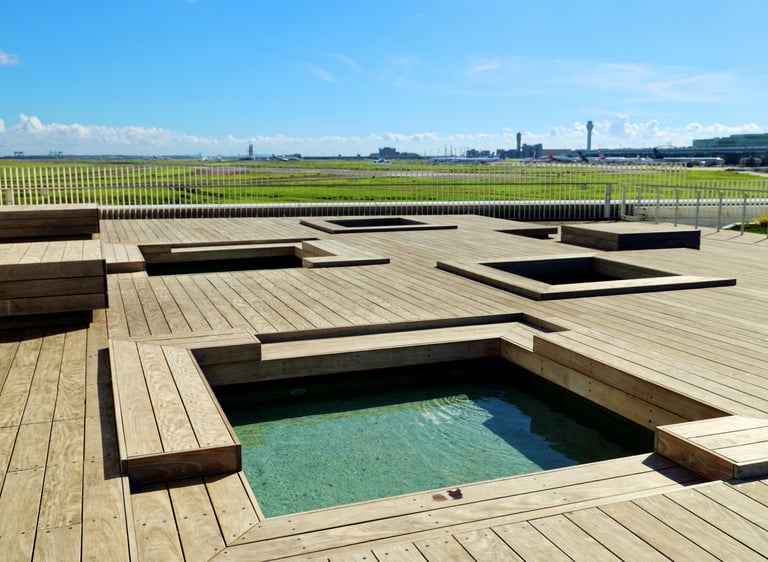
The most uniquely Tokyo ashiyu on this list. On the rooftop of Haneda Innovation City (HICity) — a cutting-edge cultural and technology complex directly connected to Tenkubashi Station, just one stop from Haneda Airport Terminal 3 — there is a free outdoor foot bath with a front-row view of one of the world's busiest airports. You soak your feet in warm water on a wooden deck while planes taxi, take off, and land on the runways directly in front of you. On a clear day, Mount Fuji is visible to the west.
The Ashiyu Sky Deck is completely free and open from 05:30 to 23:30 every day — making it one of the earliest-opening ashiyu in the city and an excellent option for travellers catching an early flight or arriving into Haneda. A towel vending machine on the deck means you do not need to bring your own. The deck is spacious enough that it rarely feels crowded, particularly on weekday mornings when the foot bath and the runway views are at their quietest and most peaceful.
HICity itself is worth a longer visit: the Innovation Corridor pedestrian path runs through the complex with restaurants focused on Japanese food culture, a Japanese teien-inspired garden with seasonal 'flower lanterns' that emit sound, VR experiences, and a self-driving bus shuttle. The combination of traditional ashiyu and aircraft taking off overhead is a specifically contemporary Tokyo experience that exists nowhere else.
Cost: Free (towel available from vending machine on-site)
Hours: 05:30–23:30 daily
Access: Directly connected to Tenkubashi Station (Keikyu Airport Line and Tokyo Monorail) — one stop from Haneda Airport Terminal 3
Best for: Plane spotters; early-morning or late-evening soaks; travellers passing through Haneda; a free and genuinely unusual Tokyo experience
Haneda arrival tip: If you have just landed at Haneda and your hotel check-in is not until the afternoon, the Ashiyu Sky Deck is one of the best ways to spend the wait — one stop from the terminal, free, with excellent views, and a completely effortless way to begin adjusting to Japan.
Also check: 10 Things to Do at Haneda Airport Terminal 3 with Your Family
What Is Ashiyu and Why Should You Try It?
Ashiyu is a specifically Japanese institution, and the concept is simple enough to explain in two sentences but benefits from a little context. The word combines ashi (足, foot) and yu (湯, hot water). It is a pool — usually outdoor or semi-outdoor, often bench-lined — in which you soak your feet and lower legs in warm, mineral-rich water while remaining fully clothed.
In Japan, ashiyu traditionally appeared wherever there were onsen — the natural hot springs that bubble from the volcanic geology beneath much of the country. Travellers who could not commit to a full bath could still benefit from the mineral water by soaking their feet beside the station or along the river walk. The tradition spread into parks, rest areas, temple approaches, and eventually city centres. Today, in its café and wellness centre form, it has become something slightly different — a deliberate urban pause, a small act of self-maintenance in a city that makes a great many demands on your body.
The health benefits are real if modest: soaking your feet in warm water increases circulation, reduces muscle tension in the legs, and triggers the same mild thermoregulatory response as a full bath. For most travellers it is less about medicine than about the specific pleasure of sitting somewhere calm with your feet in hot water, watching the world go by. After a full day in Tokyo, this is a considerable pleasure.
How to Use an Ashiyu — A Quick Guide
Bring a small towel. Most ashiyu do not provide towels. A compact hand towel or a quick-dry travel towel is all you need to dry your feet before putting your socks back on.
Wear easy footwear. Slip-on shoes, sandals, or anything that comes off quickly makes the experience more comfortable. Lace-up boots at the end of a long day are less fun.
Roll up your trousers. You soak from the feet to just below the knee. Rolling up trousers or loose-fitting bottoms before sitting down is the standard approach.
Ease in slowly. The water is usually hot — 40–43°C is typical. Lower your feet gradually rather than plunging in. Most people acclimatise within a minute or two.
Ten to fifteen minutes is the sweet spot. You do not need to soak for a long time to feel the benefit. In busy spots, keeping your session to a reasonable length allows others to use the bath.
Dry your feet thoroughly. Pat your feet dry before standing up and putting socks back on. This is both comfortable and considerate — wet feet on the surrounding area is the main etiquette concern at shared ashiyu.
No soap, no scrubbing. Unlike a full onsen, ashiyu do not require washing beforehand. Simply remove shoes and socks and soak.
Practical Tips
IC card payment. All the spots above are reachable by train or metro using your Suica IC card or Welcome Suica Mobile. Load sufficient balance before setting out — top-up machines and convenience stores are everywhere in Tokyo if you run low.
Best time of day. For rooftop and view-focused ashiyu (Toyosu Senkyaku Banrai, Manyo Club), the evening visit with the night view is the most rewarding. For café-style ashiyu (Mominoki, Riraku), mid-afternoon is both practical and quieter than evenings.
Weekday vs weekend. The free Toyosu Senkyaku Banrai ashiyu gets crowded at weekends and on fine evenings — check the crowd monitor by the elevator and be prepared to wait. Paid spots like Mominoki House are more reliably available, especially if you book ahead.
Children. Most ashiyu welcome children. The café-style spots with set sessions (Mominoki, Riraku) are better suited to adults who want a quiet rest; the open public ashiyu at Toyosu and on Niijima are suitable for all ages.
Tattoos. Ashiyu are generally more relaxed about tattoos than full onsen facilities. Outdoor and café-style ashiyu typically have no restriction. If visiting the Tokyo Toyosu Manyo Club for the full indoor bathing facilities, check current policy — many onsen facilities in Japan still prohibit tattoos.
The Case for Slowing Down
Tokyo rewards energy. The city is designed for movement — the trains are fast, the streets are full, the sights accumulate quickly. But it also rewards the occasional decision to stop. The ashiyu is a specifically Japanese form of that decision: not a full retreat, not an hour at the spa, just ten minutes with your feet in hot water and the city visible at a slight remove.
In a city where you will walk further than you expect and see more than you planned, the ashiyu is not a concession to tiredness. It is a recalibration. You get back on the train with feet that feel like they belong to you again. This is worth more than it sounds, especially on Day 3 of a Tokyo itinerary when the Shinkansen south is still two days away.
For the train journeys themselves — and how to get to and from Tokyo by Shinkansen — our complete guide to the Japan Rail Pass covers everything you need, and our 7-day JR Pass itinerary from Tokyo to Fukuoka lays out the full route from the capital southward.
Happy travels — and happy soaking.
Looking for a hotel in Japan?