
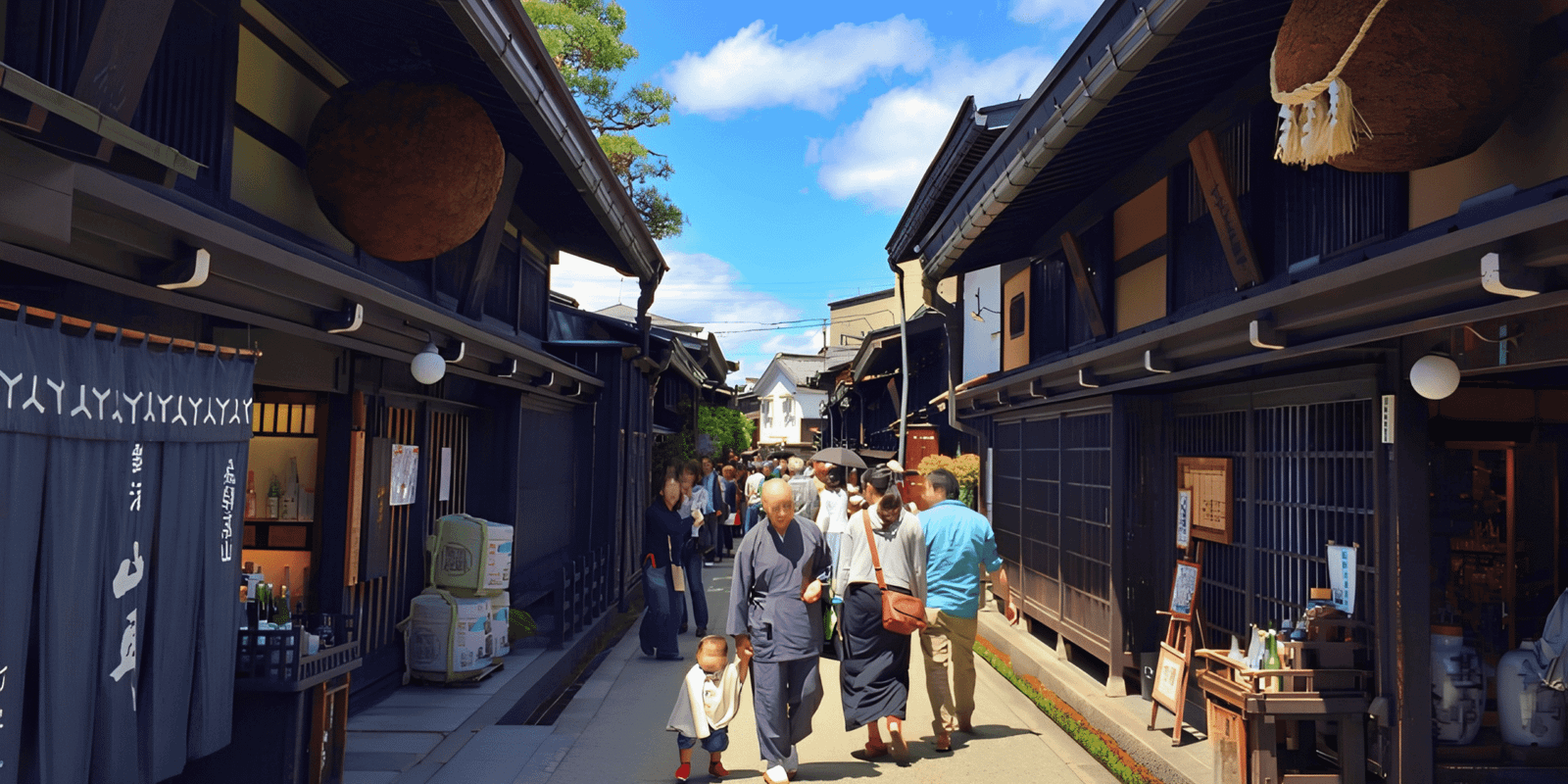
Hida Takayama and Shirakawa-go offer one of the best combinations of historic townscapes, mountain scenery, traditional food, and rural Japan in the Chubu region.
Takayama is a compact mountain city in Gifu Prefecture known for its beautifully preserved old town, traditional wooden merchant houses, morning markets, sake breweries, and Hida beef.
About 50 minutes away by bus, Shirakawa-go offers a very different experience. Its mountain village of traditional gassho-zukuri farmhouses is recognized as part of a UNESCO World Heritage Site and is one of Japan’s most distinctive countryside destinations.
Together, Takayama and Shirakawa-go fit especially well into a rail itinerary connecting Nagoya, Toyama, Kanazawa, and the Japanese Alps.
Why Visit Takayama?
A Beautifully Preserved Old Town
Takayama’s Sanmachi Historic District preserves rows of traditional wooden buildings dating from the city’s days as an important merchant and craft center.
The compact streets are filled with shops, cafés, sake breweries, restaurants, and historic buildings, making Takayama particularly enjoyable to explore on foot.
Easy to Explore Without a Car
Most of Takayama’s major central attractions are within walking distance of JR Takayama Station.
The Sanmachi old town is approximately a 15-minute walk from the station, so travelers can explore much of the city without relying on taxis or local buses.
Excellent Local Food
Takayama is also an excellent food destination. Local specialties include Hida beef, regional sake, Hoba miso, Takayama ramen, and traditional sweets.
Food stalls, markets, restaurants, and sake breweries are scattered throughout the old town, making local food easy to combine with sightseeing.
Why Visit Shirakawa-go?
A UNESCO World Heritage Village
Shirakawa-go is famous for its traditional gassho-zukuri houses, whose steep thatched roofs were designed to cope with the region’s heavy winter snowfall.
The historic villages of Shirakawa-go and nearby Gokayama were added to the UNESCO World Heritage List in 1995.
One of Japan’s Most Photogenic Rural Landscapes
The village of Ogimachi contains the largest concentration of gassho-zukuri houses in Shirakawa-go.
Walking among the farmhouses gives you a very different experience from Japan’s major cities, while the hillside viewpoint provides the classic panoramic view across the village.
Easy Day Trip from Takayama
Direct highway buses connect Takayama with Shirakawa-go in approximately 50 minutes.
This makes Takayama one of the most convenient bases for visiting Shirakawa-go without renting a car.
Takayama & Shirakawa-go at a Glance
| Destination | Best Known For | Recommended Time |
|---|---|---|
| Takayama | Historic old town, food, sake, markets | 1–2 days |
| Shirakawa-go | Gassho-zukuri farmhouses and UNESCO village | 3–5 hours |
| Takayama → Shirakawa-go | Direct highway bus | About 50 min |
Train Travel Japan Tip: Don’t treat Takayama simply as a transit point for Shirakawa-go. Takayama deserves at least one night of its own, while Shirakawa-go works very well as a half-day excursion or as a stop between Takayama and Kanazawa.
How to Get to Takayama by Train
Takayama does not have a Shinkansen station, but it is connected to Japan’s main rail network by the scenic JR Limited Express Hida.
For most travelers coming from Tokyo, Kyoto, or Osaka, the easiest route is to take the Tokaido Shinkansen to Nagoya and transfer there to the Limited Express Hida for Takayama.
| Starting Point | Recommended Route | Approx. Time |
|---|---|---|
| Nagoya | Limited Express Hida | About 2 hr 20–30 min |
| Toyama | Limited Express Hida | About 1 hr 30 min |
| Tokyo | Shinkansen to Nagoya + Limited Express Hida | About 4–4.5 hrs |
| Kyoto | Shinkansen to Nagoya + Limited Express Hida | About 3 hrs |
| Shin-Osaka | Shinkansen to Nagoya + Limited Express Hida | About 3.5 hrs |
From Nagoya to Takayama
From Nagoya Station, take the JR Limited Express Hida directly to Takayama.
The journey takes approximately 2 hours 20–30 minutes and is one of the most scenic limited express rides in central Japan.
After leaving the Nagoya area, the train follows the Hida River through increasingly mountainous scenery before reaching Takayama.
Train Travel Japan Tip: This is not simply a transfer. The Limited Express Hida journey is part of the experience, so try to travel during daylight if possible and enjoy the river and mountain scenery along the way.
From Toyama to Takayama
Selected Limited Express Hida trains connect Toyama and Takayama directly in approximately 90 minutes.
This makes Toyama an excellent gateway if you are approaching Takayama from the Hokuriku region.
However, not every Hida service operates between Toyama and Takayama, so check the current timetable before planning your journey around a specific departure.
From Tokyo to Takayama
The easiest rail route from Tokyo is:
- Take the Tokaido Shinkansen from Tokyo to Nagoya.
- Transfer at Nagoya Station.
- Take the Limited Express Hida from Nagoya to Takayama.
Allow roughly 4–4.5 hours in total, depending on the Shinkansen you use and the connection at Nagoya.
Connection tip: The Limited Express Hida runs much less frequently than the Tokaido Shinkansen. When planning this route, choose your Hida departure first and then select a Shinkansen that gives you a comfortable connection at Nagoya.
From Kyoto or Osaka to Takayama
From Kyoto or Shin-Osaka, the most straightforward route is also via Nagoya.
- Take the Tokaido Shinkansen to Nagoya.
- Transfer to the Limited Express Hida.
- Continue directly to Takayama.
Allow approximately 3 hours from Kyoto and around 3.5 hours from Shin-Osaka, depending on connections.
A limited number of Hida services may operate over longer routes involving Osaka, but for most visitors the Shinkansen connection at Nagoya is faster and provides much more scheduling flexibility.
Does the Japan Rail Pass Cover the Limited Express Hida?
Yes. The Japan Rail Pass covers eligible JR Limited Express Hida services, including the route between Nagoya and Takayama.
It also covers eligible JR Shinkansen travel used to connect with the Hida. On the Tokaido Shinkansen, standard Japan Rail Pass travel is available on Hikari and Kodama services.
Using a Nozomi with a Japan Rail Pass requires the separate JR Pass Nozomi/Mizuho supplementary ticket.
JR Pass tip: If your journey includes Tokyo, Nagoya, Takayama, and other distant destinations, the nationwide JR Pass may be useful. For a trip focused mainly on Takayama, Shirakawa-go, Kanazawa, and the Hokuriku region, a regional pass may provide better value.
Arriving at Takayama Station
JR Takayama Station is conveniently located close to the historic center.
The old town is approximately a 15-minute walk away, while the adjacent Takayama Nohi Bus Center is the main departure point for buses to Shirakawa-go and other destinations around the Japanese Alps.
Train Travel Japan Tip: If you arrive before hotel check-in, leave your luggage at your accommodation or use station-area storage and start exploring Takayama on foot. The compact center makes it very easy to begin sightseeing immediately after your train arrives.
How to Get from Takayama to Shirakawa-go
Shirakawa-go does not have a train station. For travelers staying in Takayama, the easiest public-transport option is the highway bus from the Takayama Nohi Bus Center, located beside JR Takayama Station.
Direct buses reach Shirakawa-go in about 50 minutes, making the village easy to visit as a half-day trip or as a stop while traveling onward toward Kanazawa or Toyama.
| Route | Transport | Approx. Time |
|---|---|---|
| Takayama → Shirakawa-go | Highway bus | About 50 min |
| Shirakawa-go → Kanazawa | Highway bus | About 1 hr 15 min |
| Takayama → Shirakawa-go → Kanazawa | Bus with sightseeing stop | Excellent one-way travel route |
Do You Need to Reserve the Shirakawa-go Bus?
Some Takayama–Shirakawa-go buses require reservations, while others operate with non-reserved seating.
On the current Nohi Bus timetable, reservation-required departures are marked with an “R.” Always check the schedule for your specific departure rather than assuming every bus works the same way.
My recommendation: If your itinerary depends on a particular bus, reserve a seat whenever a reservable departure is available. Shirakawa-go is extremely popular, especially during weekends, holidays, autumn foliage, and the winter snow season.
Non-reserved buses operate on a first-come, first-served basis. Extra buses may be added during busy periods, but if all available seats are filled, you may need to wait for a later departure.
Where Does the Bus Leave in Takayama?
Takayama Nohi Bus Center
Buses for Shirakawa-go depart from the Takayama Nohi Bus Center, immediately beside JR Takayama Station.
This makes the transfer very convenient if you arrive in Takayama on the Limited Express Hida.
Arriving at Shirakawa-go
Highway buses arrive at the Shirakawa-go Bus Terminal in Ogimachi.
The terminal is conveniently located on the northern side of the historic village, close to Wada House and within walking distance of the main gassho-zukuri sightseeing area.
The terminal has a waiting area, tourist information, ticket facilities, restrooms, and coin lockers.
What Should You Do with Your Luggage?
Highway buses normally have an underfloor luggage compartment for suitcases and larger bags.
However, space is shared among passengers and can be limited, so avoid traveling with unnecessarily large or excessive luggage.
If Shirakawa-go Is a Stopover
Leave your suitcase in a locker at the Shirakawa-go Bus Terminal while you explore Ogimachi, then collect it before boarding your onward bus.
This makes it practical to travel from Takayama to Shirakawa-go, sightsee for several hours, and continue to Kanazawa without returning to Takayama.
Train Travel Japan Tip: Shirakawa-go is much easier to explore without a suitcase. If you are changing hotels that day, use the bus terminal luggage facilities rather than dragging large bags through the village.
Takayama → Shirakawa-go → Kanazawa: The Best One-Way Route
One of the most efficient ways to include Shirakawa-go in a Japan itinerary is to use it as a sightseeing stop between Takayama and Kanazawa.
- Check out of your Takayama hotel in the morning.
- Take the highway bus from Takayama to Shirakawa-go.
- Store your luggage at the Shirakawa-go Bus Terminal.
- Spend around 3–5 hours exploring the village.
- Collect your luggage.
- Take an onward highway bus from Shirakawa-go to Kanazawa.
- Check into your Kanazawa hotel that evening.
The Shirakawa-go–Kanazawa bus journey takes approximately 1 hour 15 minutes on direct services.
This route saves considerable backtracking compared with visiting Shirakawa-go as a round trip from Takayama and then traveling separately to Kanazawa the following day.
Reservation tip: If you plan to use Shirakawa-go as a stopover, reserve your onward bus as well as your morning bus whenever required. Missing the later connection can significantly disrupt a one-way itinerary.
Does the Japan Rail Pass Cover the Shirakawa-go Bus?
No. The nationwide Japan Rail Pass does not cover the Nohi Bus to Shirakawa-go.
Your JR Pass can cover eligible rail travel to Takayama or from Kanazawa, but the highway bus portion normally requires a separate fare.
What About the Takayama-Hokuriku Area Tourist Pass?
The Takayama-Hokuriku Area Tourist Pass is different. It includes specified bus routes linking Takayama, Shirakawa-go, Kanazawa, Toyama, and Shin-Takaoka, making it particularly useful for this type of itinerary.
Some covered buses still require advance seat reservations. If you are using this regional pass, check the reservation procedure carefully before travel.
Important for pass holders: Nohi Bus currently states that passengers using the Takayama-Hokuriku Area Tourist Pass who need a reserved bus must make the reservation by telephone rather than through the normal online booking system.
Train Travel Japan Tip: For a route such as Nagoya → Takayama → Shirakawa-go → Kanazawa → Kyoto or Osaka, compare the Takayama-Hokuriku Area Tourist Pass with the nationwide JR Pass before buying either one. The regional pass specifically includes bus travel through Shirakawa-go, which the nationwide JR Pass does not.
Continuing to Kanazawa? Read my Kanazawa by Train guide for station access, sightseeing, rail passes, and onward train connections.
What to See and Do in Takayama
Central Takayama is compact and easy to explore on foot. For a first visit, I would focus on the morning markets, Takayama Jinya, Sanmachi Historic District, sake breweries, and local food.
These attractions are all close together, so you can see the main highlights without constantly using buses or taxis.
1. Sanmachi Historic District
Sanmachi is the heart of Takayama’s preserved old town. The streets are lined with traditional wooden merchant houses, lattice-fronted shops, cafés, restaurants, sake breweries, and small museums.
The area developed as an important commercial center and still preserves much of its historic character.
Sanmachi is approximately a 12–15 minute walk from JR Takayama Station.
Train Travel Japan Tip: Visit Sanmachi earlier in the morning or later in the afternoon if you want to experience the traditional streets with fewer tour groups.
2. Takayama Morning Markets
Takayama has two well-known morning markets: the Miyagawa Morning Market along the river and the Jinya-mae Morning Market in front of Takayama Jinya.
Depending on the season and vendor, you may find local vegetables, fruit, pickles, flowers, sweets, crafts, souvenirs, and other regional products.
The markets generally finish around noon, so visit them before doing the rest of your sightseeing.
3. Takayama Jinya
Takayama Jinya is one of the city’s most important historic sites.
During the Edo period, Takayama came under direct control of the Tokugawa shogunate, and the Jinya served as the local government headquarters for officials sent to administer the region.
The complex includes traditional rooms, administrative areas, courtyards, and storehouses and offers useful historical context before exploring the merchant streets of Sanmachi.
4. Visit a Takayama Sake Brewery
Takayama has a long-established sake-brewing tradition, supported by the region’s cold climate, clean mountain water, and local rice.
Several breweries are located within the old town. Look for the large sugidama — balls made from cedar leaves — hanging outside brewery entrances.
Depending on the brewery, visitors may be able to purchase tastings or sample different local sake varieties.
Good to know: Brewery hours and tasting arrangements vary, so treat sake tasting as a flexible part of your walk rather than building your entire itinerary around one particular brewery.
5. Try Hida Beef and Local Takayama Food
Food is one of the highlights of Takayama. The best-known specialty is Hida beef, which appears in everything from full steak meals to sushi-style bites and street-food snacks.
Other dishes worth looking for include Hoba miso, Takayama ramen, local pickles, traditional sweets, and regional sake.
The old town makes it easy to sample smaller items as you walk, so you do not necessarily need to save everything for one large meal.
6. Miyagawa River
The Miyagawa River runs through central Takayama and provides a pleasant walking route beside the old town.
The Miyagawa Morning Market occupies part of the riverbank in the morning, while bridges across the river connect naturally with Sanmachi and the surrounding sightseeing streets.
7. Higashiyama Walking Course
If you have extra time in Takayama, the Higashiyama Walking Course offers a quieter alternative to the busy old-town streets.
The route passes through a peaceful area of temples, shrines, wooded paths, and traditional residential streets on the eastern side of the city.
It is a good choice if you enjoy walking and want to see a less commercial side of Takayama.
Train Travel Japan Tip: Add the Higashiyama area after exploring Sanmachi and Takayama Jinya rather than trying to squeeze it into a short half-day visit.
8. Hida Folk Village
Hida Folk Village is an open-air museum featuring traditional houses relocated from communities around the Hida region.
The buildings help explain the traditional architecture and rural lifestyle of the Japanese Alps, making it a worthwhile addition if you have a full day in Takayama.
Unlike the main old-town sights, Hida Folk Village is outside the central walking area, so allow additional time to reach it from Takayama Station.
Train Travel Japan Tip: If you are also visiting Shirakawa-go, I would treat Hida Folk Village as optional. Shirakawa-go gives you the experience of seeing traditional houses in their original village setting.
Suggested First-Time Walking Route in Takayama
- Start at JR Takayama Station.
- Walk to the Jinya-mae Morning Market.
- Visit Takayama Jinya.
- Cross into the Sanmachi Historic District.
- Explore the traditional streets and sake breweries.
- Stop for Hida beef or another local specialty.
- Walk toward the Miyagawa River and market area.
- Continue exploring the old town at a relaxed pace.
How Much Time Do You Need in Central Takayama?
| Time Available | What You Can Do |
|---|---|
| 3–4 hours | Morning market, Takayama Jinya, and Sanmachi |
| Half day | Main sights plus lunch, sake, and relaxed old-town walking |
| Full day | Central sights plus Higashiyama Walking Course or Hida Folk Village |
My recommendation: Spend at least one night in Takayama and give the city a proper half day or full day of its own. That lets you enjoy the old town in the morning and evening rather than seeing it only during the busiest middle part of the day.
What to See and Do in Shirakawa-go
Most visitors to Shirakawa-go spend their time in Ogimachi, the largest and best-known gassho-zukuri village in the World Heritage area.
The village is compact enough to explore on foot, but I recommend allowing around 3–4 hours rather than rushing through it in one or two hours.
1. Walk Through Ogimachi Village
The main attraction is simply walking through the historic village and seeing the traditional gassho-zukuri farmhouses in their original mountain setting.
The steep thatched roofs resemble hands joined in prayer and were designed to cope with the heavy snowfall of this region.
Take time to explore the smaller lanes, waterways, rice fields, traditional homes, and views toward the surrounding mountains rather than walking only along the busiest main road.
Important: Shirakawa-go is not an open-air theme park. Many of the gassho-zukuri houses are still private homes. Stay on public paths, respect signs, and do not enter private property simply to take photographs.
2. Visit Wada House
Wada House is one of the best places to see the interior of a traditional gassho-zukuri farmhouse.
It is one of the largest gassho-style houses in the World Heritage village and is designated an Important Cultural Property of Japan.
The building is still used as a residence, but parts of the first and second floors are open to visitors. Seeing the interior helps explain how these enormous thatched houses were actually used by local families.
Wada House is only about a 4-minute walk from Shirakawa-go Bus Terminal, making it an easy first stop after arriving.
3. Go Up to the Ogimachi Castle Site Observatory
For the classic panoramic view of Shirakawa-go, head to the Ogimachi Castle Site Observatory above the village.
From the viewpoint, you can see the gassho-zukuri houses spread across the valley with mountains rising behind them. It is one of the best places to understand the layout and setting of the entire village.
You can reach the observation area on foot or by shuttle bus.
Current access note: Private vehicles cannot drive to or park at the Ogimachi Castle Site Observatory. Visitors should walk or use the observation-deck shuttle bus. Check the current shuttle schedule before your visit, especially during winter or poor weather.
4. Cross Deai Bridge
Deai Bridge is the pedestrian suspension bridge crossing the Sho River between the World Heritage village and the Seseragi Park side.
The bridge provides attractive views of the river and surrounding mountains and is also one of the main pedestrian gateways into Ogimachi for visitors arriving from the parking area.
5. Gassho-zukuri Minkaen Outdoor Museum
If you want to see more traditional buildings, consider visiting the Gassho-zukuri Minkaen Outdoor Museum near Deai Bridge.
The museum contains more than 20 relocated gassho-style buildings, including farmhouses and other traditional structures. Some can be entered, giving you another chance to examine the construction and interiors at close range.
I would treat this as an optional addition if you have four to five hours rather than squeezing it into a short visit.
How Much Time Do You Need in Shirakawa-go?
| Time Available | What You Can Do |
|---|---|
| About 2 hours | Quick walk through Ogimachi and village photos |
| 3–4 hours | Ogimachi, Wada House, observation deck, and relaxed walking |
| 4–5 hours | Everything above plus lunch and the outdoor museum |
My recommendation: Allow around 3–4 hours for your first visit. This works especially well when using Shirakawa-go as a stop between Takayama and Kanazawa.
Suggested Shirakawa-go Walking Route
- Arrive at Shirakawa-go Bus Terminal.
- Visit Wada House.
- Walk or take the shuttle to the observation deck.
- Return downhill and explore the lanes of Ogimachi.
- Stop for lunch or a local snack.
- Walk toward Deai Bridge.
- Add the Gassho-zukuri Minkaen Outdoor Museum if time allows.
- Return to the bus terminal for your onward journey.
Train Travel Japan Tip: Avoid scheduling your onward bus too tightly. Shirakawa-go is much more enjoyable when you can wander through the village at a relaxed pace rather than constantly checking the time.
Best Time to Visit Takayama and Shirakawa-go
Takayama and Shirakawa-go are beautiful throughout the year, but the atmosphere changes dramatically with the seasons.
For most first-time visitors, I would choose spring or autumn for the best balance of scenery, comfortable walking weather, and easier transportation.
Spring — Comfortable Weather and Festival Season
Spring is an excellent time to visit Takayama. Temperatures gradually become more comfortable, although mornings and evenings can still feel quite cool because of the city’s mountain location.
One major attraction is the Spring Takayama Festival, held every year on April 14 and 15.
The festival features beautifully decorated yatai floats, traditional processions, marionette performances, and an evening procession with illuminated floats.
Festival warning: Takayama becomes extremely busy during the festival. Book accommodation and transportation well in advance if your trip falls on April 14 or 15.
Summer — Green Mountains and Longer Days
Summer brings lush green scenery throughout the Japanese Alps. Shirakawa-go is surrounded by green mountains and rice fields, creating a very different appearance from its famous winter landscape.
Takayama is generally cooler at night than Japan’s major lowland cities, but daytime temperatures in July and August can still become hot.
The rainy season normally affects early summer, so bring rain protection if visiting in June or early July.
Autumn — One of the Best Times to Visit
Autumn is one of my favorite seasons for this region. Cooler temperatures make walking comfortable, and the surrounding mountains gradually turn red, orange, and yellow.
Around central Takayama, autumn colors often become especially attractive from late October into early November.
Shirakawa-go’s official tourism information also identifies late October to early or mid-November as the usual peak period for autumn foliage, depending on the weather that year.
Autumn Takayama Festival
The Autumn Takayama Festival is held annually on October 9 and 10.
Like the spring festival, it includes ornate festival floats, processions, traditional performances, and evening events.
If you enjoy Japanese festivals, this can be an excellent time to visit, but accommodation demand and crowds are much higher than normal.
Winter — The Most Dramatic Scenery
Winter completely transforms both Takayama and Shirakawa-go. Snow-covered traditional buildings create some of the most memorable scenery in central Japan.
Shirakawa-go is located in one of Japan’s heavy-snow regions. Significant snow commonly accumulates from late December through February.
Takayama is also very cold in winter, with temperatures frequently dropping below freezing and snow or ice common on streets and paths.
Winter footwear matters: Wear waterproof shoes or boots with good grip. Takayama’s official tourism guidance recommends non-slip footwear because snow and ice can make walking hazardous.
What About the Shirakawa-go Winter Light-up?
Shirakawa-go is famous for special winter illumination events, when snow-covered gassho-zukuri houses are lit after dark.
However, these events are not simply normal evening sightseeing. Access arrangements, reservations, transportation, and viewing rules can change from year to year.
Important: If the winter light-up is a major reason for your trip, check the official Shirakawa-go information for that specific year before booking accommodation or transportation. Do not assume you can simply arrive in the village that evening.
Which Season Is Best for You?
| Season | Best For | Main Consideration |
|---|---|---|
| Spring | Comfortable sightseeing, blossoms, Takayama Festival | Festival dates can be extremely busy |
| Summer | Green scenery and longer daylight hours | Rain and daytime heat |
| Autumn | Foliage, comfortable walking, Takayama Festival | Popular weekends can be crowded |
| Winter | Snow scenery and traditional atmosphere | Cold, ice, snow, and transport disruption |
My recommendation: For a first trip, choose late October or early November if your dates are flexible. You get beautiful mountain scenery without the more difficult winter conditions. If snow-covered Shirakawa-go is your priority, winter is unforgettable, but build more flexibility into your itinerary.
How Many Days Do You Need for Takayama and Shirakawa-go?
At minimum, I recommend allowing two days and one night for Takayama and Shirakawa-go.
This gives you time to explore Takayama’s old town and morning market, stay overnight in the city, and visit Shirakawa-go the following day.
If your itinerary allows it, two nights in Takayama makes the trip much more relaxed and gives you more flexibility with bus connections, weather, and sightseeing.
| Time Available | Recommended Plan |
|---|---|
| 1 day | Takayama only, or a very rushed combination |
| 2 days / 1 night | Takayama + Shirakawa-go highlights |
| 3 days / 2 nights | Relaxed Takayama visit + Shirakawa-go |
| 3+ days | Add Kanazawa, Toyama, Okuhida, or other Japanese Alps destinations |
Option 1: Takayama + Shirakawa-go in 2 Days / 1 Night
Day 1 — Arrive in Takayama
- Travel to Takayama by Limited Express Hida.
- Leave your luggage at your hotel.
- Visit Takayama Jinya.
- Explore the Sanmachi Historic District.
- Visit a sake brewery or try local snacks.
- Have Hida beef or another regional specialty for dinner.
- Stay overnight in Takayama.
Day 2 — Morning Takayama + Shirakawa-go
- Visit one of Takayama’s morning markets.
- Return to your hotel and collect your luggage.
- Take the highway bus to Shirakawa-go.
- Store your luggage at the bus terminal.
- Spend around 3–4 hours exploring Ogimachi.
- Visit Wada House and the observation deck.
- Return to Takayama or continue onward to Kanazawa.
Best use of one night: If Kanazawa is your next destination, continue from Shirakawa-go to Kanazawa rather than returning to Takayama. This avoids unnecessary backtracking.
Option 2: Takayama + Shirakawa-go in 3 Days / 2 Nights
This is my preferred option if Takayama is an important part of your trip.
Day 1 — Arrive and Explore Takayama
- Arrive by Limited Express Hida
- Explore Sanmachi
- Visit Takayama Jinya
- Try local sake and Hida beef
Day 2 — Shirakawa-go Day Trip
- Take a morning bus to Shirakawa-go
- Explore Ogimachi for 3–4 hours
- Visit Wada House and the observation deck
- Return to Takayama during the afternoon
- Enjoy a quieter evening in Takayama
Day 3 — Takayama Morning and Onward Travel
- Visit the morning market
- Enjoy any remaining old-town sights
- Check out and continue to Nagoya, Toyama, or another destination
Two nights also give you some protection against poor weather or a disrupted bus schedule and allow you to experience Takayama outside the busiest daytime sightseeing period.
Option 3: Takayama → Shirakawa-go → Kanazawa
For travelers continuing through central Japan, this is often the most efficient itinerary.
- Spend one or two nights in Takayama.
- Check out in the morning.
- Take the highway bus to Shirakawa-go.
- Store luggage at the Shirakawa-go Bus Terminal.
- Explore the village for around 3–4 hours.
- Collect your luggage.
- Take the onward bus to Kanazawa.
- Stay overnight in Kanazawa.
This creates a natural route through the Japanese Alps without retracing your journey.
Train Travel Japan Tip: When using Shirakawa-go as a stopover, reserve your onward bus before the trip if your chosen service requires reservations. Do not wait until you arrive in the village to decide how you will continue to Kanazawa.
Can You Visit Takayama and Shirakawa-go in One Day?
Technically yes, but I do not recommend it if you are traveling from a major city such as Tokyo, Kyoto, or Osaka on the same day.
Takayama deserves time of its own, and the Limited Express Hida journey plus the bus to Shirakawa-go makes a same-day visit unnecessarily rushed.
If you are already staying in Takayama, however, Shirakawa-go is very manageable as a half-day excursion.
Should You Stay Overnight in Shirakawa-go?
Most travelers can see the major sights as a day visitor, but an overnight stay offers a very different experience.
Staying in or near the village lets you experience Shirakawa-go after many day-trip buses have departed and gives you the opportunity to stay in a traditional local guesthouse or gassho-style accommodation.
Consider staying overnight if you want to:
- Experience the village early in the morning or after day-trippers leave
- Stay in traditional accommodation
- Travel at a slower pace
- Spend more time photographing the village
- Explore beyond the main Ogimachi sightseeing route
My recommendation: For most first-time visitors, spend one or two nights in Takayama and visit Shirakawa-go for several hours. If Kanazawa is next, use Shirakawa-go as your sightseeing stop between the two cities.
Takayama & Shirakawa-go FAQ
Is Takayama worth visiting?
Yes. Takayama is one of central Japan’s most enjoyable historic towns, with preserved streets, morning markets, sake breweries, Hida beef, Takayama Jinya, and easy access to Shirakawa-go.
How many days do you need in Takayama?
I recommend at least one night, with two nights being better if you also want to visit Shirakawa-go without rushing.
How long does it take from Nagoya to Takayama by train?
The JR Limited Express Hida takes approximately 2 hours 20–30 minutes from Nagoya to Takayama, depending on the service.
Is the Limited Express Hida covered by the Japan Rail Pass?
Yes. Eligible JR Limited Express Hida services are covered by the nationwide Japan Rail Pass.
Is there a train to Shirakawa-go?
No. Shirakawa-go does not have a train station. Most travelers reach it by highway bus from Takayama, Kanazawa, Toyama, or another nearby transport hub.
How long does the bus from Takayama to Shirakawa-go take?
Direct highway buses generally take about 50 minutes.
Do you need to reserve the bus to Shirakawa-go?
Some departures require reservations and others do not. Check your exact Nohi Bus service before travel and reserve in advance when required, especially during busy periods.
How much time do you need in Shirakawa-go?
For a first visit, allow around 3–4 hours. That gives you time to explore Ogimachi, visit Wada House, see the observation deck, and walk through the village without rushing.
Can you visit Takayama and Shirakawa-go in one day?
You can if you are already staying in Takayama, but I would not recommend traveling from Tokyo, Kyoto, or Osaka and trying to see both destinations properly on the same day.
Is Shirakawa-go better as a day trip or a stopover?
Both work well, but using Shirakawa-go as a stop between Takayama and Kanazawa is especially efficient because it avoids returning to Takayama after sightseeing.
Does the Japan Rail Pass cover the Shirakawa-go bus?
No. The nationwide Japan Rail Pass does not cover the Nohi Bus to Shirakawa-go. A separate fare is normally required.
Does the Takayama-Hokuriku Area Tourist Pass cover Shirakawa-go?
Yes. The pass includes specified bus routes connecting Takayama, Shirakawa-go, Kanazawa, Toyama, and Shin-Takaoka, although some services still require advance seat reservations.
What is the best season to visit Takayama and Shirakawa-go?
Spring and autumn are the easiest overall for comfortable sightseeing. Winter offers the most dramatic snow scenery, but it also requires warmer clothing, better footwear, and more flexibility for transport.
Related Guides
5-Day Takayama-Hokuriku Area Tourist Pass Itinerary
See how to travel from Nagoya through Takayama, Shirakawa-go, Kanazawa, Kyoto, and Osaka using the Takayama-Hokuriku Area Tourist Pass.
Inuyama Castle: A Timeless Samurai Treasure
Staying in Nagoya before heading to Takayama? Inuyama Castle is an easy half-day trip and one of Japan’s rare surviving original National Treasure castles.
JR Regional Passes Guide
Compare regional rail passes around Japan, including options designed for travel through Takayama, Shirakawa-go, Kanazawa, and the Hokuriku region.
Before You Buy a JR Pass
Compare the cost of your planned train journeys with the current JR Pass price. Depending on your route, individual tickets or a regional pass may offer better value.
Check Current JR Pass PricesAbout Train Travel Japan
Train Travel Japan is written from firsthand experience traveling throughout Japan by rail. I am a Japanese native based in Canada and have traveled to all 47 prefectures of Japan over more than 30 years.
My goal is to make Japan train travel easier to understand, especially for international visitors planning JR Pass trips, regional rail journeys and independent itineraries.