
Hakodate, Hokkaido: Complete Train Travel Guide
Hakodate has a quality that is difficult to name precisely but immediately felt when you arrive: it is a city that has seen the world, on its own terms, in its own way. In 1854, when the Japan–US Treaty of Amity forced Hakodate open as one of Japan's first international ports, the city became a place where ten foreign nations established consulates, where Russian Orthodox missionaries built onion-domed churches on steep cobblestone hillsides, where French Catholic and British Anglican congregations erected their own buildings within walking distance of each other, and where wealthy Japanese merchants began constructing Western-style wooden homes that still stand today. That layered history is visible in the architecture of Motomachi, audible in the Russian choral music drifting from a century-old Orthodox church, and present in the extraordinary variety of the morning seafood market.
JR PASS 7 DAYSJR PASS 14 DAYSJR REGIONAL PASSHOKKAIDOFOODNATURE GETAWAYSHISTORICAL SITESAKURA CHERRY BLOSSOMS
Josh K
4/18/202612 min read


Hakodate is also, by general consensus, the possessor of one of the three greatest night views in Japan. From the summit of Mount Hakodate — 334 metres above the city — the peninsula stretches out below like a narrow isthmus caught between two bays, the city lights spread across it on both sides, the dark water glittering at every edge. It is one of those views that lives up to its reputation.
This guide covers everything you need to visit Hakodate by train: how to get here from Tokyo and Sapporo, how the local tram network works, what to see and do, what to eat, and how to fit Hakodate into a wider Hokkaido or Japan itinerary. Recommended stay: one to two nights. One day is enough to see the highlights; a second day rewards slower exploration and gives you the morning market at dawn without rushing for a train.
Planning a broader Hokkaido trip? Our 6-day Hokkaido itinerary using the JR Regional Pass covers Hakodate as the final stop on a circuit including Sapporo, Asahikawa, Furano, and Otaru. For the full north-to-south Japan journey that passes through Hakodate, see our 15-day Sapporo to Fukuoka itinerary.
Getting to Hakodate by Train
Hakodate sits at the southern tip of Hokkaido, connected to Honshu via the Seikan Tunnel — the world's longest undersea railway tunnel at 53.85 kilometres. The city has two relevant stations: Shin-Hakodate-Hokuto (the Shinkansen terminus) and Hakodate Station (the city's main station, where the trams depart and the morning market is located).
From Tokyo — Hokkaido Shinkansen
Take the Tohoku Shinkansen north from Tokyo to Shin-Aomori, then the Hokkaido Shinkansen (Hayabusa service) through the Seikan Tunnel to Shin-Hakodate-Hokuto Station. Total journey: approximately 4 hours, fully covered by the Japan Rail Pass. At Shin-Hakodate-Hokuto, transfer to the Hakodate Liner — a local JR connecting train to Hakodate Station in about 20 minutes, also covered by the JR Pass. Reserve your Shinkansen seat in advance (free with the pass).
Tip: Sit on the right-hand side of the train (facing direction of travel) for Pacific coast views through Aomori. After the Seikan Tunnel, the left-hand side gives the first views of Hokkaido.
From Sapporo — Limited Express Hokuto
The Limited Express Hokuto runs between Sapporo and Hakodate in approximately 3 hours 30 minutes, covered by both the JR Pass and the JR Hokkaido Regional Pass. The train follows the coast for much of the journey — sit on the left side heading south for the best ocean views. Reserve seats in advance, especially on weekends.
JR Hokkaido Regional Pass: If your trip is focused on Hokkaido only, this regional pass covers all JR Hokkaido trains including the Hokuto and the Hakodate Liner — at a lower price than the nationwide JR Pass. See our JR Regional Passes guide for a full comparison. Buy the JR Hokkaido Pass here
From Hakodate Airport
Hakodate Airport (HKD) has direct flights from Tokyo (Haneda and Narita), Osaka, and Nagoya. A shuttle bus runs to Hakodate Station in about 20 minutes for ¥450. A taxi costs around ¥2,500–¥3,000. The airport is 8 kilometres east of the city centre.
At Hakodate Station
The station is compact and easy to navigate. Inside you will find the JR Ticket Office (Midori no Madoguchi, open 05:30–22:00) for pass exchanges, reservations, and train information; the Twinkle Plaza Travel Service (10:00–18:00) for rail pass purchases; and the Tourist Information Center for English maps and sightseeing help. The Morning Market is one block southwest — close enough to walk to before checking into your hotel.
Getting Around Hakodate — The City Tram
Hakodate's city tram (streetcar) is the backbone of sightseeing transport. Old, slow, and enormously charming, it connects almost every destination you will want to reach. Two lines operate from Hakodate Ekimae (station front):
Line 2: Hakodate Ekimae → Jujigai (Motomachi district and Mt. Hakodate Ropeway) → Yunokawa Onsen
Line 5: Hakodate Ekimae → Goryokaku-koen-mae (Goryokaku Fort) → Yunokawa
A single ride is ¥260 flat-rate. A one-day tram pass costs ¥600, pays for itself after three journeys, and is available from the Tourist Information Center at Hakodate Station or from tram drivers. Trams run 06:00–22:30, every 6–12 minutes.
Important: Your Suica or Welcome Suica Mobile card does not work on the Hakodate tram — it is run by a separate operator. Have cash ready, or buy the day pass. The day pass is strongly recommended if you are visiting more than two or three stops in a day.
Find the best hotel in Hakodate or Hokkaido
What to See and Do in Hakodate
Hakodate Morning Market (Asaichi)
The morning market is the best reason to wake up early in Hakodate — and one of the most purely pleasurable food experiences in Hokkaido. It has been operating since the 1940s; around 250 stalls spread across a covered arcade one block from the station, opening at 05:00 (06:00 in winter) and running until roughly noon, with the energy at its peak in the early morning when the catch is freshest.
The market specialises in Hokkaido's cold-water seafood: live Hakodate squid (May–October), crab, sea urchin (uni), salmon roe (ikura), and scallops. Several restaurants within the market serve kaisendon — fresh seafood rice bowls where you select your own toppings from whatever is fresh that morning. This is among the finest breakfasts available anywhere in Japan.
Squid fishing (summer, May–October): Some stalls operate small tanks where you catch your own squid and have it prepared in front of you — sashimi, grilled, or tempura. Genuinely fun, genuinely delicious.
Hakodate Shio Ramen: Several stalls and small restaurants within the market serve the city's signature clear salt-broth ramen alongside the seafood. A bowl at 07:00 is a different experience from lunchtime.
Arrive early. By 09:00 the best fresh seafood is often gone and tour groups begin to arrive. Weekday mornings between 06:00 and 08:30 are the ideal window.
Mount Hakodate and the Night View
The view from the summit of Mount Hakodate is the city's defining attraction — rated three stars in the Michelin Green Guide, listed alongside Sapporo and Nagasaki as one of Japan's three great urban panoramas. The city sits on a narrow peninsula barely two kilometres wide, with the port on one side and Hakodate Bay on the other. From 334 metres, you see both: the city's lights spreading the full length of the isthmus between two dark bodies of water, the illuminated ships below, and on a clear night the lights of the Tsugaru Strait and the distant mountains of Honshu.
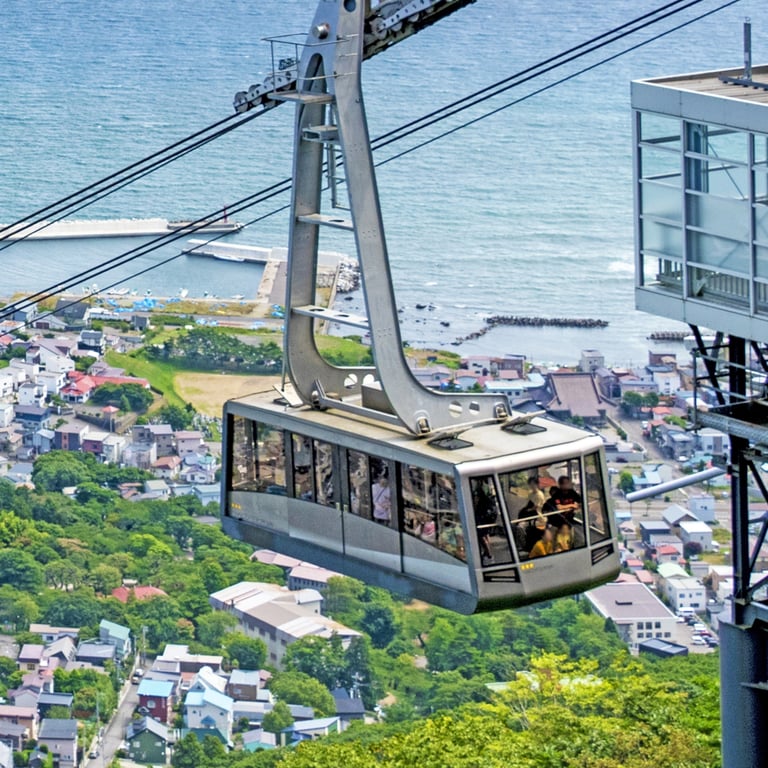
The summit is reached by Mt. Hakodate Ropeway from the Jujigai district — a three-minute cable car ride (¥1,500 return for adults) running approximately 10:00–22:00, last ascent at 21:50. A summit bus also runs from Hakodate Station from April to November. The tram stop for the ropeway is Jujigai on Line 2, about 15 minutes from Hakodate Station; the ropeway base is a 10-minute walk uphill from the stop.
Best time: Arrive by ropeway about 30 minutes before sunset and watch the city transition from dusk to darkness — significantly more rewarding than arriving after dark. Visibility is best in winter when the air is clearest. Check the official ropeway website for daily summit visibility forecasts before going up; fog is common and a cloudy visit is disappointing.
Goryokaku Fort and Tower
Built in 1864 and modelled on European star-fortress design, Goryokaku is the first Western-style fort in Japan — a five-pointed star calculated to eliminate defensive blind spots, inspired by French military engineering, intended to protect Hokkaido against Russian encroachment from the north. In practice, it became the site of the Battle of Hakodate in 1869 — the last stand of the Tokugawa shogunate against the Meiji imperial forces, and the final armed resistance of the samurai era. It is a remarkably loaded site for a park.
Today the earthworks form a spacious park planted with 1,600 cherry trees — among the most celebrated in Hokkaido, and the venue for a famous cherry blossom festival in late April and early May. In other seasons the moated grounds are peaceful and worth a long walk.
The Goryokaku Tower — a 107-metre observation tower immediately beside the fort — is the only way to appreciate the star shape from above. The view from the second-floor observation deck (¥1,200 for adults) is exceptional: the geometric perfection of the earthworks, the moat forming the points of the star, the city spreading toward the mountains beyond. The tower also contains an excellent exhibition on the Battle of Hakodate.
Getting there: Line 5 tram to Goryokaku-koen-mae Station (about 15 minutes from Hakodate Station), then a 10-minute walk north to the tower.
Motomachi District
Motomachi is Hakodate's historic hillside district and its most architecturally extraordinary neighbourhood — a steep grid of cobblestone lanes and stone-walled slopes running up the eastern face of Mount Hakodate, lined with the consulates, churches, and Western-style homes built by foreign residents after the port opened in 1859.
The buildings have survived remarkably well. Walking through Motomachi you encounter: a Russian Orthodox Church with green copper onion domes (1919, with Byzantine interior and piped Russian choral music — ¥200 to enter); a Gothic-style Roman Catholic Church built by French missionaries; an Anglican Church with an unusual wooden cross-shaped design; and the former British Consulate, a cream-and-blue colonial building that governed British affairs in Hokkaido from 1859 to 1934. The Old Public Hall of Hakodate Ward — sky-blue and lemon-yellow with pillars, verandas, and elaborate wrought-iron decoration — was completed in 1910 and is among the finest examples of Meiji-era Western architecture in northern Japan.
At the base of the district, Hachimanzaka Slope is one of Hakodate's most photographed streets: a wide, straight cobblestone road that runs directly down to the harbour, with fishing boats visible at the bottom. The view is best on a clear day when you can see across the Tsugaru Strait to the mountains of Honshu.
Getting there: Line 2 tram to Jujigai Station. The main Motomachi churches and Hachimanzaka Slope are 5–10 minutes uphill from the tram stop. Most churches are free; the Russian Orthodox Church charges ¥200. Allow 1.5–2 hours to walk the full district.
Kanemori Red Brick Warehouses
The Kanemori Red Brick Warehouses line the Hakodate Bay waterfront in the former port district — solid late-19th-century brick construction that served as working cargo storage until the port modernised. Today they are a shopping and dining complex housing restaurants, souvenir shops, and the Hakodate Beer brewery and hall (craft beer produced on-site, available at the adjacent restaurant). The Kanemori Youbutsukan space hosts exhibitions, flea markets, and seasonal events throughout the year.
The waterfront terrace with the warehouses behind you and the harbour in front is one of the most pleasant places in the city for an evening drink. In winter the Hakodate Christmas Fantasy is held here — an illuminated tree on the pier, fireworks over the bay. In summer, beer garden events animate the outdoor space. Worth lingering over regardless of the season.
Getting there: Take the tram to Jujigai and walk 5 minutes toward the waterfront — the red brick buildings are immediately visible. From Motomachi it is a short walk downhill and west along the harbour.
Yunokawa Onsen
Hakodate's main hot spring district, Yunokawa, sits at the eastern end of the tram line about 20 minutes from Hakodate Station. The sodium chloride springs here have been drawing visitors since the 17th century. Several ryokan accept day visitors (higaeri nyuyo) for their public baths — typically ¥500–¥1,500 — making a midday soak possible without staying overnight.
The Hakodate Tropical Botanical Garden, a short walk from the Yunokawa tram stop, offers one of Hokkaido's more specific seasonal attractions: between November and March, a troop of wild Japanese macaques bathes in a geothermally heated outdoor pool. The combination of tropical plants, snow on the ground, and snow monkeys sitting contentedly in steaming water is one of those experiences that does not translate well to description but is unmistakably memorable in person. Admission is ¥300 for adults, and monkey feed is available for ¥100 from a dispensing machine.
Onuma Quasi-National Park (Day Trip)
About 30 minutes north of Hakodate by JR train to Onuma Koen Station (covered by the JR Pass), Onuma Quasi-National Park is a landscape of two interconnected lakes — Onuma and Konuma — dotted with dozens of forested islands and dominated by the volcanic cone of Mount Komagatake rising 1,131 metres above the water. The park is at its best in autumn foliage season and spring cherry blossom, though it is worth visiting in any season. Canoes, rowboats, and bicycles are available to rent near the station for exploring the lake edges at your own pace.
What to Eat in Hakodate
Hakodate's food culture is built almost entirely on what comes out of the sea. The cold, clean waters of the Tsugaru Strait and the surrounding Hokkaido coastline produce some of the finest seafood in Japan.
Kaisendon (seafood rice bowl): The morning market's signature dish — warm rice topped with your choice of fresh seasonal seafood. Sea urchin, salmon roe, scallop, crab, squid, or any combination. The quality here, with seafood landed hours before you eat it, is exceptional.
Hakodate Shio Ramen: The city's signature noodle dish uses a light, clear salt-based (shio) broth rather than the heavier pork or miso bases common elsewhere in Hokkaido. More delicate, letting the noodle quality and clean toppings come forward. Several shops near the station and morning market specialise in it.
Fresh squid (ika): Hakodate is famous across Japan for its squid — caught fresh in the strait and available May–October at the market and throughout the city. Sashimi, salt-grilled (shioyaki), or tempura are all excellent when the squid is this fresh. Outside season, the preserved and processed squid products make excellent souvenirs.
Hakodate Beer: Craft beer brewed in the Kanemori Red Brick Warehouses — an ale, a stout, and a seasonal variety. Available in the attached beer hall and at several restaurants. Good brewing in an excellent setting.
Lucky Pierrot: A Hakodate institution since 1987. This eccentric local fast food chain operates only in the Hakodate area and has resisted all expansion outside it. The China Burger (fried chicken with sweet sauce) is the famous order. Every branch has its own wild interior decor theme. The branch near the Kanemori Warehouses is the most visited.
A One-Day Hakodate Itinerary
Most of Hakodate's highlights can be covered in a single full day if you start early and plan your timing around the night view.
05:30 — Hakodate Morning Market. Head directly to the market. Order kaisendon for breakfast, watch the stalls come to life. Allow 60–90 minutes.
07:30 — Walk to Kanemori Red Brick Warehouses. The waterfront is quiet and beautiful in the early morning light. The warehouses do not open until 09:30 — use the time to walk the harbour and find a coffee.
09:00 — Motomachi District. Take the tram to Jujigai and walk the hillside lanes. Visit the Russian Orthodox Church, walk Hachimanzaka Slope, explore the Old Public Hall. Allow 1.5–2 hours.
11:00 — Goryokaku Fort and Tower. Take the tram to Goryokaku-koen-mae. Ascend the tower for the aerial view, then walk the grounds. In cherry blossom season, add an extra hour. Allow 1.5 hours.
13:00 — Lunch. Several good options near Goryokaku. Alternatively, return toward the Kanemori Warehouses for lunch at the beer hall.
14:30 — Yunokawa Onsen (optional). Take the tram to Yunokawa for a midday soak or, in winter, the snow monkeys at the Tropical Botanical Garden. Allow 1.5–2 hours.
17:30 — Dinner. Return to the city centre. Seafood restaurant near the morning market or the Kanemori area. Reserve in advance for weekends.
19:30 — Mount Hakodate Night View. Tram to Jujigai, ropeway to the summit. Arrive before 20:00 for a good spot. Last descent at 22:00. Allow 1.5 hours.
Two days: Use Day 2 for Onuma Quasi-National Park in the morning (30 minutes by JR train) and a slower return through Motomachi in the afternoon. The morning market on Day 2 is worth revisiting — different catch, fewer crowds, no time pressure.


Which Rail Pass Is Right for Hakodate?
7-day or 14-day Japan Rail Pass: Covers the Hokkaido Shinkansen from Tokyo to Shin-Hakodate-Hokuto, the Hakodate Liner, and the Hokuto Limited Express to Sapporo. Right for a longer Japan trip including Tokyo and destinations further south. Buy the JR Pass here
JR Hokkaido Regional Pass: Covers all JR Hokkaido trains including the Hokuto and Hakodate Liner. Does not cover the Shinkansen from Honshu. Right for a Hokkaido-focused trip arriving by air into Sapporo or Hakodate. Available for 5 or 7 days. Buy the JR Hokkaido Pass here
For a full comparison of all regional pass options, see our complete guide to JR Regional Passes.
Where to Stay in Hakodate
The most convenient area is around Hakodate Station — walking distance to the morning market, tram access to everything. Hotels range from business hotels (JR Inn Hakodate is directly connected to the station) to mid-range options and small guesthouses.
For a more atmospheric stay, ryokan in the Yunokawa Onsen district offer in-house hot spring baths and kaiseki dinners with ocean views. These require a 20-minute tram ride from the station but are considerably more memorable than a standard hotel.
Practical Tips for Visiting Hakodate
Buy the one-day tram pass. ¥600 from the Tourist Information Center or tram driver. Pays for itself after three journeys and eliminates the need for coins on every boarding.
Check the summit visibility forecast. The night view can be completely obscured by cloud or fog. The ropeway website and Tourist Information Center post daily forecasts. Do not go up on a cloudy evening.
Arrive at the morning market early. 05:30–08:30 is the best window for fresh seafood and a quiet atmosphere. By 09:00 the best options are often gone.
Summer squid season (May–October). Fresh squid at the market — sashimi and live squid fishing — is one of Hakodate's defining food experiences. Do not miss it if visiting in season.
Winter snow monkeys (November–March). The macaque bathing at the Tropical Botanical Garden in Yunokawa is only available in winter. Add it to a Yunokawa onsen visit.
Suica / Welcome Suica Mobile. Works for JR trains (Hakodate Liner, Hokuto) and convenience stores, and on the city tram.
Hakodate Christmas Fantasy (December). A large illuminated event at the Kanemori Warehouses with fireworks over the bay. Very popular — book accommodation well in advance for December visits.
Why Hakodate Is Worth the Journey
Hakodate is the kind of city that changes depending on when you look at it. At 05:30 it is a fish market alive with cold water and fresh catch and people who have been awake since before dawn. At midday it is a hillside of cobblestone lanes and century-old churches, the sea visible between buildings at the bottom of every slope. At dusk it begins its slow transformation into the view from above — and then the ropeway takes you up and the city becomes something else again: a pattern of light between two bays, one of the most beautiful urban night views on earth.
Few Japanese cities offer so many distinct versions of themselves in a single day. And few reward a second look as generously — the second morning at the market when you know which stalls to visit, the second Motomachi walk when you find the Hakodate City Museum of Northern Peoples and the smaller churches that the first visit rushed past.
To continue south from Hakodate toward Tokyo, our 9-day Tokyo to Sapporo itinerary covers the Sendai and Tohoku leg in full. For those heading north into Hokkaido, our 6-day Hokkaido JR Regional Pass itinerary covers the full island from Hakodate through Furano, Asahikawa, and back to Sapporo.
Happy travels.